The Invisible Tax: What is a Conflict Premium?
 અમારી સાથે જોડાઓ
 અમને અનુસરો
How Global Conflict Hits Your Wallet: Understanding the 2026 Energy Crisis
✨ આઇ સંચાલિત સારાંશ
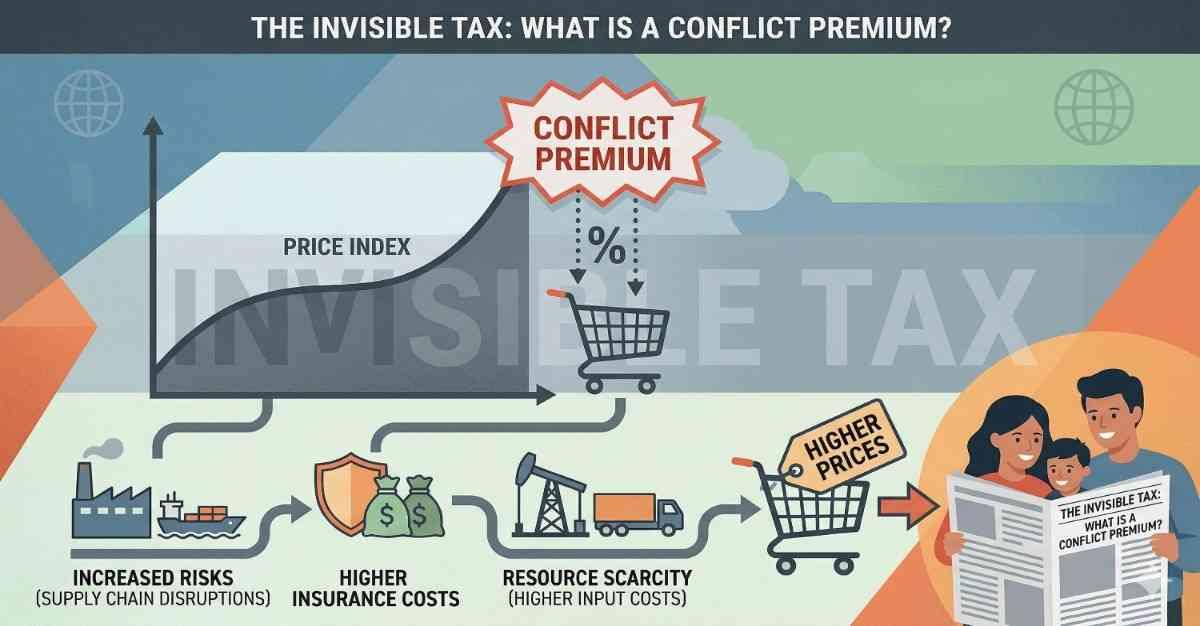
The Invisible Tax: What is a Conflict Premium?
A "Conflict Premium" (or Geopolitical Risk Premium) is the price hike that occurs when the market fears a supply disruption, even before a single drop of oil is actually lost. Traders and oil companies raise prices as "insurance" against the risk of closed shipping lanes or damaged refineries.
In 2026, the Strait of Hormuz, the world’s most important energy chokepoint - handles nearly 20% of the world’s oil and LNG. For India, the stakes are even higher: we rely on the Middle East for roughly 45% of our crude oil, 60% of our natural gas, and over 90% of our cooking gas (LPG). When peace talks in Islamabad or Muscat stall, this "premium" spikes. When a diplomatic breakthrough is teased, prices drop.
1. The Fuel Pump: Why Your Commute is "Diplomatic"
India imports over 85% of its crude oil. Even though the government has slashed fuel taxes recently to cushion the blow, the retail price of petrol and diesel remains sensitive to the "fear factor" in the Gulf.
Example: In early March 2026, when Iran threatened to retaliate against energy infrastructure, global Brent crude jumped from $70 to $105. Even if Indian refineries had enough stock for a month, the replacement cost of that oil went up instantly.
The Indian Context: If you live in a city like Pune or Hyderabad, you might see petrol prices stay stable for a week, then jump because a peace plan was rejected. Your weekend road trip is now essentially a bet on the success of Middle East de-escalation.
2. The Kitchen Crisis: LPG and the "Ras Laffan" Effect
Perhaps the most direct impact on Indian households in 2026 is the cost of cooking gas. India is the world’s second-largest LPG importer.
The Breakdown: Unlike oil, which we can source from Russia or Brazil, our LPG infrastructure is heavily "locked in" to the Middle East. When the Ras Laffan complex in Qatar—a primary supplier to India—faced disruptions this March, it triggered a supply squeeze.
Indian Market Impact: For the low-income households under the Ujjwala Yojana scheme, the government has to choose: either increase subsidies (which widens the national deficit) or let the price of a cylinder rise. Currently, "force majeure" notices from Middle Eastern suppliers mean that the availability of your next refill depends on whether cargo ships are granted "non-hostile" transit through the Strait of Hormuz.
3. The Electricity Bill: Gas vs. Coal
You might wonder why a gas conflict affects your electricity bill when India runs mostly on coal. The answer lies in "Peak Demand."
The Summer Stress: As India enters the summer of 2026, peak power demand is expected to hit a record 270 Gigawatts. While coal handles the "base" load, gas-fired plants are used as "firefighters"—they can be turned on quickly when everyone switches on their ACs in the evening.
The Premium: With LNG (Liquefied Natural Gas) prices soaring due to the conflict, the cost of running these "peak" plants has tripled. To keep your lights on without a blackout, the grid has to buy expensive "spot" gas.
The Indian Strategy: To avoid passing this massive cost to you, the Indian government is currently restarting old coal plants (like the 4,000 MW Mundra plant in Gujarat) to act as a buffer. However, if the conflict lasts, the higher cost of imported coal and gas will eventually "creep" into your DISCOM (Electricity Distribution Company) bills through a "Fuel Adjustment Charge."
The Path Ahead: Navigation, Not Just Policy
In the 2026, India’s energy security is no longer a matter of just building more power plants. It is about strategic geography. While the government is diversifying imports (buying more from Brazil and Argentina) and accelerating the shift to Electric Vehicles (EVs) to break the oil habit, these are long-term solutions. In the short term, the "Conflict Premium" acts as a reminder of how interconnected our lives are.
The next time you see a headline about "Middle East Peace Plans," don't just view it as international news. View it as a potential discount on your next fuel refill or electricity bill. In 2026, the most important "energy policy" for India isn't being written in New Delhi—it’s being negotiated in the diplomatic halls of West Asia.
Disclaimer: The article is for informational purposes only and not investment advice.