India's Gas Crisis Is Real And It Was Years in the Making
 எங்களுடன் சேருங்கள்
 எங்களைப் பின்தொடரவும்
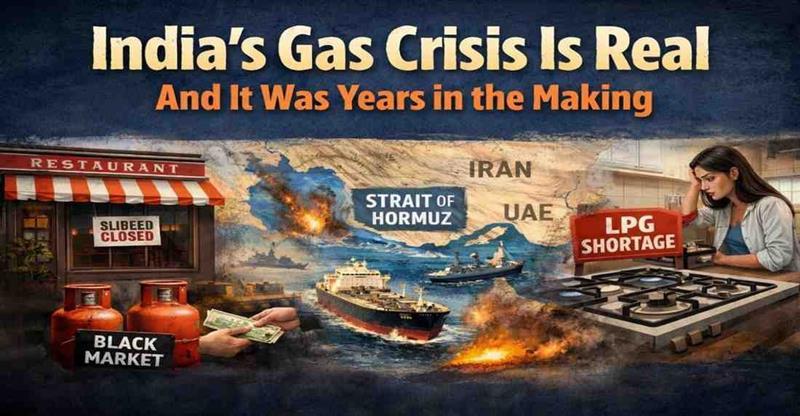
Restaurants are shutting. Black markets are thriving. The Strait of Hormuz has India's kitchens in a chokehold. Here's everything you need to know.
✨ AI இயங்கும் சுருக்கம்
Walk into almost any restaurant lane in Mumbai right now and you'll see something unusual: shuttered shutters, padlocked doors and harried owners making frantic phone calls. Twenty per cent of Mumbai's eateries have already closed. The Indian Hotel and Restaurant Association has warned that if LPG cylinder supply isn't restored soon, half of Mumbai's restaurants could go dark within days. Bengaluru, Lucknow, Chennai the story is the same everywhere.
Some restaurant owners are turning to coal. Others are sourcing commercial cylinders from the black market at double the official price just to keep their tandoors burning. What began as a quiet supply chain squeeze has become a full blown national crisis one that is now threatening to reach household kitchens too. How did it come to this? And more importantly, could it get worse?
The Order That Sparked the Panic
The immediate trigger was a government order issued on March 9, which formally prioritised LPG supply into: Household cooking gas, piped natural gas (PNG), and CNG for vehicles were placed in the top bracket guaranteed 100 per cent supply. Commercial users, including restaurants and hotels were pushed to a second tier, entitled to only 80 per cent of their usual supply and only subject to availability.
In plain language: households come first. Whatever is left over goes to restaurants. That "whatever is left over" clause is where the crisis lives. Several restaurant associations report they aren't even receiving that 80 per cent in practice, deliveries have slowed to a trickle or stopped entirely. In Lucknow, even household deliveries that used to arrive within 24 hours are now taking five to seven days. Some restaurants are buying cylinders from the black market at double the price just to keep operating.
Why India Doesn't Produce Enough LPG
This crisis didn't materialise overnight. It is the product of two structural problems that have been building for years.
The first is price control. Unlike petrol and diesel which are broadly linked to global crude prices, LPG is heavily subsidised. The government spent roughly Rs 12,000 crore in LPG subsidies last year alone. Because of this, oil companies often sell LPG below their production cost and wait for government reimbursement. The result? Refineries have a financial incentive to use propane and butane the raw gases that make up LPG for petrochemical production instead, where margins are far higher. This is a direct reason why India still self-produces only 40 per cent of its LPG demand.
The second is the Ujjwala boom. When the government launched the Pradhan Mantri Ujjwala Yojana in 2016, it was a landmark welfare scheme bringing clean cooking fuel to millions of poor households. LPG connections surged from 14 crore to 33 crore households. Demand exploded. Domestic production capacity never caught up. The gap was quietly filled by imports and now those imports are disrupted.
Why propane and butane matter now: To boost LPG output urgently, the government has directed that propane and butane be diverted exclusively to LPG production. These gases are also feedstock for plastics, synthetic rubber (think tyres), textile fibres, paints, and industrial chemicals. A temporary dip in those industries is likely.
The Strait of Hormuz Problem
India imports LPG primarily from the Gulf: Saudi Arabia, Qatar, UAE, and Kuwait. Qatar alone supplies 47.3 per cent of India's liquefied natural gas needs. For LPG, the Gulf concentration is similarly high. And right now, geopolitical tensions centred on the US-Iran conflict have disrupted shipping lanes through the Strait of Hormuz, the narrow chokepoint through which roughly 80–85 per cent of India's energy imports pass.
India technically holds 50–60 days of crude oil reserves. But crude and LPG are different products. You cannot quickly convert crude stockpiles into cooking gas the refinery process has its own timeline. Meanwhile, LPG storage capacity sits at only around 1.9 million metric tonnes about 21–22 days of national consumption. Approximately 10 days' worth of that buffer has already been drawn down.
What the Government Is Doing
The response has been multi-pronged. The government has invoked the Essential Commodities Act (1955), giving it authority to control production and distribution, prevent hoarding and direct refineries to raise output. Refineries have been instructed to increase LPG production by 10 per cent which would raise the domestic contribution from 40 per cent to roughly 44 per cent still leaving 56 per cent dependent on imports. Here is what has been done so far:
- Household LPG, PNG, and CNG declared top priority supply — 100 per cent guaranteed
- Commercial users capped at 80 per cent of usual supply, subject to availability
- Essential Commodities Act invoked to direct refinery output
- Propane and butane redirected entirely to LPG production
- Booking intervals extended to 25 days to curb hoarding
- A joint grievance committee formed by IOC, HPCL, and BPCL
- Diversification efforts underway — sourcing from USA, Australia, Norway, Algeria
Officials have urged calm and said household supply cycles remain stable. But the ground reality as queues lengthen and delivery timelines stretch tells a more complicated story.
Will This Reach Your Kitchen?
The government's declared priority is to protect the household consumer. If the crisis is short lived and shipping lanes reopen the worst may pass within weeks. But if disruptions persist, the arithmetic gets uncomfortable. India's LPG buffer is around three weeks. Half of it is already gone.
The two scenarios most analysts are watching: either the geopolitical conflict eases and Gulf shipments resume, or India escalates by deploying the Indian Navy to escort cargo vessels through the Strait a significant and sensitive diplomatic step. In the meantime, if prices climb sharply, households may find themselves looking at electric induction stoves as the most practical fallback. For restaurants without that option, the math is grimmer still.
The bottom line: India's LPG crisis is the convergence of a global supply shock with domestic vulnerabilities that have been quietly accumulating for a decade: low domestic production, subsidised pricing that disincentivised investment and surging demand from welfare schemes that were never matched by infrastructure. The short -term trigger is the Strait of Hormuz. The long-term question is whether this crisis finally forces a reckoning with India's energy architecture.
Disclaimer: The article is for informational purposes only and not investment advice.