100 Years of Pump Manufacturing: Kirloskar Group’s Leading Pump Maker Gains 15%; Order Book Stands at Rs 4,627.7 Crore
Karan / 02 Nov 2026 / Categories: Mindshare, Trending
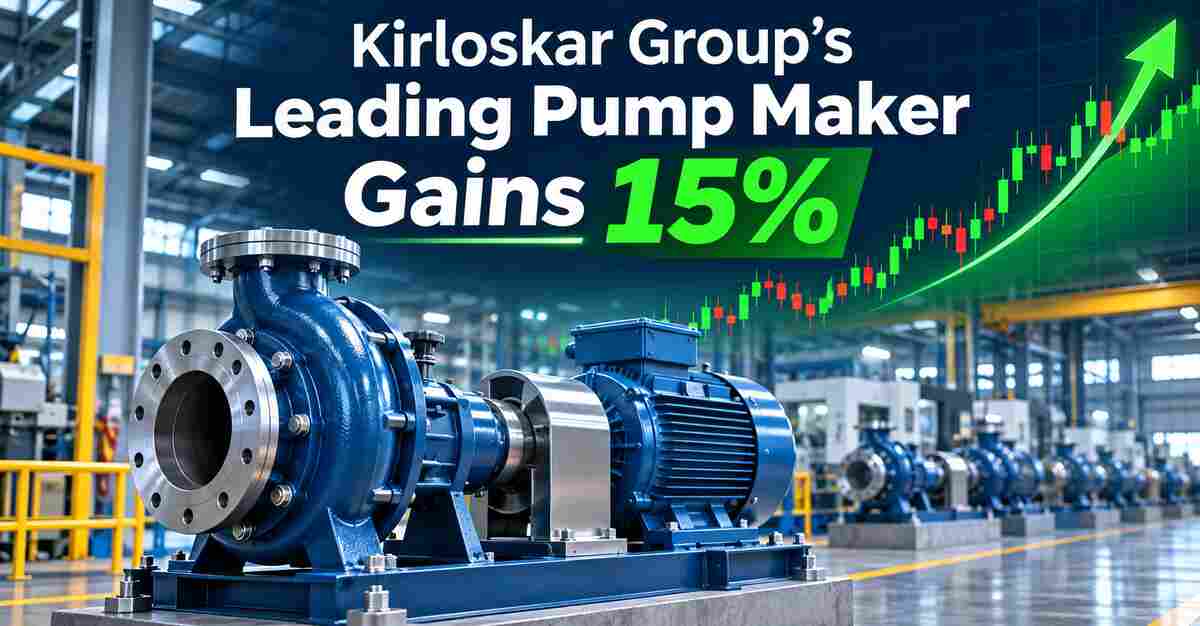
Kirloskar Brothers reported stronger Q2 FY27 revenue and order inflows, though margin compression, overseas profitability pressures and negative operating cash flow remained key watchpoints.
Kirloskar Brothers operates across engineered pumps, fluid management systems, valves and related services, with demand linked to water, irrigation, power, industrial and infrastructure projects. The company reported a 24 per cent YoY increase in consolidated revenue for the second quarter of fiscal year 2026-27 (FY27), supported by stronger execution and a sharp rise in fresh order inflows.
Consolidated net revenue from operations rose to Rs 1,276.7 crore in Q2 FY27 from Rs 1,027.7 crore a year earlier. Earnings before interest, Tax, depreciation and amortisation (EBITDA) increased 16 per cent to Rs 143.2 crore, while profit after tax (PAT) grew 4 per cent to Rs 74.7 crore. Earnings per share improved to Rs 9.30 from Rs 8.90.
Profit growth, however, trailed revenue growth as operating margins moderated. EBITDA margin declined by 0.8 percentage points to 11.2 per cent, while PAT margin fell to 5.9 per cent from 7 per cent. Gross margin narrowed to 49.2 per cent from 53.6 per cent as cost of goods sold rose 35 per cent. Higher employee costs, other expenses, finance costs and depreciation also weighed on earnings conversion.
The order pipeline was the clearest positive in the quarter. Total orders received rose to Rs 2,047.2 crore from Rs 1,219.2 crore a year earlier, with domestic orders accounting for Rs 1,401.7 crore and overseas subsidiaries contributing Rs 645.5 crore. The consolidated pending Order Book reached Rs 4,627.7 crore on September 30, 2026, up from Rs 4,062.2 crore at the end of the preceding quarter.
Within the standalone order book, irrigation and water resource management accounted for Rs 1,041 crore, followed by power at Rs 703.1 crore. Overseas revenue growth was accompanied by weaker profitability at Kirloskar Brothers International B.V., where EBITDA margin fell to 5.3 per cent from 9 per cent. In particular, SPP Pumps in the UK recorded higher revenue but substantially lower EBITDA.
Cash conversion remains an execution monitor. Net cash from operating activities was negative Rs 58 crore in the first half, against a positive Rs 105.6 crore a year earlier, as working capital changes resulted in an outflow of Rs 183.8 crore.
As of 10:20 am on November 2, 2026, Kirloskar Brothers shares were trading at Rs 1,835.60. The stock was up 14.52 per cent from the previous close of Rs 1,602.85 and remained about 11.5 per cent below its 52-week high of Rs 2,073.00. Over one year, the shares had declined 18.75 per cent, compared with an 8.48 per cent fall in the BSE 500, indicating weaker performance than the broader benchmark over that period.
What This Means for Investors
The expanding order book improves revenue visibility for Kirloskar Brothers, particularly in water management, irrigation and power, which together form a substantial part of its domestic engineered backlog. The Rs 2,047.2 crore quarterly order inflow also suggests that demand conditions remain supportive across domestic and international markets. Revenue growth of 24 per cent YoY indicates improved execution, but lower gross and EBITDA margins show that scale has not yet translated into proportionate profit growth.
The development is therefore supportive for the company’s growth outlook, but mixed for earnings quality. Investors will look for the larger backlog to convert into revenue without further pressure on working capital, especially after first-half operating cash flow turned negative. Recovery in overseas profitability, notably at SPP Pumps in the UK, is also important because international operations contributed strongly to revenue growth but diluted consolidated margins. Sustained improvement in service mix, pricing and project execution would be needed to support stronger profit conversion.
Disclaimer: The article is for informational purposes only and not investment advice.