40 Years of Fund Manager Exits
Arvind DSIJ / 05 Mar 2026 / Categories: DSIJ_Magazine_Web, DSIJMagazine_App, MF - Special Report, Mutual Fund, Special Report
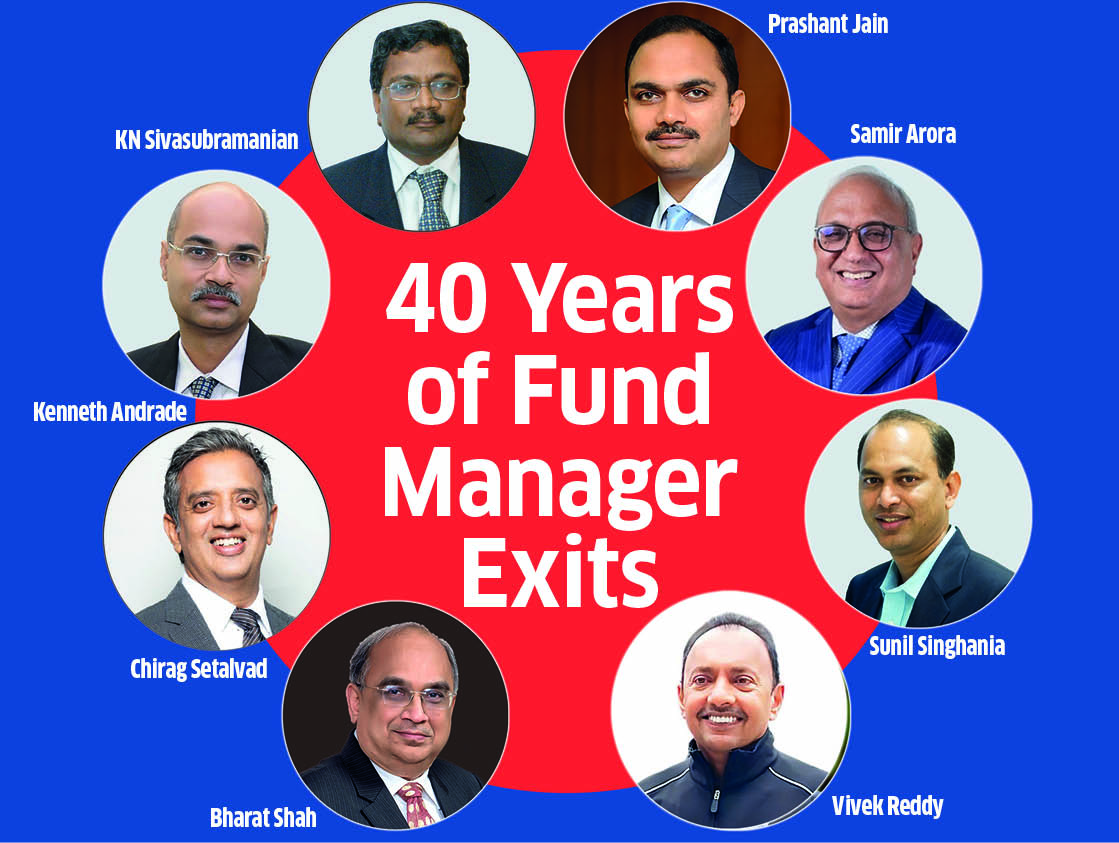
As DSIJ celebrates its 40th anniversary, the perspective afforded by four decades of financial reporting provides a unique vantage point to observe the cyclical nature of investment management. In 1986, when this journal first began tracking the markets, the investment landscape was a starkly different terrain.
From the US 64 era of “trust the institution” to the 2001 rock star phase and today’s process driven fund houses, this piece tracks why celebrated fund managers fade, flee, or reinvent themselves in PMS and AIFs. The takeaway is timeless: don’t chase a name; understand the process and the cycle, because in markets, stars change but risk remains. [EasyDNNnews:PaidContentStart]
The Forty-Year Lens: From Monolith to Multifaceted Industry
The chronicle of the Indian Mutual Fund industry is inextricably linked to the broader narrative of India’s economic liberalisation and the subsequent democratisation of wealth. As DSIJ celebrates its 40th anniversary, the perspective afforded by four decades of financial reporting provides a unique vantage point to observe the cyclical nature of investment management. In 1986, when this journal first began tracking the markets, the investment landscape was a starkly different terrain. It was an era dominated by a single institutional entity, the Unit Trust of India (UTI), and its legendary flagship, the Unit Scheme 1964. For the average Indian household of the mid-1980s, the concept of a 'mutual fund' was synonymous with UTI. There were no 'star managers' in the public consciousness then; there was only the institutional reliability of a government-backed behemoth that promised safety and steady dividends.
The transition from this monolithic beginning to the high velocity, star-studded industry of the late 1990s, and finally to the process-oriented juggernaut of the 2020s, represents one of the most significant shifts in global finance and not only domestic finance. This transformation was not merely structural but psychological. It involved moving millions of investors away from the comfort of administratively determined prices to the transparency, and volatility, of net asset value. At the heart of this evolution were the fund managers, the individuals who interpreted the markets for the masses. Over 40 years, the industry has seen the rise of titans who managed hundreds of crores of rupees with a single nod. It has seen many of those same titans disappear from the mutual fund stage, moving into the shadows of private equity, alternative investment funds, or facing the cold reality of regulatory exclusion. In the following paragraphs, we will walk you through this journey.
The Monolith Phase: US-64 and the Illusion of Permanence
To understand the disappearance of the modern star manager, one must first understand the environment of the 1960s through the 1980s. UTI was established in 1963 by an Act of Parliament with the noble objective of mobilising the savings of small investors into the capital markets. For nearly a quarter-century, UTI enjoyed an absolute monopoly. Its US-64 scheme was perceived by the public as a quasi-Bank deposit, an impression reinforced by the fund's historical behaviour of paying out dividends that remained constant or increased regardless of underlying market conditions. This period was devoid of the 'star manager' culture because investment decisions were largely administrative, often dictated by the Chairman or based on directives that ignored the advice of specialised research cells. T he regulatory framework of this era was similarly opaque. UTI functioned under the administrative control of the Reserve Bank of India until 1978, after which the Industrial Development Bank of India took over. Crucially, UTI remained outside the purview of the Securities and Exchange Board of India even after the latter's establishment in 1992. This lack of transparency, combined with a concentration of power in the hands of a few individuals, laid the groundwork for the crises that would eventually dismantle the UTI monopoly and usher in the era of private competition and individual star managers.

The 1986 launch of Mastershare, a close-ended equity growth fund, marked a watershed moment. It was the first time the term 'mutual fund' was introduced into the common Indian lexicon. T his period also saw the introduction of the Unit-Linked Insurance Plan and the first Indian offshore fund, The India Fund, launched in 1986 in collaboration with DSP Merrill Lynch. T hese innovations signalled the beginning of a shift from pure 'saving' to 'investing', setting the stage for the arrival of private sector experts who would soon become household names.
The 1993 Revolution: The Birth of the Private Sector Star
The year 1993 represents the true birth of the star fund manager in India. Following the Narasimha Rao government's decision to open the industry, Kothari Pioneer, a joint venture between the Chennai-based Kothari group and America’s Pioneer Group, became the first private sector mutual fund to register in July 1993. This was the era of Vivek Reddy, who, alongside Shyam Kothari, introduced innovations that were considered radical at the time. They were the first to disclose NAVs daily, a task so manual that it required employees to physically run f loppy disks to the stock exchange and use dial-up modems to transmit data.
The success of Kothari Pioneer was built on a foundation of professional management and transparency. By providing account statements instead of glossy unit certificates and promising redemptions within three days, they broke the bureaucratic mould of the public sector. The performance was equally startling; an investment of `10,000 in the Bluechip Fund at its 1993 inception would have grown to over `11.12 lakh by March 31, 2018. This success proved that individual expertise could deliver alpha that the institutional monoliths could not.
The Pantheon of 2001: Stars At Their Zenith
By the turn of the millennium, the Indian mutual fund industry had entered its 'Rock Star' phase. Performance was no longer attributed to the 'Trust' or the 'Bank' but to the individual sitting in the CIO’s chair. In 2001, the industry was defined by a handful of managers whose calls could move markets and whose exits would trigger massive redemptions.

Samir Arora, based in Singapore but managing Alliance’s Asian Emerging Markets, was perhaps the most prominent of these f igures. His philosophy—'Listen to everything; believe nothing'—and his penchant for visiting 75 companies a year allowed him to spot trends like the rise of Zee Telefilms and Digital Equipment long before they became market favourites. His ability to time exits just as bad news began to surface made him a legend among retail investors.
Simultaneously, Bharat Shah at Birla Sun Life was hailed as the 'king of good times' before the tech meltdown of 2000. A twice-qualified accountant, Shah believed in sustainable business models but became deeply associated with the technology boom. His Birla Advantage Fund delivered a staggering 300 per cent return in 1999, catapulting him to celebrity status. However, the subsequent 40 per cent loss in 2000 highlighted the primary danger of the star manager model. When a manager’s conviction turns into an obsession, the investors bear the brunt of the downside.
The Great Disappearances: When Stars Fade or Flee
The narrative of the last forty years is not just one of growth, but of transition. Many of the titans of 2001 are no longer in the mutual fund industry. Their 'disappearance' from the public mutual fund stage occurred through three primary mechanisms: regulatory intervention, institutional consolidation, and the allure of the alternative investment space.
The Regulatory Exit: The Samir Arora Saga
The most dramatic disappearance was that of Samir Arora. In early 2003, Alliance Capital decided to review strategic alternatives for its Indian subsidiary. During this period, allegations surfaced that Arora was working to thwart the sale of the AMC to other bidders in order to facilitate a management buyout alongside Henderson Global Investors at a lower valuation. SEBI’s investigation alleged that Arora’s actions contributed to a steep fall in the NAV and massive redemptions of nearly `1,300 crore.
SEBI eventually barred Arora from the securities market for f ive years, a sentence that was later contested but effectively ended his tenure as a mutual fund manager. This event served as a cautionary tale for the industry regarding 'key-man risk'. When a single manager’s personal interests or legal troubles could lead to a billion-dollar outflow from a fund, the institutional framework had to be reassessed. Arora eventually transitioned to the hedge fund and AIF space, founding Helios Capital. The era of the 'unregulated' star was over.
The Institutional Transition: The Kothari Pioneer Exit
The disappearance of the Kothari Pioneer team followed a different trajectory. In July 2002, Templeton Asset Management acquired Pioneer ITI. While the schemes like the Bluechip and Prima funds continued under the Franklin Templeton banner and delivered robust long-term returns, the original founding team dispersed. Vivek Reddy, the visionary CEO who brought daily NAV to India, left the professional management space to manage his own assets and those of a close circle of friends. T his transition highlighted a recurring theme: as successful boutique AMCs are swallowed by global giants, the entrepreneurial stars who built them often prefer to exit rather than become cogs in a larger corporate machine.
The Long-Distance Runner: Prashant Jain and the HDFC Dynasty
No history of Indian fund management is complete without Prashant Jain. His career spanned nearly three decades, starting at SBI Mutual Fund in 1991, moving to Zurich India, and f inally reigning as CIO of HDFC Mutual Fund for 19 years. Jain was the only Indian manager to manage a single scheme, the HDFC Balanced Advantage Fund (formerly HDFC Prudence), for over 28 years, delivering an average annual return of 17.9 per cent against the Sensex’s 9.6 per cent.
Jain’s 'disappearance' from the mutual fund space in 2022 was not due to scandal or acquisition but was a natural evolution toward the alternative investment space. His tenure at HDFC was marked by a disciplined, value-oriented philosophy that often saw him out of favour with the market. Between 2018 and 2020, his funds underperformed as his bets on public sector banks and energy companies languished. However, his eventual vindication as value strategies returned to favour cemented his reputation for conviction. When he finally resigned, he co-founded 3P Investment Managers, moving into the AIF space where he could manage concentrated portfolios for ultra-high-net-worth families with the same principles of 'Prudence, Patience, and Performance'.

The Industry’s Defence: Institutionalisation and Process
The exit of stars like Samir Arora, Bharat Shah, and eventually Prashant Jain led to a fundamental shift in how AMCs market themselves. Today, fund houses avoid the 'star manager' label, preferring to promote their 'team-based, process-driven investment approach'. This is a strategic defence against key-man risk. By declaring that all decisions are based on a shared institutional framework, AMCs hope to mitigate the redemption pressure that follows a manager’s departure.
Fund houses like ICICI Prudential have been at the forefront of this shift. From a team of six in 1998, the AMC has grown to over 3,000 employees. Their philosophy emphasises that while fund managers are encouraged to develop individual styles, they must operate within a rigid internal process for stock selection and risk mitigation. This institutionalisation ensures that even when a prominent figure like Nilesh Shah moves (as he did from ICICI Prudential to Kotak), the underlying performance and philosophy of the fund remain stable.
The Active vs. Passive Debate And The Rise Of The Algorithm
The institutionalisation of fund management has also paved the way for the rise of passive investing. By December 2025, India’s passive funds AUM had risen to about `14.20 lakh crore. As active managers struggle to consistently beat benchmarks in the Large-Cap space, many investors are choosing to remove the 'manager risk' entirely by opting for Index Funds and ETFs. Furthermore, the rise of quant-based strategies and AI augmented investing is challenging the traditional role of the star manager. A 2025 Stanford study suggested that AI 'analysts' could improve on human portfolios, suggesting that the star of the next forty years may be a silicon-based process rather than a carbon-based personality.
The Alternative Renaissance: Where the Stars Go Now
The stars of the Indian mutual fund industry have not disappeared; they have simply moved to more lucrative and less-regulated pastures. The growth of Portfolio Management Services and Alternative Investment Funds represents a migration of talent. As of 2025, the Indian PMS industry has crossed `3.8 lakh crore in AUM. Managers like Sunil Singhania (Abakkus), Kenneth Andrade (Old Bridge), and Saurabh Mukherjea (Marcellus) have found that the AIF and PMS structures allow for more concentrated bets, 'skin in the game' through performance linked fees, and a clientele (ultra-HNIs) that is less prone to the panic-selling seen in retail mutual funds.

“Returns are as reported by the cited sources for the stated period/ date; methodology (net/gross, fees, and return calculation such as TWRR) differs across managers and platforms.”
This migration has profound implications for the retail investor. While the 'best and brightest' may still be managing money, they are increasingly inaccessible to the common person due to high entry barriers (`50 lakh for PMS and `1 crore for AIFs). This creates a bifurcated market: a process driven, mass-market mutual fund industry for the retail base, and a boutique, manager-driven alternative industry for the wealthy.
Lessons from 40 Years of Turnover: A Summary for the Next Generation
As we look back at the forty years since 1986, several immutable lessons emerge for the investor. The first is that the disappearance of a star manager is rarely the end of a fund, provided the institutional framework is robust. Schemes like the Birla Advantage and the HDFC Flexi Cap have survived the departure of their most famous captains and continued to deliver returns, proving that the brand and the process often outlast the individual.
The second lesson is that manager turnover is often a signal of industry maturity. The era of the 'unregulated titan' ended with the US-64 and Samir Arora crises, giving way to the transparent, SEBI-governed environment we enjoy today. The f inal lesson is that while the medium of investment may change—from unit certificates to digital folios, from mutual funds to AIFs—the core principles of successful investing remain unchanged: diversification, discipline, and an understanding that no star is brighter than the market itself.

Dalal Street Investment Journal, having witnessed the industry's growth from a few thousand crores to eighty-one trillion rupees (`81.01 lakh crore at the end of January 2026), recognises that the 'stars' who disappeared were essential catalysts. They challenged the monopoly of UTI, introduced global standards of research, and taught a generation of Indians how to dream of wealth beyond the fixed deposit. Even as they move into the specialised world of AIFs or the quiet of private management, their legacy remains in the robust, diverse, and transparent industry that continues to serve the Indian saver. As the magazine celebrates its 40th year, the focus must remain on the next generation of managers; or perhaps the next generation of algorithms. These will guide the Indian investor through the next four decades.
The Future of Manager Turnover: Navigating the Next 40 Years
The trajectory of manager turnover suggests that the industry is moving toward a hybrid model. We are seeing a rise in 'Co CIO' structures and expanded management teams, as seen at HDFC following Prashant Jain’s exit, where responsibilities were split between Chirag Setalvad and Shobhit Mehrotra. This strategy is designed to ensure that no single individual becomes 'too big to fail' or 'too important to leave'.
For the retail investor, the path forward is clear: focus on the fund house’s culture and the consistency of its performance across cycles, rather than chasing the latest star. In a world where transparency is high and digital tools allow for real-time tracking, the true 'star' is the investor who stays the course. The last 40 years have shown us that managers will rise, they will shine, and they will eventually disappear. But the market, and the opportunities it provides for those with patience and prudence, is eternal.
Final Reflections on the 40-Year Journey
The evolution from the administratively priced US-64 units to the real-time, app-based investing of 2026 is a testament to the resilience of the Indian financial system. The disappearance of star managers, while often seen as a loss, is actually a sign of an industry that is outgrowing its dependence on individuals and maturing into a global-standard financial ecosystem.
As we celebrate this 40th anniversary, we do so with the knowledge that while the names on the door may change, the promise of the mutual fund—to provide expert management and diversification to every Indian—remains as relevant as it was in 1986. The lessons learned from manager turnover are not just about the people who left, but about the institution that remains, stronger and more transparent than ever before.
[EasyDNNnews:PaidContentEnd] [EasyDNNnews:UnPaidContentStart]
To read the entire article, you must be a DSIJ magazine subscriber.
[EasyDNNnews:UnPaidContentEnd]