A Comprehensive Guide to Investing in Mutual Funds!
DSIJ Intelligence-6 / 18 Oct 2025 / Categories: General, Knowledge, Trending
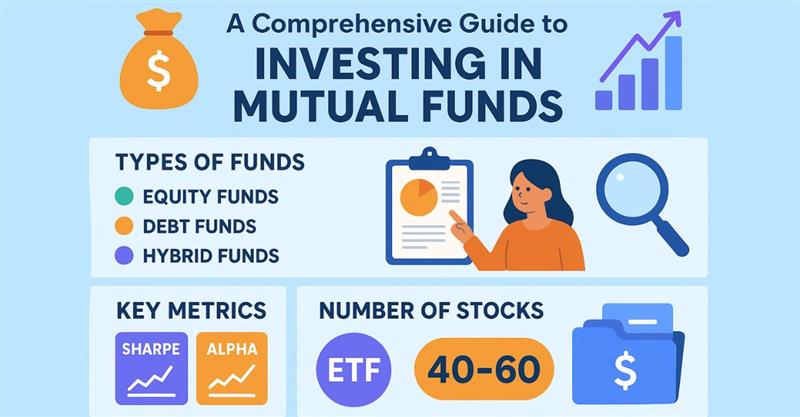
Investing in mutual funds is not just about picking the top-performing fund but aligning choices with your financial goals, risk tolerance, and time horizon.
Introduction
Mutual Funds have long been one of the most accessible and efficient investment vehicles for retail investors. They pool money from multiple investors to invest in a diversified portfolio of stocks, bonds, or other securities, managed by professional fund managers. However, choosing the right mutual fund requires understanding its type, objective, performance metrics, and cost structure. Here’s a comprehensive guide to help you make informed mutual fund investment decisions.
Types of Mutual Funds and Their Purpose
Mutual funds can broadly be classified based on their investment objective and asset allocation:
- Equity Funds: Invest primarily in stocks and are ideal for long-term wealth creation. Categories include Large-Cap funds (stable blue-chip stocks), Mid-Cap and Small-Cap funds (higher growth and risk), and multi-cap or flexi-cap funds (diversified across market caps).
- Debt Funds: Suitable for conservative investors seeking stable returns with lower volatility. They invest in bonds, government securities, and money market instruments.
- Hybrid Funds: Combine equity and debt exposure to balance growth and stability. These suit investors with moderate risk tolerance.
- Index Funds: Passively track a benchmark index like the Nifty 50 or Sensex, providing market returns at a lower cost.
- Sectoral/Thematic Funds: Focus on specific sectors (IT, pharma, Banking) or themes (ESG, infrastructure). They can outperform in specific cycles but carry concentration risk.
Each type serves a distinct purpose — equity for long-term growth, debt for income stability, and hybrid for balanced returns.
Key Ratios and Metrics to Evaluate Funds
Before investing, analysing a few performance metrics is crucial:
- Expense Ratio: Indicates the annual fee charged by the fund. Lower expense ratios generally enhance long-term returns.
- Sharpe Ratio: Measures risk-adjusted return — higher values indicate better reward for the risk taken.
- Alpha: Shows how much excess return the fund generates over its benchmark; a higher alpha is desirable.
- Beta: Measures volatility relative to the market; a beta above 1 means higher risk.
- Portfolio Turnover Ratio: Reflects how frequently the manager changes holdings — lower turnover often means more consistent strategy and lower transaction costs.
Why the Number of Stocks and Fund Size Matter
The number of holdings in a fund affects diversification. Funds with 40–60 stocks generally balance concentration and diversification well. Too few stocks can increase volatility, while too many can dilute performance and make the fund mirror an index.
Smaller AUMs (Assets Under Management) often offer flexibility and agility. Fund managers in smaller funds can take meaningful positions in high-conviction ideas without liquidity constraints. In contrast, very large funds struggle to deploy capital efficiently, especially in mid- and small-cap segments, which can hurt performance.
When ETFs Make More Sense than Mutual Funds
Exchange-Traded Funds (ETFs) are passive instruments that replicate an index and trade like stocks. They are more cost-efficient than active mutual funds because they don’t involve fund manager expenses.
ETFs make more sense in categories where fund managers find it difficult to consistently outperform benchmarks — such as large-cap funds or developed market exposure. For instance, a Nifty 50 ETF or S&P 500 ETF can offer similar returns to active peers at a fraction of the cost, saving investors on fees over time.
Conclusion
Investing in mutual funds is not just about picking the top-performing fund but aligning choices with your financial goals, risk tolerance, and time horizon. Evaluate the type of fund, analyse performance ratios, consider diversification, and stay mindful of costs. In markets where active management adds limited value, opting for low-cost ETFs can be a smarter strategy. With informed decisions and a disciplined approach, mutual funds can be a powerful tool to build long-term wealth.