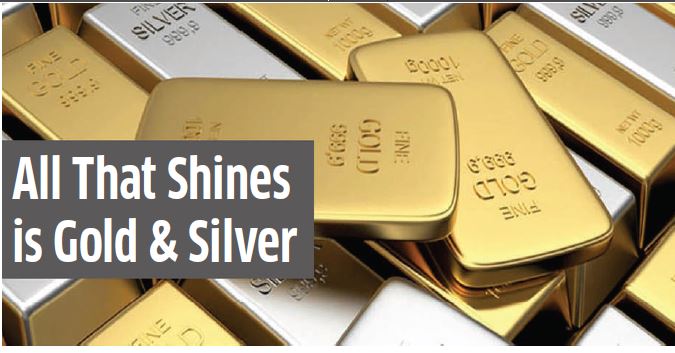
All That Shines is Gold & Silver
Ninad Ramdasi / 18 Apr 2024 / Categories: DSIJ_Magazine_Web, DSIJMagazine_App, Special Report, Special Report, Stories
longstanding obsession.
Precious metals gold and silver hold a special place when it comes to the investment journey of Indians. They help diversify investment risks and provide a hedge against market volatility, making them an essential component of a well-rounded investment strategy. Vaishnavi Chauhan explores the impact of precious metals on your portfolio.
For Indians, in particular, gold and silver have been a longstanding obsession. The primary reason for this is their liquidity. They can easily be converted into cash. Additionally, they serve as valuable collateral for loans. Historically, gold has played a vital role in India’s economic stability. During the 1991 crisis, when India’s foreign exchange reserves experienced a drastic dip, the country pledged 40 tonnes of gold to stabilise the situation. As of now, gold and silver are on a trailblazing path! These precious metals have surged to record highs in India, leaving many wondering - what is fuelling the flames. [EasyDNNnews:PaidContentStart]
It's evident that both gold and silver have outperformed the Nifty 50 index. Gold, in particular, has surged with over a 15 per cent return year-to-date (YTD), while silver has also delivered impressive returns of over 12 per cent. In contrast, the Nifty 50 has yielded returns of just over 3 per cent YTD. This trend suggests that investors may be turning to safe-haven assets like precious metals amidst market volatility, as reflected in the Nifty 50's decline.
Are the global economic jitters sparking a safe haven stampede? Or are local traditions playing a role? We will delve into the multifaceted reasons behind this rally, exploring the interplay of global uncertainty, investor sentiment, and even auspicious occasions in India. So, let us first understand the significance of this shiny surge for both seasoned investors and everyday consumers.
1) Lower Interest Rates on the Horizon — Central banks, notably the U.S. Federal Reserve, are widely expected to implement interest rate cuts later in 2024 even after the recent hotter than expected inflation number. This anticipation serves as a significant catalyst for the rise in gold and silver prices. When interest rates are lowered, traditional interest-bearing investments like bonds lose their appeal to investors seeking returns. As a result, they turn to assets like gold and silver, which are perceived as safe havens for wealth preservation, despite not offering interest.
2) Geopolitical Tensions — Global geopolitical tensions, such as the recent developments in the Middle East, can breed market instability and investor anxiety. During periods of uncertainty, investors flock to safe haven assets that are perceived to retain their value regardless of market fluctuations. Gold, with its timeless reputation for stability, becomes a sought-after choice. Investors are willing to pay a premium for this perceived security, thereby driving up gold prices.
3) De-Dollarisation and Gold — Countries seeking to diminish the dominance of the U.S. dollar in their economies often explore diverse strategies. Central banks, aiming to reduce reliance on the dollar while ensuring stability in their financial systems and international trade participation, seek alternative reserve currencies. One such alternative gaining traction is gold. Central banks worldwide have increasingly turned to gold reserves to diversify their holdings and bolster economic resilience. In 2023, the central bank’s demand for gold surged to 1,037 metric tonnes, which is second highest number ever recorded since 1950, as reported by the World Gold Council. This trend underscores the growing significance of gold as a viable option for countries aiming to mitigate dollar dependency and enhance financial sovereignty.
4) The Weakening U.S. Dollar — Gold is primarily priced in USD on the global market. The value of gold relative to other currencies depends on the strength of the USD. If the USD weakens against other currencies, it becomes cheaper for investors holding stronger currencies to buy gold priced in USD. This increased demand from a wider pool of investors can contribute to a rise in gold prices.
5) Elections — With elections around the corner, one can anticipate uncertainty in the markets, as gold and elections are closely linked. Investors prefer to allocate their funds to options with a stable performance history.
Performance of Gold, Silver and Nifty 50

Gold, Silver & Equity Gold and silver prices typically exhibit a low correlation with equity market movements. In fact, the correlation between gold and equities tends to be negative, indicating that they often move in opposite directions, with changes in one asset class having little impact on the other. Similarly, the correlation between the equity markets and silver prices is extremely weak, typically less than 0.1, suggesting that their price movements are largely independent of each other. Recent market dynamics deviate from the typical pattern as both gold and silver prices, along with equity markets, have hit all-time highs.
Analyzing covariance data from YTD since January 2011 sheds light on the historical behavior of gold, silver, and Nifty 50 in relation to each other. Covariance, measuring the strength and direction of the linear relationship between variables, offers valuable insights.
Silver displays a low correlation with both gold and Nifty 50. Gold exhibits a minor, albeit negative, relationship with silver, indicating its least correlation with Nifty 50. Similarly, Nifty 50 shows little to no correlation with gold and silver. This historical trend suggests that precious metals and Nifty are largely independent and do not significantly influence each other.
Typically, gold and silver prices show a low correlation with equity market movements, often even displaying a negative correlation, implying opposing movements. Similarly, the correlation between equity markets and silver prices tends to be extremely weak, typically below 0.1, indicating largely independent price movements.
However, recent market dynamics deviate from this typical pattern, with gold, silver, and equity markets all reaching all-time highs simultaneously. This simultaneous trend is attributed to investors' perception of overvaluation in both equity and commodity markets, potentially indicating market bubbles. Over the past year, significant rallies in both markets have raised concerns about excessive valuations, prompting expectations of a healthy correction ranging from 5-7 per cent. Such a correction is deemed necessary to address inflated prices and restore market equilibrium.

Gold and Gold Loan
The recent surge in gold prices has had a notable impact on the gold loan industry. The Loan-to-Value (LTV) ratio holds significant importance in secured loans, particularly in the context of gold loans. This ratio reflects the proportion between the borrowed amount and the market value of the asset used as collateral in this case, gold. Expressed as a percentage, it's a crucial determinant in assessing the maximum loan amount.
When the price of gold increases, it positively impacts the Loan-to-Value (LTV) ratio in two primary ways:
1. Increased Loan Eligibility — As the gold price rises, the value of the collateral, your gold also increases. Consequently, the LTV ratio improves, potentially allowing you to borrow a larger sum against the same gold asset.
2. Improved Loan Terms — A higher LTV ratio signifies reduced risk for the lender. With the appreciation in the value of gold, the loan amount represents a smaller portion of the overall collateral value. This can lead to more favorable loan terms for borrowers, including:
- Lower Interest Rates: With decreased risk, lenders may offer loans at lower interest rates.
- Easier Loan Approval: A stronger LTV due to higher gold prices may facilitate smoother loan approvals, as lenders perceive reduced risk in extending credit.
Understanding these dynamics can be advantageous for borrowers seeking gold loans, as they navigate through potential opportunities for maximizing loan benefits.
Lets understand with a help of an example — Previously, individuals could secure a loan of ₹75,000 against gold valued at ₹1 lakh. However, with the recent increase in gold prices, the same individual can now avail an additional loan of ₹10,000 without depositing any additional sum, as the value of the gold collateral has risen to ₹1,10,000.
Moreover, the Reserve Bank of India’s ban on IIFL for disbursing fresh gold loans has resulted in approximately 15 per cent of NBFC supply being vacated. This ban not only affects gold loans but also optimises operating leverage, expands ROE and reduces auctions, thereby supporting asset quality.

Analysing the table
Muthoot Finance Ltd. and Manappuram Finance Ltd. stand out among the top gold loan companies in India, delivering impressive six-month returns. This surge in gold prices has unequivocally fueled a notable upswing in the performance of gold loan companies, reflecting positively on their financial outcomes.
Jewellery-making Sector — The recent surge in gold and silver prices has not only impacted the loan industry but also the jewellery-making sector. Traditionally, when gold prices rise, consumer interest in jewellery tends to wane. However, contrary to expectations, the continuous upward trend in gold prices is unlikely to deter demand for the precious metal in India, according to jewellers.
In fact, recent market dynamics have revealed a notable shift in customer sentiment and behaviour. Customers are expressing satisfaction with their timely purchases as gold prices continue to climb. Moreover, with festivals like Gudi Padwa and Akshay Tritiya on the horizon, the demand for gold jewellery is expected to see a further boost. Anticipation is also high for the upcoming wedding season in the following quarter, which is poised to fuel this positive sentiment even more.
India, being one of the largest markets for gold, is witnessing a steady growth in demand driven by increasing affluence. Gold holds a significant cultural significance in the country, revered not only as a symbol of wealth and prestige but also deeply integrated into various ceremonies and traditions. Particularly in rural communities, gold is viewed as a reliable investment due to its portability and security, further strengthening its appeal.
Overall, despite the soaring prices, the demand for gold jewellery remains resilient in India, underlining its enduring importance in both cultural and economic contexts.

Takeaway for investors
Looking back over the past six months, we've witnessed a tremendous rally in precious metals, driven by various factors such as inflation, the price of the U.S. dollar, and geopolitical tensions. What's particularly noteworthy this time is that both the equity market and precious metals are soaring to their respective all-time highs. As we dive deeper into this scenario, it becomes apparent that the impact of gold and silver extends beyond just the individual jewellery-making sector; it also affects the gold loan sector.
With the rise in prices, there has been an increase in the loan-to-value ratio, which has consequently boosted the performance of banks and NBFCs (Non-Banking Financial Companies). Despite precious metals reaching all-time highs, investors remain positive about purchasing them. This sentiment suggests that investors are satisfied with their purchases and are expecting further surges, especially considering the festive and wedding seasons around the corner.
[EasyDNNnews:PaidContentEnd] [EasyDNNnews:UnPaidContentStart]
To read the entire article, you must be a DSIJ magazine subscriber.
Current print subscribers click here to login
Subscribe NOW to get DSIJ All Access!
[EasyDNNnews:UnPaidContentEnd]