Analysing Company Management: A Guide for Investors!
DSIJ Intelligence-6 / 26 Sep 2025 / Categories: General, Knowledge, Trending
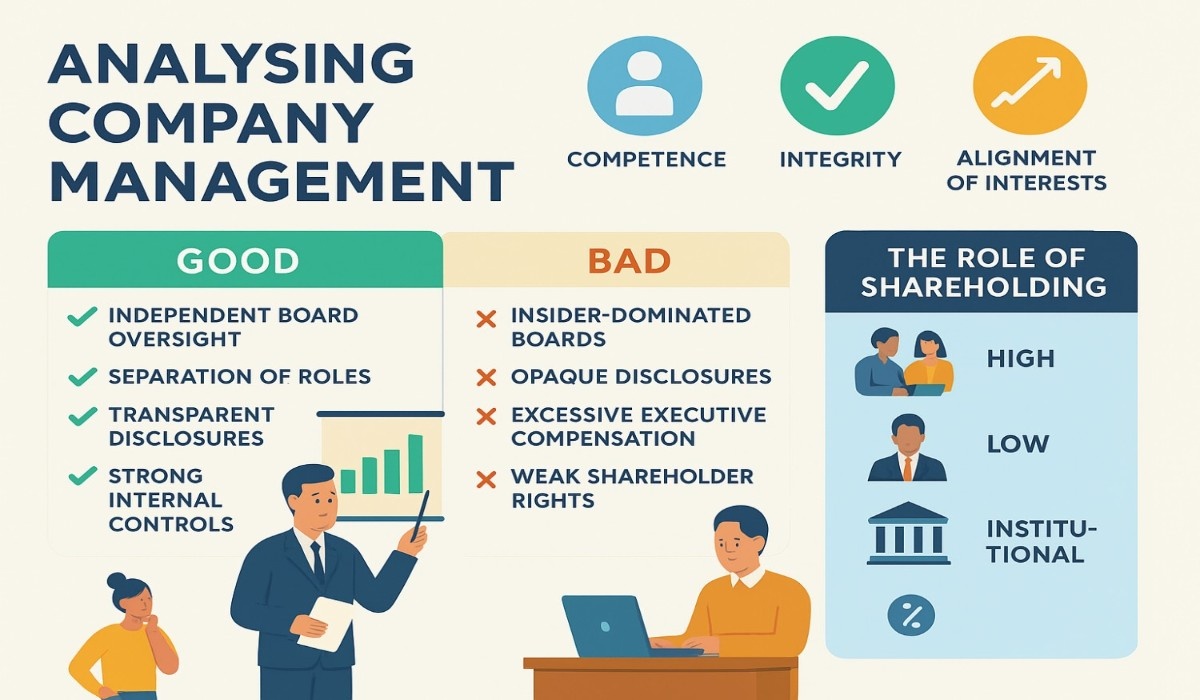
Analysing management quality goes beyond reviewing financials—it requires evaluating leadership’s integrity, governance practices, and shareholder alignment.
Evaluating the quality of a company’s management is a critical part of investment analysis. While financial statements reveal performance, the integrity, vision, and governance standards of leadership determine long-term sustainability. Strong management practices, aligned incentives, and sound corporate governance are vital indicators of a company’s ability to create shareholder value.
Key Aspects of Management Analysis
When analysing management, investors should focus on three pillars: competence, integrity, and alignment of interests.
- Competence reflects whether executives have the skills and track record to navigate challenges, innovate, and execute strategy.
- Integrity ensures decisions are transparent, ethical, and in the company’s best interest rather than for personal gain.
- Alignment of interests emphasizes how management’s compensation, incentives, and ownership stake tie them to long-term shareholder returns.
Scrutinizing annual reports, earnings calls, leadership history, and organizational culture help investors assess management credibility.
Good vs. Bad Corporate Governance Practices
Corporate governance is the system by which companies are directed and controlled. Good practices build trust and accountability, while poor practices can erode investor confidence.
Good Practices:
- Independent board oversight with a majority of non-executive directors.
- Separation of roles between the CEO and Chairperson to avoid concentration of power.
- Transparent disclosures on strategy, risks, and executive compensation.
- Strong internal controls to prevent fraud and mismanagement.
- Diversity and inclusion on boards, encouraging varied perspectives and reducing groupthink.
Bad Practices:
- Insider-dominated boards with limited independence.
- Opaque disclosures that obscure risks or performance details.
- Excessive executive compensation not tied to performance.
- Weak shareholder rights, such as limited voting power or staggered boards.
- Related-party transactions that benefit insiders at the expense of minority shareholders.
Good governance practices enhance accountability and shareholder protection, while poor ones heighten the risk of misallocation of capital and reputational damage.
The Role of Shareholding in Management Decisions
The ownership structure of a company significantly influences management behaviour.
- High promoter or insider shareholding often ensures that management decisions align with long-term shareholder value, as leaders have significant skin in the game. However, excessively high insider ownership may lead to entrenchment, where management prioritizes personal control over minority shareholder interests.
- Low insider shareholding increases reliance on professional managers. While this can promote accountability, it may also create agency problems where management pursues personal benefits (such as perks or short-term earnings manipulation) over sustainable value creation.
- Institutional ownership (mutual funds, pension funds, insurance companies) can act as a stabilizing force, as these investors often demand higher governance standards and accountability.
Balanced ownership, with sufficient insider stakes to encourage alignment but not enough to dominate decision-making, tends to support stronger governance outcomes.
Conclusion
Analysing management quality goes beyond reviewing financials—it requires evaluating leadership’s integrity, governance practices, and shareholder alignment. Good governance, characterized by independence, transparency, and accountability, strengthens investor confidence, while weak governance exposes firms to ethical and operational risks. Shareholding structure further shapes management incentives: high insider ownership can foster alignment but risks entrenchment, while low ownership requires vigilant external oversight. For investors, understanding these dynamics is essential to identifying companies capable of generating sustainable long-term value.