Ather Energy Ltd.
DSIJ / 16 Apr 2026 / Categories: Analysis, Analysis, DSIJ_Magazine_Web, DSIJMagazine_App, Regular Columns
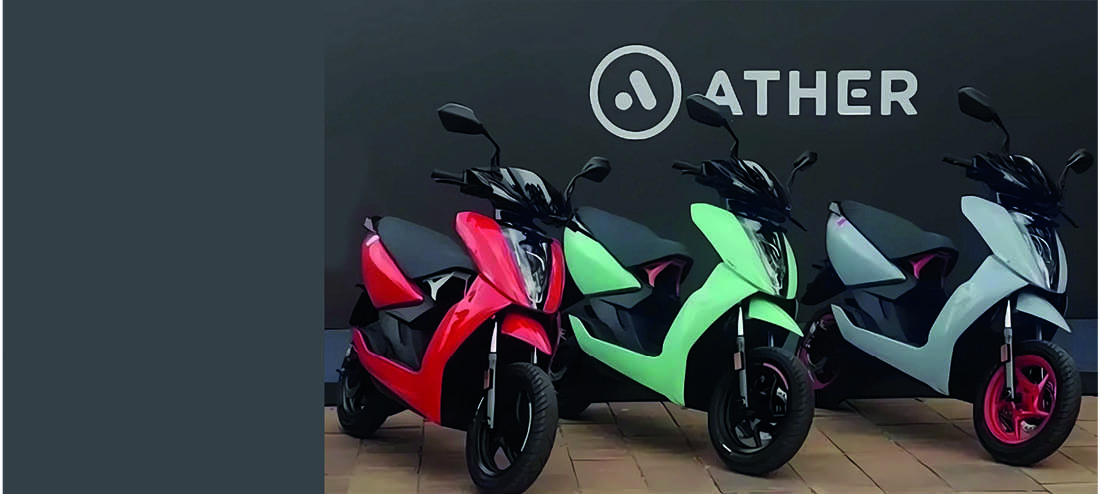
Ather Energy is positioning itself to lead India’s electric two-wheeler transition.
Ather Energy is positioning itself to lead India’s electric two-wheeler transition. The business is improving, but is the stock still worth buying?[EasyDNNnews:PaidContentStart]
Why Ather Matters Right Now
The excitement around India's electric two-wheeler industry is no longer being driven only by subsidies or the promise of a cleaner future. It is now being fuelled by something more durable, the segment is turning into a genuine mass market.
Rising fuel prices, sharply lower running costs of electric scooters, improving battery performance, and a rapidly expanding charging network have together made electric scooters a practical everyday choice, not just an aspirational one. The numbers reflect this. India sold approximately 1.4 million electric two-wheelers in FY2026, up 22 per cent year-on-year and more than seven times the volume sold just four years ago. Electric two-wheelers now account for about 57 per cent of all EVs sold in the country, and yet penetration sits at just 6.5 per cent of total two-wheeler sales. Over 93 in every 100 scooters sold in India still run on petrol at roughly ₹2 per kilometre, versus about 30 paise per kilometre for an electric. The cost case for switching has never been clearer. The question now is simply, who captures that shift?
Since its May 2025 IPO at ₹321, Ather’s share price has more than doubled, touching ₹803 in March 2026. Since then, while its nearest rival Ola Electric has seen sales collapse by over 50 per cent, Ather recorded 2,39,124 units in FY2026, 82 per cent year-on-year growth rising to a 18.8 per cent market share as on Q3 FY26 and cementing its place as the No. 3 player in the country
This analysis unpacks how Ather makes money, where its unit economics stand, how it compares with competitors, and what the stock's sharp move already prices in.
What is Ather: The Business
Founded in 2013 by Tarun Mehta and Swapnil Jain, two IIT Madras graduates, Ather is an Indian electric two-wheeler company headquartered in Bengaluru. It designs, manufactures, and sells premium electric scooters built around a technology-first philosophy, connected dashboards, over-the-air (OTA) software updates, navigation, fast-charging infrastructure, and performance-oriented riding modes.
Its current product lineup consists of two families, the Ather 450 series (450S, 450X, 450 Apex) targeting performanceoriented urban riders, and the Ather Rizta, a family-oriented scooter launched in April 2024 that has quickly become the company's highest-volume product. Together, these span a price range from roughly ₹1.05 lakh to ₹1.9 lakh (exshowroom), placing Ather firmly in the premium segment of the market.
Manufacturing is done at its facility in Hosur, Tamil Nadu, which has an installed capacity of 4,20,000 units per year. A 3.0 plant in Maharashtra (Chhatrapati Sambhajinagar), with a capacity of one million units annually, is expected to begin phased production from May 2026.
Beyond the vehicles, Ather has built a supporting ecosystem, Ather Grid, its network of 5,000 fast-charging points spread across India, Nepal, and Sri Lanka, the widest two-wheeler fast-charging network in the country, and AtherStack, its proprietary software platform that delivers connectivity, navigation, and ongoing feature updates to customers postpurchase. Over 600 Experience Centres serve as its retail and service touchpoints across India.
In simple terms, Ather is a premium electric scooter brand that sells vehicles, software-driven experiences, and charging access under one roof, rather than a low-cost EV player chasing volume at any price.
How Ather Makes Money
Ather is not simply a scooter seller. It is building a multi-layered revenue model where the vehicle is the entry point and the software, services, and charging network form the long-term engine. The analogy that best captures this is the ‘iPhone and the App Store’. The device is the starting point, but the ecosystem and recurring updates keep customers engaged and paying over time.
The revenue mix currently looks like this:

The vehicle business remains dominant, but the non-vehicle slice is growing and matters disproportionately for margins. Software subscriptions carry far higher margins than scooter hardware, and 91 per cent of Ather's customers opted for AtherStack Pro in Q3 FY26, the company's paid software suite. Non-vehicle revenue stood at 14 per cent of total income in Q3 FY26, up from 12 per cent a year earlier.
The key idea is this, Ather is transitioning from a pure hardware business toward a hardware-plus-services model. Every scooter sold is effectively the beginning of an ongoing customer relationship, not a one-time transaction. That shift materially improves the quality and stickiness of earnings over time.
Unit Economics: Is It Getting Better?
Unit economics is the most important question for any pre-profit growth company - is each unit the company sells getting more profitable over time, or is it getting worse? For Ather, the answer is clearly and demonstrably improving, and this among other facts underlies much of the stock's re-rating. The table below shows how the key per-vehicle metrics have evolved from FY25 through Q3 FY26:

Three things stand out from the data:
■ Cost reduction has outpaced price pressure — Revenue per vehicle has declined from ₹1,28,295 to ₹1,20,867 as Ather pushes more volume through the Rizta, which is lower-priced than the 450 series. But COGS per vehicle has fallen even faster from ₹1,20,777 to ₹1,09,681 driven by higher localisation, better scale on the motor and battery, and more efficient manufacturing. The net result is that gross profit per vehicle has improved from ₹7,518 in FY25 to ₹11,187 in Q3 FY26.
■ EBITDA losses are shrinking fast — The per-vehicle EBITDA loss has narrowed from ₹34,152 in FY25 to just ₹4,407 in Q3 FY26. This is not a small move, it represents an improvement of nearly ₹30,000 per vehicle in a single year. In Q3 FY26, the company's overall EBITDA margin narrowed to -3 per cent.
■ Software is becoming a meaningful contributor — Non-vehicle revenue (subscriptions, charging, accessories, services) has grown to 14 per cent of total income in Q3 FY26, up from 12 per cent in FY25. With over 91 per cent of customers opting for AtherStack Pro, this recurring layer is expanding without adding proportional costs, which is what drives margin improvement at scale.
Why the Stock Has Rerated
Ather listed in May 2025 at ₹321 per share with a somewhat muted debut, the stock actually settled 8.5 per cent below the issue price on Day 1. Within months, the narrative changed completely. By March 2026 the stock had touched ₹803, an all-time high, representing a return of over 150 per cent from the IPO price in under a year.
Three things drove this rerating:
■ From story to numbers — When Ather listed, investors were largely valuing it on potential. What followed was a series of Quarterly Results that showed actual execution, volumes up 67 per cent year-on-year in Q2, then 50 per cent in Q3, market share climbing from 11.7 per cent in FY25 to 18.8 per cent in Q3 FY26, revenue hitting a record ₹995.7 crore in Q3 FY26, and EBITDA losses narrowing dramatically. Numbers replaced promises, and the market re-priced accordingly.
■ Ola's collapse created a vacuum — Ola Electric, which had been the dominant player with 35 per cent market share in FY25, saw sales collapse by over 51 per cent in FY26, dragged down by quality issues, service failures, and loss of consumer trust. That vacuum benefited players with stronger brands and better service networks, and Ather was one of the clearest beneficiaries, absorbing a meaningful share of premium-segment buyers who had moved away from Ola.
■ Premium positioning proved its value — In a market where Ola's aggressive discounting strategy was destroying value, Ather's refusal to compete on price turned from a potential weakness into a strength. Its brand loyalty, customer satisfaction scores, and software ecosystem held firm, and investors began pricing in a higher-quality business model, one that earns through experience and ecosystem rather than sticker-price volume.
In short, the stock rerated because what was once seen as a ‘premium but loss-making niche EV start-up’ is now perceived as a high-quality, structurally improving mobility business with a credible path toward profitability.
Competitive Landscape: Where Ather Stands
India's electric two-wheeler market has consolidated sharply. TVS, Bajaj, Ather, Ola, and Hero together account for over 85 per cent of industry sales. Within this group, the competitive dynamics have shifted significantly over the past year, with legacy OEMs gaining ground and Ola losing it.
Ather's competitive position is structural rather than pricebased. It does not compete for the cheapest-scooter buyer, instead, it targets urban riders who value build quality, software richness, and the convenience of Ather Grid fast-charging. This creates what can fairly be called an ‘experience moat’, a narrower but stickier and higher-margin customer base.

The Rizta has been a critical move in this context. While the 450 series speaks to performance enthusiasts, the Rizta, a familyoriented scooter with the largest seat in its class and generous storage, has broadened Ather's appeal without meaningfully compromising its premium image. As of Q3 FY26, the Rizta accounted for approximately 70 per cent of Ather's sales volumes.
Where Ather trails is distribution depth. TVS and Bajaj operate through thousands of existing dealer points, Ather's 600 Experience Centres are growing but remain concentrated in South and West India. Expanding this network, particularly into North and Central India, is both the biggest growth opportunity and the biggest execution challenge ahead.
The Rare Earth Magnet Risk And Ather's Response
Rare earth magnets are a core component of the high‑efficiency electric motors used in most premium e‑scooters. They deliver strong torque and performance in a compact form factor. The problem is that China controls the vast majority of global rare earth mining, refining and magnet production, leaving Indian EV makers structurally exposed to geopolitical and supply‑chain disruption.
This risk is not theoretical. In FY26, Bajaj Auto's Chetak production was disrupted in July and August due to rare earth magnet supply issues, a real‑world example of the vulnerability. Ather was not immune either, and the company deferred certain PM E‑DRIVE claims during the disruption period.
Ather's response has been proactive and technically substantive. The company has developed Heavy Rare Earth Free (HREF) motors that eliminate the most sensitive and expensive elements dysprosium and terbium while retaining lighter rare earth formulations that are easier to source. These designs have received ARAI approvals and PM E‑DRIVE eligibility, confirming they meet performance standards without the highest‑risk inputs.
Beyond HREF, Ather is also developing rare‑earth‑lite and alternative magnet architectures for its next‑generation EL platform, reducing long‑term exposure further. The company has also incorporated a Hong Kong subsidiary to support procurement and build supply chain resilience within the Asia‑Pacific region.
For investors, this matters because it signals that Ather is engineering hardware‑level resilience into its business, not just riding the EV wave and hoping the supply chain holds. It is an area where Ather appears better prepared than most of its peers.
Growth Triggers Ahead
Ather's growth story over the coming years is not dependent on a single catalyst. It is a combination of product, geography and platform expansion that together could drive meaningful incremental volume and margin improvement.
■ The EL Platform (Festive Season 2026) — Ather's most important near‑term launch is its new EL scooter platform, designed specifically for the ₹1 Lakh to ₹1.3 Lakh segment that accounts for roughly 50 per cent of the total e‑scooter market. The EL platform is engineered for lower mechanical costs and faster assembly, targeting the volume tier without compromising software quality. The first EL‑based scooter is expected to launch in the festive season of 2026, with production at the new Chattrapati Sambhajinagar plant.
■ Entry into Electric Motorcycles (Zenith Platform) — Motorcycles account for 63 per cent of India's total two‑wheeler market, a segment where EV penetration is currently negligible. Ather is developing the Zenith platform for electric motorcycles targeting the 125–300cc equivalent segments. If electric penetration in motorcycles hits even 5 to 10 per cent by 2030, it represents a market multiple times the size of the current e‑scooter opportunity. Ather getting in early, with a software‑defined product, positions it well for this transition.
■ Geographic Expansion: Middle and North India — Ather's current stronghold is South India, where it commands 24 per cent market share. Its fastest‑growing region is now Middle India (Gujarat, Maharashtra, MP, Odisha), where share has climbed from 8.8 per cent to 17.4 per cent in a single year. North India Punjab, UP, Rajasthan is the next frontier, with market share still in low single digits. As the Chattrapati Sambhajinagar plant reduces Logistics costs for North and West India, this expansion becomes more economically viable.
■ Deepening the Software Revenue Layer — With 91 per cent of customers on AtherStack Pro and non‑vehicle revenue at 14 per cent of total income, Ather is building a recurring revenue engine on top of its hardware base. As the cumulative installed base of Ather scooters grows, the company crossed 5,00,000 cumulative deliveries in October 2025, the subscription and services layer compounds with each additional sale.
■ Fleet and B2B Opportunity — Last‑mile delivery demand from e‑commerce and food delivery companies is driving strong B2B electric two‑wheeler adoption. This segment values total cost of ownership above all else, and electric scooters win clearly on operating costs. Ather's premium positioning and charging network make it a credible option for corporate fleet buyers looking for reliability over price.
Risks and Challenges
Ather's improved execution does not make it risk‑free. Several real challenges could slow or complicate the growth story. Intense competitive pricing pressure. TVS, Bajaj and Hero are all gaining share and deploying their existing dealer networks aggressively. If Ather is forced to cut prices across the board to defend share, particularly once legacy OEMs launch more capable, software‑equipped products, ASP compression could outpace cost reduction and delay the path to EBITDA breakeven.
■ Brand dilution during scaling — Ather's valuation premium rests on its image as a premium, tech‑first brand. As it pushes higher volumes through the Rizta and the upcoming EL platform and expands into lower‑tier cities, maintaining consistent build quality, software updates and service standards across a larger, more distributed network is a real operational challenge. Any deterioration in customer experience could erode the 'experience moat' and reprice the stock toward a more commoditised valuation.
■ Subsidy and policy risk — The PM E‑DRIVE scheme, which provided subsidies of ₹5,000 per kWh of battery capacity, was scheduled to expire in March 2026. Any meaningful withdrawal of EV incentives could temporarily widen the price gap between electric and petrol scooters, slowing adoption and compressing volumes. Ather's ability to offset this through its own cost reduction is improving but not yet certain.
■ Rare earth supply disruption (residual risk) — Although Ather is developing HREF and rare‑earth‑lite motors, a portion of its current production still relies on rare earth inputs. A sudden Chinese export restriction or supply shock could push up motor costs and create a short‑to‑medium‑term margin headwind before the redesigned motors scale to full production.
■ Execution risk on new platforms — The EL platform launch, the Zenith motorcycle programme, the Chattrapati Sambhajinagar plant ramp and the geographic expansion into North India are all happening simultaneously. Executing across all four at once, while improving unit economics and managing working capital, is operationally demanding.
Valuation and Conclusion
Since its May 2025 IPO at ₹321, Ather’s share price has more than doubled, with a market capitalisation of approximately ₹29,000 crore. Since the company is yet to make profit, the most relevant metric is EV/Sales, not PE. At current prices, Ather trades at roughly 9x trailing twelve‑month sales, compared to Ola Electric, which trades closer to 5x. That premium reflects the market’s view of Ather as a higher‑quality, better‑managed and more execution‑credible business with a clear path to profitability.
At 9x sales, the market is not betting on another cheap rerating from IPO levels, it is pricing in a continuation of high‑volume growth, steady margin improvement and the successful execution of the EL platform and geographic expansion. The easy upside from the listing price has already played out, and further upside will need to come from delivered results, EBITDA breakeven and expanding market share, not from valuation expansion alone.
Ather has made a genuine transition over the past year, it entered the public markets as a credible but loss‑making premium EV brand and now looks more like a structurally improving mobility business with improving unit economics, a growing installed base and a clear roadmap for the next few years.
For a long‑term investor comfortable with pre‑profit growth exposure, the appropriate stance is a monitored HOLD, keep the position if already in and track quarterly execution closely. The story remains intact, but the margin of safety has narrowed significantly since the IPO.
[EasyDNNnews:PaidContentEnd] [EasyDNNnews:UnPaidContentStart]
To read the entire article, you must be a DSIJ magazine subscriber.
[EasyDNNnews:UnPaidContentEnd]