Birla 2.0: Reinventing the Empire
Arvind / 17 Sep 2026 / Categories: Cover Stories, Cover Story, DSIJ_Magazine_Web, DSIJMagazine_App, Stories
It is the latest, and in some ways the most telling, entry in a pattern that has been building for two years. Birla Opus, the group's paint brand under Grasim Industries, rolled out manufacturing capacity across six plants in barely two years, a build-out speed that took established players a decade to match. Indriya, a jewellery format, opened to compete with Tanishq and Kalyan in a business built on trust earned over generations, not capacity built in months. Aditya Birla Fashion and Retail demerged its lifestyle brands into a freshly listed entity, Aditya Birla Capital raised fresh equity to fund an insurance and lending push, and now UltraTech, the group's cash-generating cement flagship, has used its own balance sheet to fund a fifth simultaneous front.
After transforming cement, metals and manufacturing businesses into global-scale companies, Kumar Mangalam Birla is attempting his most ambitious transition yet, creating consumer and infrastructure franchises in categories dominated by established giants. This deep dive examines the strategy, financial strength, risks and challenges behind the group's biggest expansion phase [EasyDNNnews:PaidContentStart]
A Group in Expansion Mode
On September 3, 2026, Kumar Mangalam Birla unveiled the Aditya Birla Group's newest bet: Ultravolt, a wires-and-cables brand built under UltraTech Cement, entering a market worth an estimated ₹90,000 crore. Backed by an investment of ₹1,800 crore, Ultravolt did not arrive as a cautious, testing-the waters entrant; it launched already positioned as the second largest player in the segment by capacity, with a stated ambition to be among the top two players outright within five years. Birla framed the bet around three structural tailwinds: urbanisation, electrification and digitisation, pointing to the Construction of over 100 million new homes over the coming decade, the expansion of power infrastructure, and the rapid build-out of data centres across India as the demand engines that would justify the wager.
It is the latest, and in some ways the most telling, entry in a pattern that has been building for two years. Birla Opus, the group's paint brand under Grasim Industries, rolled out manufacturing capacity across six plants in barely two years, a build-out speed that took established players a decade to match. Indriya, a jewellery format, opened to compete with Tanishq and Kalyan in a business built on trust earned over generations, not capacity built in months. Aditya Birla Fashion and Retail demerged its lifestyle brands into a freshly listed entity, Aditya Birla Capital raised fresh equity to fund an insurance and lending push, and now UltraTech, the group's cash-generating cement flagship, has used its own balance sheet to fund a fifth simultaneous front.
None of these moves would qualify as a surprise in isolation. Large Indian conglomerates diversify constantly. What makes this moment different is the pattern: the Aditya Birla Group, built and scaled on commodities, cement, aluminium, viscose fibre and telecom infrastructure, is simultaneously attacking more than a couple of consumer- and infrastructure-facing categories where it has no incumbent advantage, no distribution history and no brand equity to fall back on. Paints, jewellery, fashion retail, wires and cables, and B2B digital platforms have one thing in common: each is dominated by a player, or two, that has spent decades building the exact assets, dealer loyalty, customer trust and distribution reach, that money alone cannot buy quickly.
The current chapter in the Aditya Birla Group's story is something that might puzzle most readers and, hence, deserves a detailed and deep dive rather than a corporate profile. Kumar Mangalam Birla has already done the easier version of this task once: he took a group of textile and commodity businesses inherited in 1995 and turned it into a collection of global-scale, professionally run industrial companies. That was, at its core, a game the group already knew how to play: buy assets, expand capacity, integrate operations and cut costs.
What he is attempting now is structurally harder. It asks a set of engineering-led, capital-intensive businesses to develop something closer to a consumer-goods instinct: brand building, dealer psychology, retail experience and underwriting discipline. Ultravolt is a partial exception; wires and cables are sold B2B and through dealers much like cement itself, which is precisely why UltraTech, rather than a consumer-facing group entity, is the one running it. The financial numbers in this story, drawn from five years of audited results across ten listed group companies, show a group with genuine balance-sheet strength and cash-generating power. They also show, in at least two of the new-economy bets, the early cost of a strategy that is still unproven. This is a story about whether capital and scale can manufacture leadership in categories that have historically been won by patience and relationships.
The Central Argument
For most of the past three decades, growth at the Aditya Birla Group has followed a familiar script: identify a commodity or industrial category with global scale potential, acquire or expand aggressively, and compete on cost and capacity. Cement, aluminium, viscose staple fibre, carbon black and telecom infrastructure were all built this way. The customer in each of these businesses is either an institutional buyer, a dealer, or, in telecom's case, a price-sensitive retail subscriber acquired through network coverage rather than brand affinity.
The businesses now receiving the group's freshest capital are different in kind. Paint is bought through a decades-old relationship between a homeowner, a painter and a dealer. Jewellery is bought on trust built over generations and guarded jealously by family-run and legacy chains. Fashion retail lives and dies on brand aspiration and store experience. In each of these, the group is not extending an existing advantage; it is building one from a standing start, against competitors who have no intention of ceding share quietly.
That raises the question this story tries to answer: is Kumar Mangalam Birla executing a carefully sequenced transformation of the portfolio, timed to income growth and formalisation trends genuinely underway in India, or has the group taken on too many capital-intensive, low-margin battles at once, at a moment when its older commodity businesses are themselves facing cyclical and margin pressure? The financial data suggests both are true simultaneously, in different parts of the portfolio. That is precisely what makes this a bet rather than a plan.
From Inheritance to Transformation
Kumar Mangalam Birla took charge of the Aditya Birla Group in 1995, at the age of 28, following the sudden death of his father, Aditya Vikram Birla. What he inherited was a group with real industrial scale but a fragmented structure, a collection of textile, fibre, cement and metals businesses spread across dozens of entities, many with overlapping promoter holdings and limited professional-management depth.
His first two decades as chairman were spent consolidating and internationalising that inheritance. Grasim's cement operations were eventually demerged into what is today UltraTech Cement, now India's largest cement maker by capacity. Hindalco's 2007 acquisition of Novelis turned an Indian aluminium producer into the world's largest flat-rolled aluminium and recycling company overnight, still the single boldest capital decision of his tenure, and one that took years to prove out on the balance sheet. Idea Cellular was built into a national telecom operator and then merged with Vodafone India in 2018, a defensive consolidation forced by a brutal price war the group did not start and could not avoid.
Through this period, Birla's capital-allocation instinct was industrial: buy scale, integrate operations, professionalise management, and let global commodity cycles do the rest. What has changed materially in the last five years is the direction of new capital. Instead of adding capacity to businesses the group already dominates, fresh investment is now flowing into categories where the group starts with a well-known name and a strong balance sheet, and very little else. That shift, more than any single product launch, is the real story here.
Anatomy of the Bold Bet
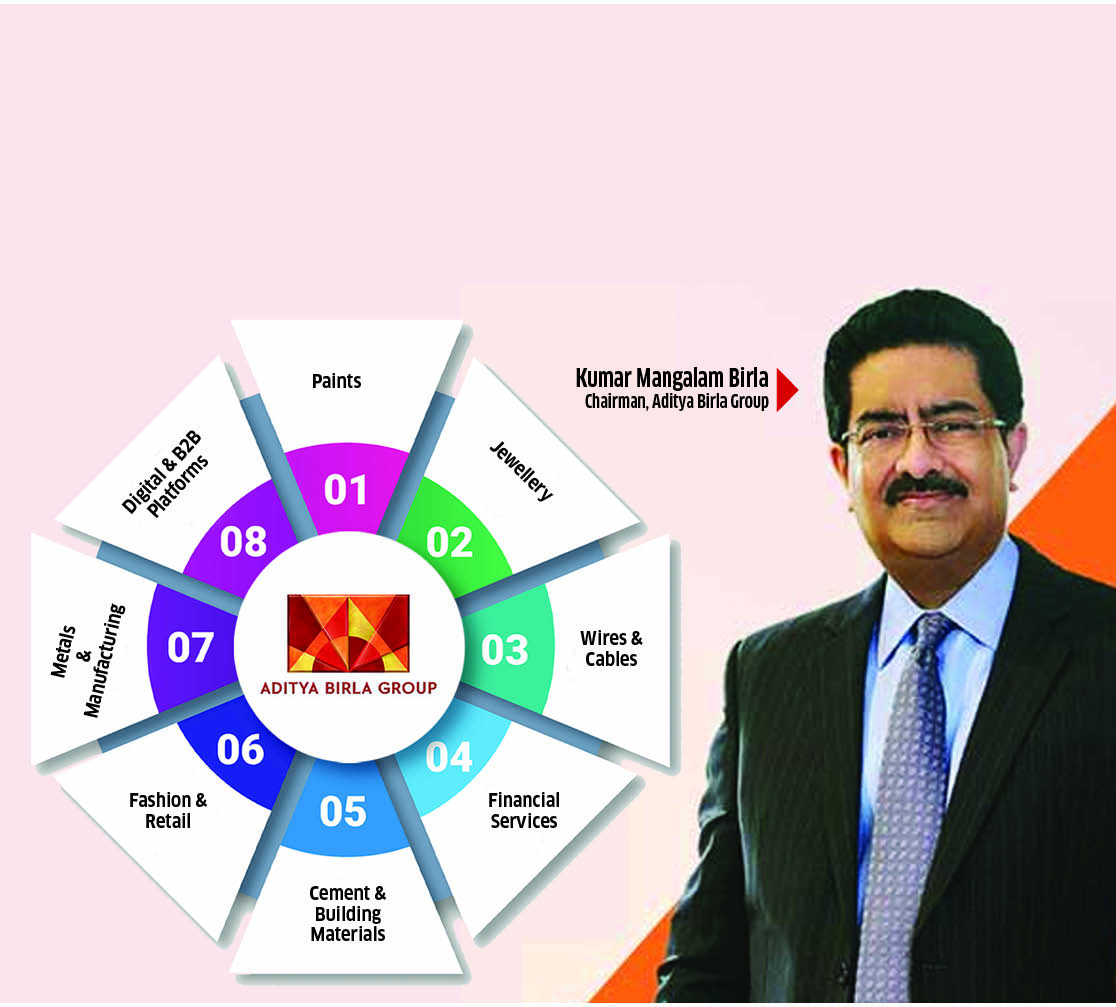
The group's expansion can be understood as eight simultaneous fronts, each carrying its own capital intensity, competitive intensity and payback horizon.

Within roughly two years of commencing operations, Birla Opus brought all six greenfield plants on stream, taking its total installed capacity to 1,332 million litres per annum and entering a decorative paints market long dominated by Asian Paints, with Berger, Kansai Nerolac and the newly entered JSW Paints also defending share. Indriya is attempting to build a branded, trust-driven retail chain in a category, jewellery, where over 60 per cent of India's market is still unorganised, and where Tanishq took roughly three decades to become the branded market leader. Ultravolt enters a wires-and-cables market dominated by Polycab, KEI Industries, Havells and Finolex, but unlike paints or jewellery, this is a B2B, dealer-led category structurally closer to cement. UltraTech's existing network of roughly 4,400 Building Solutions outlets and its relationships with contractors and electricians give it a genuine, if unproven, distribution shortcut that its other new-economy bets do not enjoy. Aditya Birla Capital is chasing scale in lending, asset management and insurance simultaneously, sectors where distribution reach and underwriting discipline matter more than balance-sheet size alone. UltraTech and Grasim continue to add cement and building-materials capacity into a housing and infrastructure cycle that has been more inconsistent than consistently strong over the past five years.
Why Now
Management's own justification for the timing rests on a reasonably well-supported macro thesis. India's per-capita income is rising through a range where discretionary consumption categories, paint repainting cycles, branded jewellery and organised fashion, historically accelerate. Formalisation, aided by GST and tighter compliance, has structurally shifted share from unorganised to organised players across paints, jewellery, wires and building materials over the last decade. Housing starts and government infrastructure spending support cement and building-materials demand, even if the cycle has been lumpier than bulls expected.
For Ultravolt specifically, Birla has pointed to three structural drivers, urbanisation, electrification and digitisation, that he expects to sustain demand well beyond a single capex cycle: over 100 million new homes are projected to be built in India over the next decade, each requiring wiring; power infrastructure is expanding to keep pace with that housing growth and industrial demand; and the rapid build-out of data centres across India is creating a new, high-value category of cable demand that did not exist at meaningful scale even five years ago. This is a more diversified demand thesis than paints or jewellery can claim, since it draws on housing, industrial capex and digital infrastructure simultaneously rather than a single consumption trend.
And critically, the group's mature businesses generate enough free cash flow, and the group carries enough balance-sheet credibility, to fund multi-year, pre-revenue capacity build-outs without immediately straining the parent's credit profile.
The counter-argument is timing risk: several of these categories, paints and financial services in particular, are being entered by well-capitalised new competitors at the same moment, from JSW Paints' 2024 entry into decorative paints to a crowded field of new-age NBFCs and insurers. A structurally growing pie does not guarantee that a new entrant captures a profitable slice of it; it only guarantees the pie is worth fighting over.
The Capital Behind the Ambition
The financial scorecard across the group's ten listed entities presents a distinctly mixed picture. UltraTech Cement grew revenue at about 14 per cent annually between FY22 and FY26, even as its operating margin narrowed from roughly 23 per cent to 20 per cent. Interest cover also declined from 12.7 times to 9.4 times, reflecting the capital intensity of its continuing capacity expansion. The coverage remains comfortable, but the moderation shows that growth has come with a higher financing burden.
Hindalco Industries presents a somewhat different picture. Revenue compounded at about 9 per cent annually over FY22–FY26, while operating margins moderated from 15.1 per cent to 13.7 per cent. Despite this, interest cover improved from 7.8 times to 10.9 times, indicating a stronger ability to service debt. With Novelis accounting for a substantial part of the group's global operations, Hindalco's scale, cash generation and balance-sheet improvement have helped strengthen its debt-servicing position even as profitability remained exposed to aluminium prices and global industrial conditions.
Market capitalisation across group companies, ~5 years ago versus today

(Source: BSE, company disclosures)
Among the faster-growing businesses, Aditya Birla Capital stands out. Revenue compounded at nearly 20 per cent annually between FY22 and FY26, while profit after Tax grew at roughly 22–24 per cent a year, depending on whether reported or adjusted PAT is considered. This still places it among the strongest profit-growth performers in the group. The expansion, however, has been accompanied by a substantial increase in borrowings and interest costs, while reported interest cover declined from around 1.6 times to 1.4 times.
That ratio needs to be interpreted differently from those of manufacturing companies. For a lending business, borrowings and interest expense are integral to operations rather than simply indicators of financial stress. The more relevant question is whether Aditya Birla Capital can continue expanding its loan book while maintaining asset quality, adequate capitalisation and disciplined funding costs. Its numbers therefore point less to conventional balance-sheet strain and more to the increasing importance of credit quality and risk management as the financial-services platform scales.

At the other end, Aditya Birla Fashion and Retail's numbers look weak in isolation, revenue essentially flat over five years and swinging to a net loss, but a large part of that reflects the June 2025 demerger of its higher-margin lifestyle brands (Louis Philippe, Van Heusen, Allen Solly and Peter England) into a separately listed entity, Aditya Birla Lifestyle Brands Limited. Judging ABFRL's standalone numbers without accounting for that structural split would overstate the damage; investors need to track ABLBL's separate performance to get a true read on the fashion portfolio. Similarly, Aditya Birla Real Estate's sharp revenue decline reflects a change in the underlying business mix rather than a straightforward demand collapse, and Vodafone Idea's large reported FY26 profit reflects a one-off deferred-tax and AGR-related accounting adjustment rather than an operating turnaround. All three are flagged in Table 2 rather than treated as comparable growth or decline.

Grasim Industries' own numbers are harder to parse cleanly because its financial statements increasingly reflect the group's evolving holding structure for financial services and paints, a consolidated numbers at the holding-company level can overstate or understate any single business line, and cross checking segment disclosures matters more than usual here.

The Birla Method of Market Entry
Across every new business, paints, jewellery and financial services, the same six-step playbook is visible:
- Enter a category with a large, structurally growing addressable market.
- Commit capital before meaningful revenue exists.
- Build manufacturing or distribution capacity at scale rather than testing with a pilot.
- Lean on the Birla name and group relationships for initial trust and access.
- Push distribution aggressively rather than organically.
- Accept multiple years of margin or return pressure while targeting outright category leadership rather than a modest, profitable niche.
This playbook has worked before in industrial categories: cement and aluminium capacity, once built, sell into a structurally growing market with relatively simple, standardised buying decisions. It is a materially harder playbook in consumer categories, where trust, brand aspiration and service experience are built person by person, transaction by transaction, and where capacity alone cannot manufacture a customer relationship. The Birla method has never really been tested against that constraint at this scale before, and that, more than the industry-specific competitive dynamics, is the real experiment underway.
The Competitive Battle
Every category the group has entered already has an entrenched, well-resourced incumbent unlikely to cede share without a fight. Asian Paints, with a market share north of 50 per cent in decorative paints, has already responded to Birla Opus and JSW Paints with sharper dealer schemes and pricing actions that compressed its own margins, a sign that new entrants are extracting share, but at an industry-wide profitability cost, not necessarily a profitable one for themselves yet. Tanishq's three-decade head start in organised jewellery, backed by Tata Group trust, will not be closed by store count alone; customer acquisition in jewellery runs through repeat purchases and generational trust that are expensive and slow to build. In lending and insurance, Aditya Birla Capital competes against both legacy private Banks and a wave of well-funded new-age NBFCs and insurance technology companies, all bidding up customer-acquisition costs simultaneously.
The wires-and-cables market reacted to UltraTech's intent to enter well before Ultravolt was even a brand name: when the board approval was first announced in February 2025, shares of Polycab, KEI Industries, RR Kabel, Havells and Finolex Cables all fell sharply in a single trading session, a rare instance of an incumbent industry pricing in a competitive threat before the new entrant had sold a single metre of cable. That reaction reflects the same dynamic UltraTech exploited in cement and Birla Opus is exploiting in paints: a large, well-capitalised entrant with an existing dealer network can credibly threaten margins even before it ships volume. Whether Ultravolt's launch-day claim to second-largest capacity converts into second-largest market share is the more important, and considerably harder, test still to come.
The common thread is that in every one of these fights, gaining share typically means either accepting lower margins than the incumbent, spending disproportionately on distribution and brand, or both, and the incumbents, sitting on stronger cash generation in their core categories, can typically absorb a prolonged price or promotional war for longer than a new entrant expects.
The Risks Behind the Expansion
Five risks stand out from the data and the strategy itself:
- Simultaneity: The group is fighting capital-intensive battles in paints, jewellery, fashion, financial services and digital platforms at once, stretching management bandwidth and diluting the benefit of the group's own scale advantage across any single fight.
- Payback period: Paints and jewellery capacity, once built, typically take several years to generate returns on capital that justify the initial outlay, a genuine test of investor patience, not just operational execution.
- Rising leverage in specific pockets: Aditya Birla Capital's interest costs and UltraTech's falling interest cover both show the cost of funding growth is rising, even if absolute debt levels remain manageable for now.
- Cyclicality in the core: Cement, metals and telecom, the businesses funding much of this expansion, are themselves exposed to commodity cycles, regulatory shifts (as Vodafone Idea's AGR-related history shows starkly) and demand volatility that could squeeze the very cash flows the new bets depend on.
- Capability transition: Consumer businesses require genuinely different organisational instincts, merchandising, brand marketing and retail experience, than the engineering- and operations-led culture that built the group's industrial businesses, and that cultural shift cannot be bought with capital alone.
Kumar Mangalam Birla's Leadership Test
Birla's own record shows a chairman who has become progressively more comfortable with large, long-gestation bets over his three decades in charge. The Novelis acquisition in 2007 remains the clearest precedent, a deal that looked overpriced and over-leveraged for years before proving out. What is different this time is the number of simultaneous bets and their category diversity: Novelis was a single large industrial acquisition inside a business Hindalco already understood; the current expansion spans half a dozen categories the group has never operated in.
Birla has also increasingly delegated day-to-day operating control to professional CEOs across group companies while retaining capital-allocation authority himself, a structure that has generally served the group's industrial businesses well but has not yet been tested at this scale in consumer categories, where founder-led or promoter-led rivals (the Tata Group in jewellery and fashion, Asian Paints' promoter legacy) often move with a different rhythm. How the next generation of Birla family leadership eventually engages with this expanded, more consumer-facing portfolio remains an open question that will matter far beyond the next five years. For now, this expansion phase is unambiguously the most diversified and highest-stakes capital-allocation test of his career.
What It Means for Investors
Investors should resist treating ‘Aditya Birla Group’ as a single investment thesis; the ten listed entities in this analysis have starkly different risk-reward profiles, and lumping them together obscures more than it reveals.
UltraTech Cement and Hindalco remain the group's most self-funding, cash-generative businesses, effectively financing much of the group's ambition through Dividends and internal accruals even as their own margins face cyclical pressure. Investors here are underwriting execution risk in the core, not the new bets directly. UltraTech shareholders now carry a second, smaller execution question too: Ultravolt's ₹1,800-crore investment is modest next to UltraTech's own balance sheet, but a genuine push for a top-two position in wires and cables will likely mean years of promotional spending and price competition before it is margin-accretive, a cost worth watching for, even if it is unlikely to move the needle on UltraTech's consolidated numbers for at least two to three years. Aditya Birla Capital offers the closest pure exposure to the group's financial-services ambitions, with the fastest profit growth in this dataset, but also the fastest-rising leverage and the tightest interest cover, a name to watch for asset-quality trends and capital-raising more than most.
Profit trajectory across the group's financial-services entities

(Source: company disclosures)
Aditya Birla Sun Life AMC is a comparatively low-risk, high-margin annuity-like business benefiting from India's structural shift towards financialised savings, and its numbers, a roughly 72 per cent operating margin and consistent profit growth, reflect that. Grasim, now the group's holding vehicle for cement, chemicals and the paints bet, requires investors to look through consolidated numbers to the underlying segments before drawing conclusions. ABFRL and its newly demerged sibling ABLBL need to be tracked as two separate, recently split stories rather than one continuous narrative. Vodafone Idea remains a structurally distinct, government-dependent turnaround story where reported profit numbers can be driven by one-off accounting items rather than underlying operating improvement, and should be read with particular caution.

On valuation, the market has already re-rated several of these names meaningfully: UltraTech's share price has compounded at roughly 9 per cent a year over five years even as earnings growth slowed, suggesting the market is not obviously under pricing execution risk in the core; Aditya Birla Capital's stock has compounded at nearly 30 per cent a year, arguably pricing in a good deal of the financial-services growth story already. For context, the Nifty 50 has compounded at roughly 9–11 per cent a year in price terms over the same trailing five-year window, so several group names have meaningfully outpaced the broader market, leaving a narrower margin of safety for investors buying today than for those who backed the group's pivot five years ago. That is a reasonable case for new money to wait for clearer operating proof points, such as Birla Opus volume-share data or ABCL's asset-quality trends, rather than buy the growth narrative alone.
Conclusion: Building the Next Birla Group
Kumar Mangalam Birla has already done the hard work of turning an inherited, fragmented industrial group into a set of global-scale, professionally managed businesses. That was proof that he could allocate capital and integrate operations well. What he is attempting now asks a fundamentally different question: can an industrial conglomerate, built on engineering discipline and manufacturing scale, build genuine consumer franchises, the kind that live on trust, brand and repeat purchase rather than capacity and cost curves?
The financial record so far is neither a vindication nor an indictment. It shows a group with real balance-sheet strength, genuine cash-generating power in its core businesses, and the patience to fund multi-year, pre-revenue bets that few Indian conglomerates could attempt simultaneously. It also shows rising leverage in the businesses carrying the heaviest new economy ambitions, margin compression in parts of the industrial core that is supposed to be funding this expansion, and at least one high-profile consumer bet, fashion retail, that has required a structural reset rather than organic improvement.
Kumar Mangalam Birla has already transformed the scale and global reach of the group he inherited. His next test is more complex: proving that an industrial conglomerate can build consumer franchises with the same success with which it built factories. The data in this story does not yet answer that question; it only tells you where to look for the answer over the next few years.
[EasyDNNnews:PaidContentEnd] [EasyDNNnews:UnPaidContentStart]
To read the entire article, you must be a DSIJ magazine subscriber.
[EasyDNNnews:UnPaidContentEnd]