Defence Stocks: Still Worth Betting On?
Arvind DSIJ / 11 Jun 2026 / Categories: DSIJ_Magazine_Web, DSIJMagazine_App, Special Report, Special Report, Stories
The defence sector has attracted significant investor interest over the past few years, turning several defence stocks into multibaggers within a short period. When the tide turned for domestic markets amid weak investor sentiment over the last year, and the benchmark Nifty 50 experienced heightened volatility, the Nifty India Defence Index remained relatively resilient and outperformed the benchmark in recent months.
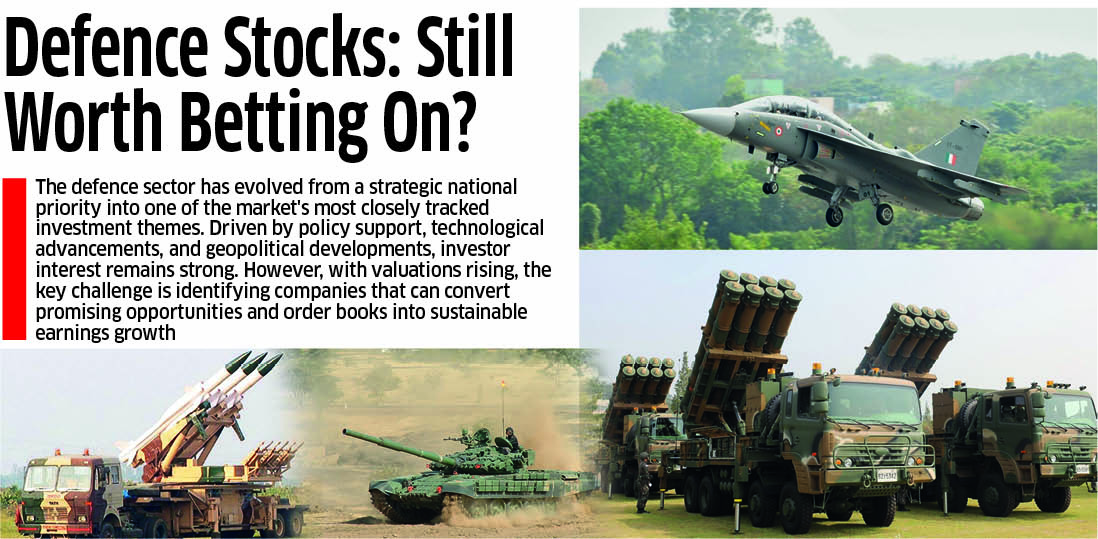
The Defence sector has evolved from a strategic national priority into one of the market's most closely tracked investment themes. Driven by policy support, technological advancements, and geopolitical developments, investor interest remains strong. However, with valuations rising, the key challenge is identifying companies that can convert promising opportunities and Order Books into sustainable earnings growth [EasyDNNnews:PaidContentStart]
For decades, defence spending was viewed primarily through the lens of national security. Governments allocated funds to safeguard borders, modernise armed forces and maintain strategic deterrence. Compared to today, investors paid less attention to the sector, considering it a domain dominated by government-owned enterprises with limited commercial appeal. That perception is changing rapidly, as reflected in the performance of defence companies.
The defence sector has attracted significant investor interest over the past few years, turning several defence stocks into multibaggers within a short period. When the tide turned for domestic markets amid weak investor sentiment over the last year, and the benchmark Nifty 50 experienced heightened volatility, the Nifty India Defence Index remained relatively resilient and outperformed the benchmark in recent months.
The contrast is striking: the Nifty 50 has fallen 11 per cent YTD, whereas the Nifty India Defence Index has rallied 17 per cent over the same period. This outperformance was primarily driven by a sharp rally in April 2026, followed by sustained buying interest and continued momentum in the sector. The obvious question is: What lies behind this resilience? Let's delve deeper into the factors at play.

Why the Focus on Defence?
The world today is witnessing one of its most uncertain geopolitical phases in recent history. The Russia-Ukraine war has fundamentally altered global security calculations. Tensions in West Asia continue to keep energy markets on edge. The recent conflict between the United States and Iran has reinforced concerns over regional stability. In Asia, China continues to expand its military capabilities, while periodic tensions between India and Pakistan remind policymakers that preparedness remains essential. The lessons from these conflicts are clear. Nations can no longer depend excessively on foreign suppliers for critical military equipment.
Supply chains can be disrupted; diplomatic relations can change and access to strategic technologies can become restricted during periods of conflict. As a result, countries across the world are increasing defence budgets and encouraging domestic production. India is no exception. As one of the world's largest military powers, India faces unique security challenges. It shares borders with two nuclear-armed neighbours, maintains extensive maritime interests across the Indian Ocean region and must continuously upgrade its military capabilities to address evolving threats.
India's ambition to transform itself from one of the world's largest defence importers into a significant manufacturing and exporting hub is creating opportunities across manufacturing, electronics, Aerospace, advanced engineering, software and emerging technologies. Against the backdrop of heightened geopolitical uncertainty and the sector's growing investment appeal, a closer look at India's defence ecosystem has become increasingly relevant for investors.
Understanding India's Defence Ecosystem
The defence sector is often viewed as a single industry, but it comprises several specialised segments that serve different military requirements. Land systems form a critical component of the ecosystem. This segment includes tanks, artillery systems, armoured vehicles, ammunition and battlefield equipment used by the Army. Continuous upgrades and modernisation programmes ensure sustained demand for these products. The aerospace segment covers fighter aircraft, helicopters, transport aircraft, engines and unmanned aerial vehicles. The growing importance of drones and surveillance systems has significantly expanded opportunities within this category.
Naval systems represent another strategic area. India's expanding maritime ambitions require warships, submarines, patrol vessels, naval weapons and surveillance systems. Given India's extensive coastline and growing focus on securing trade routes, naval modernisation is expected to remain a priority. Missile and strategic systems constitute one of the most technologically advanced segments. These include offensive and defensive missile platforms, air defence systems and precision guided weapons. Electronics has emerged as a particularly important segment. Modern warfare increasingly depends on radars, sensors, communication systems, electronic warfare equipment and surveillance technologies.
Many of these systems require sophisticated engineering capabilities and offer attractive growth opportunities. Emerging technologies are further reshaping the sector. Artificial intelligence, robotics, autonomous platforms, cybersecurity and space-based defence capabilities are becoming integral components of modern military strategy. The future battlefield is likely to be defined as much by technology as by traditional weapons. To gain a clearer perspective on the sector's overall financial health, let us examine how the leading players across these segments have performed.
Orders Fuel Growth, Profits Face Headwinds
To gain a deeper understanding of the defence sector's performance, we analysed the financial performance of the constituents of the Nifty India Defence Index. Collectively, these companies command a market capitalisation of around `12 lakh crore, making the index a representative barometer of India's defence ecosystem. At an aggregate level, the sector delivered a healthy performance in FY26, with revenue surging by around 13 per cent over FY25. The growth was broad-based, with nearly 85 per cent of the index constituents reporting positive growth in net sales, while several companies posted strong double-digit gains.

The robust performance was largely driven by a healthy order pipeline, faster execution of defence contracts, increasing indigenisation under the government's self-Reliance initiatives, and sustained demand across defence, aerospace, and related segments. Among the constituents, Apollo Micro Systems emerged as the fastest-growing company, registering revenue growth of nearly 60 per cent. The sharp rise was primarily supported by strong execution of its expanding order book, higher supplies to defence and aerospace programmes, and growing demand for its electronic and electro-mechanical systems used in mission-critical applications.
Considering profitability, the sector reported aggregate net profit growth of around 10 per cent in FY26. However, the growth was largely concentrated among a few industry leaders, while the broader profitability trend remained mixed. Several companies, despite delivering healthy revenue growth, reported a decline in net profits. This divergence can be attributed to multiple factors. Defence manufacturing is typically characterised by long project cycles and fixed-price contracts.
These characteristics can expose companies to cost overruns and margin pressures during the execution phase. Many firms also witnessed higher employee expenses, increased spending on research and development, and elevated depreciation and interest costs following capacity expansion initiatives. As a result, while order inflows and revenue recognition remained strong, profit growth was uneven across the sector, highlighting the varying stages of project execution and operational efficiency among defence companies.
The Government's Push Towards Self Reliance
The transformation of India's defence sector would not have been possible without sustained policy support. Reflecting the government's continued focus on national security and military modernisation, the Union Budget for FY27 earmarked `7.85 lakh crore for the Defence Ministry. This is the highest allocation among all ministries and constitutes 14.7 per cent of the Centre's total expenditure. For years, India remained heavily dependent on imports for advanced military equipment.
While imports helped address immediate requirements, they also exposed the country to strategic vulnerabilities. Recognising these risks, policymakers began focusing on self-reliance and indigenous manufacturing. The Atmanirbhar Bharat initiative has become the cornerstone of this strategy. A series of positive indigenisation lists have identified defence equipment that must increasingly be sourced from domestic manufacturers. These lists cover hundreds of items, ranging from simple components to sophisticated weapon systems.
The objective is straightforward: encourage domestic production while reducing import dependence. Defence procurement policies have also been revised to provide greater preference to locally manufactured products. Domestic defence manufacturers stand to benefit from the government's decision to earmark `1.39 lakh crore for indigenous procurement in FY27. Another major initiative has been the development of defence industrial corridors in Uttar Pradesh and Tamil Nadu.
These corridors aim to create integrated manufacturing ecosystems by attracting investments from large corporations, MSMEs and component suppliers. Innovation has received a significant boost as well. Programmes such as Innovations for Defence Excellence (iDEX) are supporting startups working on cutting-edge technologies. Areas such as drones, artificial intelligence, surveillance systems and autonomous platforms are witnessing growing entrepreneurial activity. The combined impact of these initiatives is gradually reshaping the industry's structure and expanding opportunities across the value chain.
What Is Driving the Sector's Growth?
Several structural factors continue to support the growth trajectory of India's defence industry. Heightened geopolitical uncertainty and strategic rivalries across regions have prompted countries to strengthen military preparedness, making higher defence spending a long-term global trend rather than a temporary reaction to isolated conflicts. At the same time, India's push towards self-reliance is creating significant opportunities for domestic manufacturers.
Every successful indigenisation effort enables local companies to replace imports with homegrown alternatives, expanding the addressable market for the industry. The ongoing modernisation of the armed forces is another major catalyst, with sustained demand for advanced aircraft, warships, missiles, surveillance systems and communication equipment required to maintain operational readiness. The growing focus on defence exports is creating new avenues for growth beyond domestic procurement.
Rapid technological advancements in areas such as drones, artificial intelligence, electronic warfare and cybersecurity are creating new growth opportunities across the defence ecosystem. In addition, defence manufacturing generates a strong multiplier effect across the economy, supporting a vast network of suppliers, component manufacturers and service providers. As the ecosystem deepens and broadens, the benefits are increasingly extending beyond a handful of large players, creating opportunities across the entire value chain.
Defence Exports: From Ambition to Reality
Perhaps the most encouraging development in recent years has been the rise of defence exports. India's defence exports reached a record `38,424 crore in FY26, marking an impressive 63 per cent growth compared to the preceding fiscal year and underscoring the country's growing presence in the global defence market. The export basket now includes patrol vessels, radars, electronic systems, aerospace components, ammunition, and a range of defence equipment supplied to countries across Asia, Africa, Europe, and Latin America. The growth of exports is important for several reasons.
First, it reduces dependence on domestic procurement cycles. Companies gain access to diversified revenue streams and larger addressable markets. Second, exports validate product quality and technological capabilities. International customers typically evaluate performance standards rigorously before placing orders. Third, export growth supports economies of scale. Higher production volumes improve operational efficiencies and strengthen competitiveness. The government's long-term objective is to position India as a significant participant in the global defence supply chain. While substantial work remains, the progress achieved so far suggests that the ambition is realistic.
Risks That Investors Should Consider
While the long-term story remains attractive, investors should not ignore the challenges. One key risk is dependence on government spending. Defence companies derive a significant portion of their revenues from government contracts. Any slowdown in procurement or budget reallocations can impact growth. Execution delays are another concern. Defence projects are often complex and subject to regulatory approvals, testing requirements and delivery schedules. Delays can affect revenue recognition and profitability.
Technology risk is also increasing. Rapid innovation means that products can become obsolete faster than before. Companies must continuously invest in research and development to remain competitive. Competition is expected to intensify as more private players enter the sector. While this will strengthen the ecosystem, it could also put pressure on margins in certain segments.
Premium Valuations: Reward or Risk?
The recent rally has been broad-based, with nearly two-thirds of the Nifty India Defence Index constituents generating higher YTD returns than their one-year returns. Yet, focusing solely on returns may not be enough. Understanding valuations is equally crucial to gauge whether current prices adequately reflect the sector's growth prospects and risks. From a valuation perspective, caution is warranted. Nearly one-third of the index constituents trade at triple-digit price-to-earnings (P/E) multiples, while several others command valuations that are not far behind.
Such lofty valuations suggest that a significant portion of future growth expectations is already priced into these stocks. In the current environment, marked by subdued market sentiment, persistent inflationary pressures, uncertainty over interest-rate trajectories, and the possibility of tighter monetary conditions, overvalued stocks remain vulnerable to sharp corrections. The defence sector's dependence on government spending and policy support further adds an element of risk.
While the long-term outlook for India's defence sector remains promising, investors should avoid treating it as a one-way investment theme. Instead, stock selection should be driven by factors such as order-book strength, execution capabilities, earnings visibility, balance-sheet quality, cash-flow generation, and valuation comfort. A disciplined, company-specific approach is likely to be more rewarding than making a broad-based bet on the sector solely on the back of its strong narrative and recent stock price performance.
The Road Ahead
The future of India's defence sector will be shaped by far more than rising military expenditure. The industry is gradually evolving into a strategic pillar of the country's manufacturing and technology ambitions. What was once largely dependent on government-owned enterprises is increasingly becoming a broader ecosystem comprising private companies, startups, component suppliers, research institutions and technology innovators.
The nature of warfare itself is changing rapidly. Recent conflicts across the globe have highlighted the growing importance of drones, surveillance systems, precision-guided weapons, electronic warfare capabilities and real-time intelligence networks. Military strength is no longer measured solely by the size of armies or the number of platforms deployed. Technological superiority, speed of execution and indigenous capabilities are becoming equally critical. This shift creates opportunities for companies operating at the intersection of defence and technology. As supply chains deepen and localisation levels improve, the benefits are likely to percolate across a wide network of industries, including electronics, aerospace, engineering and software. That said, investors should approach the sector with balanced expectations.
Defence remains a long-gestation business where project delays, regulatory hurdles and valuation excesses can create periods of volatility. Stock performance may not always move in line with the long-term industry opportunity. Nevertheless, the broader direction appears clear. As geopolitical uncertainties persist and nations prioritise strategic self-reliance, India's defence industry is steadily positioning itself as a critical contributor to both national security and economic growth.
For long-term investors, the sector represents not merely a play on defence spending but a participation in India's ambition to build globally competitive industrial and technological capabilities. The key for investors is to remain selective, focusing on companies with strong fundamentals and reasonable valuations rather than chasing the sector indiscriminately. Stay tuned for more insightful analysis and updates to help identify emerging opportunities across sectors and make informed investment decisions.
[EasyDNNnews:PaidContentEnd] [EasyDNNnews:UnPaidContentStart]
To read the entire article, you must be a DSIJ magazine subscriber.
[EasyDNNnews:UnPaidContentEnd]