Eternal: Race to Dominance Is Testing Investor Patience
Ratin DSIJ / 05 Feb 2026 / Categories: Analysis, Analysis, DSIJ_Magazine_Web, DSIJMagazine_App, Regular Columns
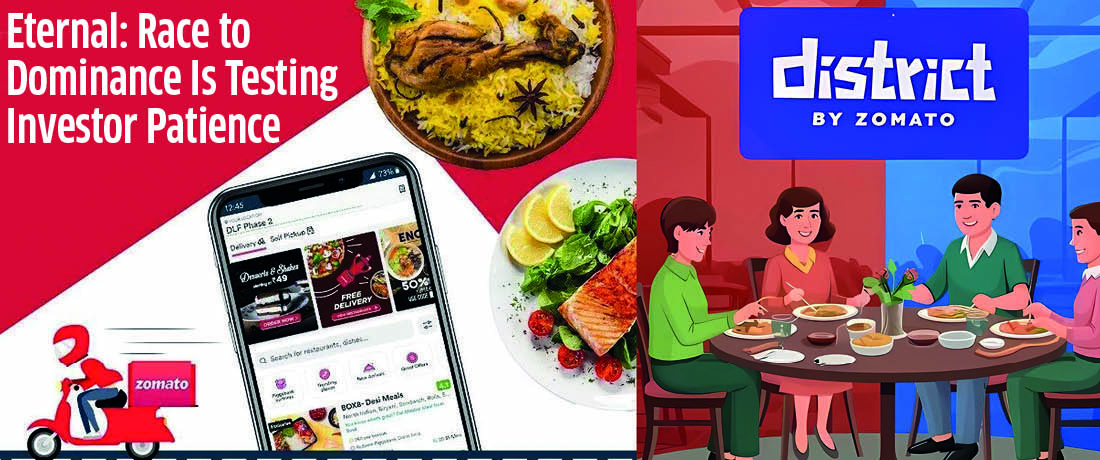
Eternal is being judged less on growth and more on discipline.
Eternal is being judged less on growth and more on discipline. One quarter can show better unit economics, yet the market wants repeatability as competition heats up. With Blinkit improving and food delivery steady, the spotlight shifts to District’s burn, the pace of investment, and how quickly the portfolio can convert scale into durable profits [EasyDNNnews:PaidContentStart]
Investment View and What Has Changed
Eternal has not been marked down because demand has disappeared. The stock is lower by roughly a quarter from its October 2025 peak because the market is re-pricing the cost, cadence, and uncertainty of the next leg. The inflection point was Q2 FY26, when profitability softened and Blinkit’s rapid dark store expansion translated into a sizable EBITDA drag, reviving a familiar concern in consumer internet models: growth can be visible and still feel expensive if the timeline to steady profits is not firm.
The subsequent quarters layered in additional pressure. Fresh capital support for Blinkit kept the ‘cash burn versus category creation’ debate alive, a block deal created a near-term supply overhang, and even as Q3 FY26 delivered a genuine milestone with quick commerce reaching adjusted EBITDA breakeven, investor response stayed cautious because competitive intensity rose at the same time. In a category where pricing, delivery fees, and assortment moves can change quickly, the market is asking for repeatability across quarters, not one good print.
The narrative has also absorbed non-operating noise. A leadership handover has changed headlines even if the operating playbook stays intact, and gig-worker welfare related costs have become another variable investors now try to price into long-duration margins. Eternal therefore sits in a phase where it can show better unit economics and still not see a clean re-rating, because the market wants proof that these economics can hold through a tougher competitive cycle.
Business Overview and the ‘Everyday Commerce’ Thesis
Eternal is best understood as a consumer internet portfolio built on a Logistics backbone. It sits at the centre of recurring, high-frequency decisions: ordering food, buying groceries in a hurry, and planning going-out experiences. That breadth explains both the ambition and the volatility in perception. This is not a single-engine company where every segment moves in the same direction at the same time. One segment generates cash today, another is scaling into profitability, and a third is being stitched into a new habit loop with front-loaded investment.
A useful anchor in this model is Net Order Value, or NOV, which is the value of orders after discounts. It is closer to the ‘real bill paid’ than the pre-offer menu price. NOV matters because it gives a cleaner read on demand quality, separates genuine usage from subsidy-led expansion, and improves comparability across segments that monetise differently.

Segment Mix and Revenue Drivers
Food delivery remains a mature engine for the company. Monetisation is driven by restaurant commissions, customer platform fees, delivery-related fees in certain cases, and advertising and sponsored listings. Advertising is a high-quality profit lever because it scales with demand without scaling delivery cost in the same proportion. In the FY25 mix used here, food delivery contributed about ₹9,418 crore, or roughly 44 per cent of total adjusted revenue.
Quick commerce, led by Blinkit, is the scale engine. Earnings come through gross margin on goods sold, seller and brand fees, in-app advertising, and selective delivery or convenience fees depending on competitive posture. In FY25, quick commerce contributed about ₹5,206 crore, or roughly 24 per cent of total adjusted revenue, which shows how quickly it has shifted from ‘optional’ to ‘core’.
Going-out, aggregated under District, is the habit formation engine. Revenue is earned through convenience or platform fees on tickets and bookings, commissions from venues and organisers, and advertising and promotions within the ecosystem, with membership monetisation being built over time. In FY25, going-out contributed about ₹737 crore, or roughly 3 per cent of total adjusted revenue. The share is small, but the strategic importance is large because this is where losses are widening.
Hyperpure is the supply-chain spine. It earns by selling ingredients and supplies to restaurants and other businesses, capturing margins through sourcing, warehousing, and distribution. In FY25, Hyperpure contributed about ₹6,196 crore, or roughly 29 per cent of total adjusted revenue, making it a large revenue line that investors still treat as optionality because profitability remains sensitive to scale and mix.
Other pilots, including Bistro, remain immaterial in financial terms, with FY25 ‘Other’ revenue of about ₹24 crore, but they matter as signals of how aggressively management is willing to experiment at the edge of the ecosystem.
Operating Reality: Three Gears Running at Once
The right way to read Eternal today is through its operating gears. Food delivery is in a harvest phase, where the strategic emphasis is on protecting margins and lifting monetisation rather than chasing reckless volume. Blinkit is in a late build and early harvest phase. Scale is now large enough for unit economics to show up, but expansion, cluster build-out, and competitive moves keep quarterly outcomes sensitive. District is in an early build phase, where spending is front loaded to acquire supply, push frequency, and seed membership-led engagement.
This mix explains why consolidated profitability can improve while investor comfort stays mixed. The market is not penalising investment itself. It is penalising the uncertainty around how long investment lasts and whether it tapers predictably. In simple terms, milestones in Blinkit do not automatically translate into a re-rating if District absorbs incremental profits in the same period.
Blinkit Unit Economics: Why the Improvement Quality Matters
The unit economics bridge captures the key point. The ‘cost below gross profit’ per order has stayed broadly in the ₹100 to ₹115 band and has not fallen meaningfully. Profitability is improving not because the cost stack has collapsed, but because the earnings above that stack have expanded. Contribution per order rose from about ₹21 in Q3 FY25 to about ₹30 in Q3 FY26, pulling adjusted EBITDA per order from negative territory toward breakeven in Q3 FY26.

This distinction matters because contribution-led improvement is typically driven by density, throughput, productivity, and monetisation rather than one-off austerity. When profitability improves mainly because contribution expands while the cost stack stays sticky, the model is strengthened structurally, provided competitive pressure does not reverse the monetisation gains.
The important structural shift underway is the transition to an inventory-led model. Nearly 90 per cent of the business has moved to the inventory model (with the remaining ~10 per cent still marketplace-led), and management commentary links this shift to a step-up in reported/adjusted revenue and a planned margin accretion over time. The mechanics are simple: as an inventory-led operator, Blinkit recognises more of the basket value in revenue (rather than only the take-rate), but it also carries a higher cost line because the goods sold now sit on the P&L. That can make revenue growth look optically stronger, which is why NOV, contribution margin, and EBITDA as a per cent of NOV remain the cleaner health metrics. The payoff is margin control.
Management has guided to 5–6 per cent EBITDA margin (as per cent of NOV) over time, and explicitly expects ~100 bps of margin accretion from the inventory shift, with ~half of that already achieved and the balance expected over the next 6–9 months. The trade-off is capital intensity: inventory-led models tie up more working capital in stock and demand tighter supply-chain execution to avoid shrink and obsolescence. Management’s stated intent is to keep net working capital below 18 days and target ~40 per cent ROCE outcomes even as capex per store rises due to larger dark stores, higher automation, and incremental supply-chain infrastructure.
Segment Profit Bridge and Why District Dominates the Debate
The segment bridge describes the consolidated tension. Food delivery adjusted EBITDA rises steadily from ₹423 crore in Q3 FY25 to ₹531 crore in Q3 FY26, operating as the cash engine. Blinkit improves from losses to a small positive outcome in Q3 FY26, and Hyperpure turns marginally positive. The swing item is District, where losses widened materially to ₹121 crore in Q3 FY26, pulling the narrative away from pure operating progress and back into investment discipline and capital allocation.

That is why the stock can look unsettled even in quarters when consolidated adjusted EBITDA improves. Investors are underwriting two things simultaneously: the durability of Blinkit’s breakeven and the trajectory of District’s investment curve. If District absorbs incremental profits at the same pace that Blinkit creates them, earnings quality remains volatile even though the underlying engines are improving.
District: Acquisition Cheque, Operating Burn, and the Payoff Window
District is the counterweight because it is still being assembled into an ecosystem at a time when the market is demanding predictability. The build has already had a meaningful cheque attached. In FY25, Eternal paid about ₹2,014 crore to assemble the District stack through two acquisitions, Orbgen Technologies at ₹1,236 crore and Wasteland Entertainment at ₹778 crore. Beyond the acquisition outlay, the ongoing burn is visible in operating losses. District’s adjusted EBITDA moved from -₹17 crore in Q3 FY25 to -₹121 crore in Q3 FY26, and across the five reported quarters in the table, the cumulative adjusted EBITDA loss is about ₹302 crore.
The implication is straightforward. District is not a rounding error inside the portfolio even though its revenue share is small. It is an investment sink in the period when Blinkit is trying to prove that scale can coexist with profits. That is why District’s loss curve has become one of the most valuation-relevant datasets in Eternal’s quarterly print.
Liquidity and the Real Question Around ‘Runway’
Liquidity provides a wide cushion while this investment cycle plays out. As of FY25, liquid resources across cash and equivalents, Bank balances, and investments are estimated at roughly ₹18,800 crore, while lease liabilities tied to stores and warehouses were about ₹2,045 crore. District’s current burn rate is not a balance sheet stress event, but it does matter for trajectory. If investment intensity stays elevated for longer than expected, the liquidity pool will shrink through a mix of capex, acquisitions, and operating losses.
The pace at which that pool reduces will depend less on food delivery, which is cash generative, and more on whether Blinkit sustains breakeven economics while scaling and whether District’s losses stabilise as the platform matures.
Growth Triggers and What Would Improve the Narrative
In food delivery, the cleanest upside lever remains advertising monetisation. Sponsored listings and performance ads can compound faster than order growth and lift margins without adding delivery costs in the same proportion. The second lever is ordering frequency: better reliability, faster delivery times, and deeper restaurant depth can push repeat behaviour without requiring proportionate marketing spend. The third lever is pricing discipline. Small moves in platform fees, delivery charges, and membership mix can lift contribution meaningfully because the base is already large and the segment is firmly in a harvest phase.
In Blinkit, the next phase is less about proving demand and more about proving that scale can be monetised without the category turning structurally uneconomic. Store maturity and density remain the most credible path to steady profitability. As newer stores age, throughput rises, fixed costs get absorbed, and productivity improves. Mix and execution also matter: expansion into higher-margin categories and tighter shrink control can lift gross margin while keeping the convenience promise intact.
In District, the catalyst is habit formation through product consolidation. If District becomes the default ‘go-out’ layer for tickets plus dining offers, frequency rises and customer acquisition costs improve through organic repeat. Membership scaling is central here, because District Pass is meant to convert occasional behaviour into repeat behaviour; the near-term cost is visible in the burn, but the medium-term payoff is better take-rates and lower acquisition intensity once cohorts mature. Supply expansion is the companion lever, as more venues, events, and experiences improve selection, conversion, and retention.
In Hyperpure, margin improvement is primarily scale-led: higher volumes can improve sourcing terms and warehouse utilisation. The ecosystem linkage matters too, because stronger supply reliability tends to improve restaurant quality and can strengthen freshness and fulfilment in quick commerce.
At the company level, what changes the narrative is a cleaner profit mix and a visible taper in District’s loss curve. Blinkit is already at breakeven in Q3 FY26, but management itself cautions that quarterly profitability is not guaranteed in a competitive environment where tactical pricing actions may be required. The re-rating, therefore, depends on Blinkit holding its unit economics through that volatility while District’s burn stops expanding at the same pace.
The key risks remain concentrated in three places. First, quick commerce competition can turn irrational, with players moving to zero minimum order values and zero delivery fees, which stresses unit economics even when demand looks strong. Second, execution risk rises as store additions continue and capex per store increases; if throughput ramps slower than planned, payback cycles lengthen and working-capital discipline gets tested. Third, policy and cost uncertainty around labour and social security compliance can pressure margins and sentiment at the wrong time, even if the long-term guidance remains intact.
Q3 FY26 Financials
Eternal has delivered a standout performance in Q3 FY26, reporting a remarkable consolidated revenue of ₹16,315 crore, reflecting a year-on-year surge of over 200 per cent. The highlight was the extraordinary growth of its quick-commerce arm, Blinkit, whose NOV soared to ₹13,300 crore, marking a 121 per cent increase from the previous year. This rapid scaling culminated in Blinkit achieving a critical milestone: a positive adjusted EBITDA of ₹4 crore, a significant turnaround from the substantial loss of ₹156 crore in the preceding quarter.
This performance underscores a powerful dual-engine growth model. While Blinkit emerges as the new powerhouse, the core food delivery business continues its steady recovery, with NOV growing to ₹9,850 crore. Strategic initiatives like lowering free delivery thresholds have successfully driven user frequency and order volume.
With a raised store expansion target and a clear path to profitability, Eternal’s Q3 results signal a compelling inflection point. The company is transitioning from a phase of aggressive growth investment to one of scalable, profitable expansion, solidifying its position as a dominant integrated player in India’s food and quick-commerce landscape.

With leadership transitioning to Albinder Dhindsa as Group CEO and Deepinder Goyal moving to Vice Chairman, Eternal signals strategic continuity with sharper execution focus.
Valuation Framework
Eternal is valued as a platform portfolio, not a single-line business. Food delivery is the cash engine, Blinkit and District are the scaling bets with different payoff windows, and Hyperpure is the supply spine. In this setup, P/E is not the right anchor because earnings are still being reshaped by where each segment sits in its cycle. The market is paying for profit durability and capital discipline across the stack, not for one quarter’s number.
A HOLD stance fits because execution is improving, but valuation upside now hinges largely on District. Food delivery remains stable and cash generative, and Blinkit’s shift toward breakeven looks higher quality because it is driven by stronger contribution rather than a collapse in costs. These two engines limit downside and keep the investment runway intact.
Near-term returns stay capped as long as District continues to absorb incremental profits and keep consolidated earnings quality volatile. The re-rating begins when District’s burn stops widening and starts tapering with volumes, while Blinkit holds near breakeven and food delivery maintains margin discipline. The market does not need District to be profitable immediately; it needs clear evidence that incremental scale is being bought at a declining marginal cost.
[EasyDNNnews:PaidContentEnd] [EasyDNNnews:UnPaidContentStart]
To read the entire article, you must be a DSIJ magazine subscriber.
[EasyDNNnews:UnPaidContentEnd]