GIFT City Funds: India’s Gateway to Global Investing
Arvind DSIJ / 02 Apr 2026 / Categories: DSIJ_Magazine_Web, DSIJMagazine_App, MF - Special Report, Mutual Fund, Special Report
For years, global investing felt like a privilege reserved for a select few, held back by access barriers and complexities. That narrative now seems to be shifting. A new financial hub is quietly changing the rules, creating a smoother path to international opportunities. But how exactly is it making global investing more accessible? Let’s take a look! [EasyDNNnews:PaidContentStart]
A Structural Shift in the Making
Indian investors are at an interesting crossroads. Over the past decade, domestic participation in capital markets has expanded meaningfully, driven by rising financial awareness, digitisation, and a steady shift from physical to financial assets. Today, the Mutual Fund industry manages over `80 lakh crore and receives more than `30,000 crore every month through systematic investment plans (SIPs) alone. Amid the emergence of new investment avenues, retail investors are increasingly taking an active role in asset allocation decisions, reflecting a notable shift towards more informed and strategic portfolio management.
Despite the increasing sophistication of investors, global diversification still accounts for a relatively modest portion of Indian portfolios, not for lack of intent but due to persistent challenges around access and execution. It is in this context that the emergence of GIFT City assumes considerable significance. Let us understand what GIFT City is, how GIFT City funds operate, their key benefits and risks, and why they matter for investors.
GIFT City: India’s International Financial Gateway
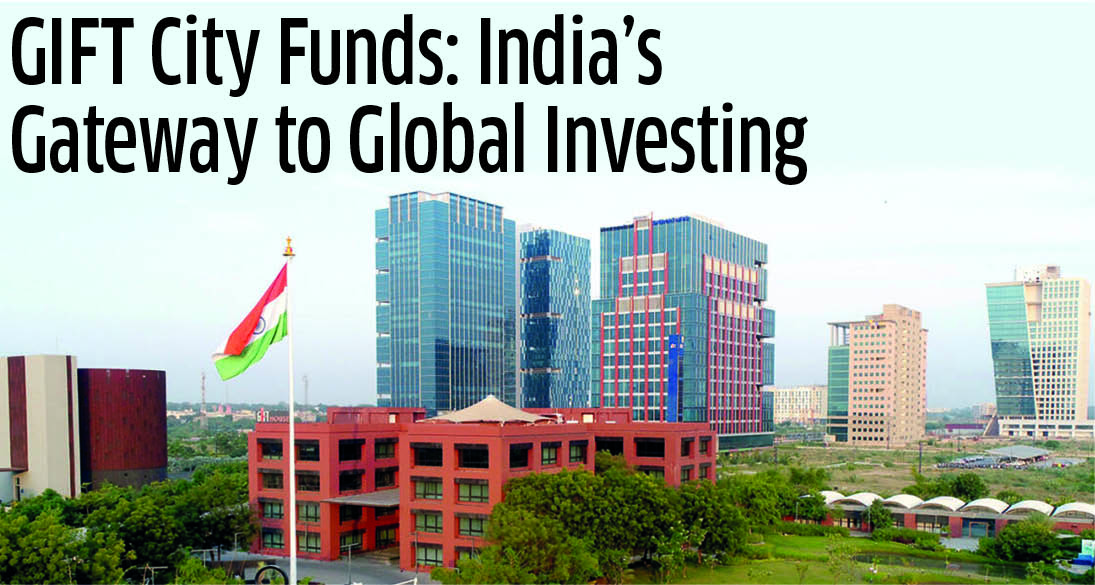
The Gujarat International Finance Tec-City, or GIFT City, represents India’s ambition to create a globally competitive f inancial hub within its own borders. Structured as an International Financial Services Centre (IFSC), it operates under a distinct regulatory and Tax framework, designed to facilitate cross-border financial activity. Unlike domestic f inancial centres, GIFT City is governed by the International Financial Services Centres Authority (IFSCA), a unified regulator tasked with overseeing Banking, capital markets, insurance, and fund management activities within the IFSC.
The objective is to create an ecosystem that combines regulatory clarity with operational flexibility, enabling India to compete with established global jurisdictions. Over the past few years, this ecosystem has begun to take shape. Leading banks, exchanges, insurers, and asset managers have established a presence. Trading activity in equities and derivatives has picked up. More importantly, the fund management space within GIFT City has witnessed steady traction. For investors, this is where the opportunity becomes tangible.
Understanding GIFT City Funds
GIFT City funds are investment vehicles domiciled within the IFSC, structured to channel capital into global opportunities. T hese funds are typically set up as Alternative Investment Funds (AIFs), portfolio management services, or feeder funds that invest in offshore strategies. From a structural perspective, they are designed to align with global best practices. They operate in foreign currency, follow internationally accepted compliance standards, and provide access to a wide range of asset classes.
What distinguishes them from traditional overseas investing routes is the combination of global exposure and domestic accessibility. Investors are able to participate in international markets through a regulated Indian platform, without having to directly engage with foreign jurisdictions. These funds can deploy capital across multiple geographies and asset classes, offering a far broader investment universe than what is typically accessible within domestic markets.
GIFT City Funds vs. Traditional Overseas Investment Routes
To better understand the relevance of GIFT City funds, it is important to compare them with conventional avenues available for overseas investing. The most widely used route for Indian investors has been the Liberalised Remittance Scheme (LRS), which permits individuals to remit funds abroad within prescribed limits and invest directly in foreign equities, mutual funds, or other instruments.
While LRS offers flexibility and complete control over investment choices, it also demands a higher level of involvement from the investor. Stock selection, portfolio monitoring, currency conversion, and compliance with regulatory reporting all rest with the individual. Additionally, taxation complexities and documentation requirements can make the process cumbersome, particularly for those without advisory support.
GIFT City funds, on the other hand, offer a more streamlined and managed approach. Investors gain access to global markets through professionally managed vehicles, where experienced fund managers handle asset allocation, research, and execution. T his significantly reduces the operational burden and lowers the entry barrier for investors seeking international diversification.
However, this convenience comes at a cost. Investors need to account for management fees and, in some cases, performance linked charges associated with these funds. Therefore, while GIFT City structures enhance accessibility and efficiency, evaluating the cost-benefit trade-off remains essential before making an allocation decision.
Expanding the Investment Universe
One of the most compelling aspects of GIFT City funds is the expansion of the investment universe they offer. Indian equity markets, while diverse, are still concentrated in certain sectors. Financial services, information technology, energy, and consumer-driven businesses dominate market capitalisation.
While these sectors have delivered strong growth, they do not fully capture global economic trends. For instance, sectors such as global technology platforms, Semiconductor manufacturing, advanced healthcare innovation, and specialised industrials are either underrepresented or absent in Indian markets. Accessing these themes requires exposure to international equities.
Similarly, global fixed income markets offer opportunities that differ significantly from domestic debt instruments. Sovereign bonds, investment-grade corporate credit, and high-yield debt across developed and emerging markets provide diversification in terms of interest rate cycles and credit risk. Alternative assets further broaden the landscape. Private equity and venture capital investments allow participation in early-stage innovation, while hedge fund strategies offer differentiated risk-return profiles. GIFT City funds serve as a conduit to these opportunities, enabling investors to construct more balanced and diversified portfolios.
Evolving Products, Rising Participation
The product landscape within GIFT City is evolving rapidly, backed by strong growth in both scale and participation. Fund management activity at GIFT-IFSC gained significant momentum in the third quarter of FY26, with cumulative commitments for non-retail schemes rising sharply to USD 32.13 billion from USD 26.30 billion in the previous quarter. Investor participation also witnessed a robust uptick, with the overall investor base expanding by 42 per cent during the period, supported by increasing traction in newly approved retail-oriented schemes.
According to data released by the IFSCA, total funds raised through the IFSC ecosystem climbed to USD 17.34 billion, up from USD 12.27 billion on a sequential basis, reflecting accelerating capital inflows into the platform. This growth is being complemented by product innovation. Asset management companies have started launching global equity strategies, feeder funds, and more recently, retail- focused offshore funds, allowing investors to access international markets with relatively lower entry thresholds. Retail participation, though still nascent, is gaining traction, with investor numbers rising significantly in recent quarters.
Looking ahead, the opportunity set is expected to broaden further. Multi-asset strategies, global fixed income funds, and alternative investment vehicles such as hedge funds and private market strategies are likely to see increased activity. Industry projections suggest that the overall GIFT City funds ecosystem could scale meaningfully over the next few years, driven by regulatory support and rising investor interest. As competition intensifies, differentiation will increasingly hinge on product innovation, cost efficiency, and risk management capabilities. Fund managers who can combine global expertise with consistent execution are likely to emerge as long-term winners in this evolving space.
Regulatory and Tax Efficiency
Another key advantage of GIFT City funds stems from the regulatory and tax framework within the IFSC, which has been purposefully structured to align with global financial centres and attract cross-border capital. From a fund manager’s standpoint, the environment offers meaningful ease. Fund set-up timelines are shorter; regulatory approvals are streamlined under a single authority, and operational flexibility is significantly higher compared to domestic jurisdictions. This reduces friction in launching global strategies and managing offshore capital.

Beyond regulatory ease, the tax architecture is equally compelling. As illustrated in the accompanying table, the framework offers significant tax advantages for both investors and fund managers. However, investors must avoid a one-size f its-all approach. Tax outcomes can vary based on the fund structure, underlying assets, and the investor’s residential status. Careful evaluation, ideally with professional advice, remains essential before allocating capital.
Currency as a Strategic Consideration
Currency plays a pivotal role in global investing, yet it often remains an underappreciated element in portfolio Construction. For Indian investors, this aspect becomes even more relevant considering the long-term trajectory of the Indian rupee. Over the years, the Indian currency has exhibited a gradual but persistent depreciation trend against major global currencies, particularly the U.S. dollar, recently approaching the 94 level. (USD 1 = `94) This movement reflects underlying macroeconomic factors such as inflation differentials, current account dynamics, and global capital flows.

In this context, exposure to foreign currency assets can serve as an effective hedge. When the rupee weakens, the value of global investments, once converted back into rupees, tends to rise, thereby enhancing overall portfolio returns. Over longer time horizons, this currency tailwind can significantly complement underlying asset performance. GIFT City funds, typically denominated in foreign currency, naturally provide this advantage by enabling investors to participate in global markets without direct remittance complexities. However, currency exposure is a double-edged sword.
Periods of rupee stability or appreciation can moderate returns from international investments, even if the underlying assets perform well. Additionally, currency volatility can introduce short-term fluctuations, making it important for investors to align such allocations with a longer investment horizon. A balanced understanding of currency dynamics, therefore, is essential when considering GIFT City funds, as they not only offer global diversification but also embed currency-linked opportunities and risks within the portfolio.
Risks and Considerations
While GIFT City funds offer a compelling route to global diversification, investors must remain mindful of the associated risks. Global market volatility is an inherent factor, with returns influenced by economic cycles, geopolitical developments, and policy shifts across regions. Unlike domestic markets, where investors may have better familiarity, global investing requires navigating diverse and often complex environments. Currency risk also plays a crucial role. While rupee depreciation can enhance returns, any appreciation may moderate gains, making outcomes sensitive to forex movements.
Another important aspect is regulatory evolution. As the GIFT City ecosystem continues to mature, frameworks and guidelines may undergo changes. Although this reflects a developing financial hub, it can introduce a degree of uncertainty. Liquidity considerations are particularly relevant for alternative strategies, where lock-in periods may restrict timely exits. Given these factors, investors should adopt a calibrated approach, aligning allocations with their risk appetite, investment horizon, and overall portfolio strategy.
The Road Ahead and Investor Strategy
GIFT City represents far more than the emergence of a new financial centre. It signals a structural shift in how India is integrating with global capital markets. As domestic savings continue to expand and investor awareness deepens, the demand for international diversification is set to rise meaningfully. In this context, GIFT City offers a well-defined, scalable platform that bridges domestic capital with global opportunities. The growing presence of global financial institutions, coupled with a supportive regulatory framework, is likely to accelerate this evolution.
As product offerings widen and awareness improves, participation is expected to move beyond institutional and high-net-worth segments to a broader investor base. Over time, GIFT City could reshape how Indian investors approach asset allocation, making global exposure a more integral part of portfolio construction rather than a niche allocation. For investors, however, the approach needs to remain measured. GIFT City funds should be viewed as a complement to domestic investments, not a replacement.
Allocating a portion of the portfolio to global assets can enhance diversification and improve risk-adjusted returns, but the extent of exposure must align with individual financial goals, risk appetite, and investment horizon. Due diligence is critical. Evaluating the track record of fund managers, understanding the underlying investment strategy, and assessing cost structures and liquidity terms are essential steps before committing capital. Equally important is clarity on the nature of exposure, whether it is global equities, fixed income, or alternative assets.
A phased allocation strategy can be particularly effective, allowing investors to gradually build exposure while gaining familiarity with global markets and managing risks more efficiently. In conclusion, GIFT City funds mark an important evolution in India’s investment landscape. While the ecosystem is still developing, the trajectory is clear. As accessibility improves and product innovation gathers pace, these structures are likely to play an increasingly significant role in portfolio construction.
For Indian investors, the conversation is no longer about whether to go global, but about choosing the most efficient route. In that journey, GIFT City is poised to become a pivotal gateway.
[EasyDNNnews:PaidContentEnd] [EasyDNNnews:UnPaidContentStart]
To read the entire article, you must be a DSIJ magazine subscriber.
[EasyDNNnews:UnPaidContentEnd]