Infrastructure Sector Is It Reaching For The Skies?
Ninad Ramdasi / 18 Apr 2024 / Categories: DSIJ_Magazine_Web, DSIJMagazine_App, Special Report, Special Report, Stories
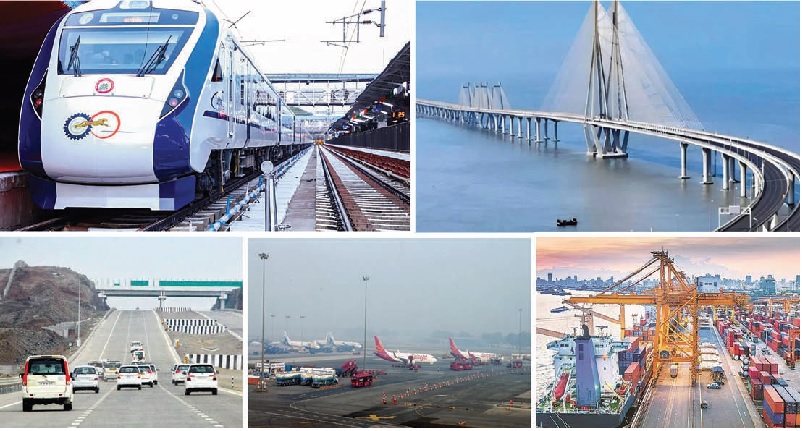
With the Lok Sabha elections drawing near, the market will now be closely monitoring the unfolding developments. The current government is sure of securing a majority, and if this goal isn’t met, experts foresee a potential market correction.
With the upcoming Lok Sabha elections looming, many of us may be feeling the urge to invest in infrastructure stocks, hoping for a favourable impact on investments if a strong political mandate ensues. Mandar Wagh delves into the government’s emphasis on infrastructural development, future growth triggers and the critical factor of fundamentals that must be taken into consideration before investing [EasyDNNnews:PaidContentStart]
With the Lok Sabha elections drawing near, the market will now be closely monitoring the unfolding developments. The current government is sure of securing a majority, and if this goal isn’t met, experts foresee a potential market correction. Conversely, a strong mandate favouring the current government would likely demonstrate market resilience, especially since Prime Minister Narendra Modi has pledged significant reforms within the first 100 days of a new government.
There have been talks suggesting that government-focused sectors like infrastructure, railway, power and renewable energy stand to gain significantly if the current government regains power. Consequently, stocks within these sectors are expected to outperform due to government backing and ongoing investor confidence. Buying activity has already been observed in these stocks, as evidenced by rallies seen over the past month in infrastructure sector stocks.
However, there are concerns about a potential market bubble, particularly in Mid-Cap and Small-Cap segments. Additionally, the aforementioned sectors present a challenge due to inflated valuations resulting from significant share price hikes. The sustainability of the rally prompts a crucial question. Delving into the fundamentals of these companies will provide insights that can help address this question and bolster confidence in their future performance. Further, analysing government initiatives and identifying growth triggers for the future will offer valuable perspectives on the trajectory of these stocks.
About the Sector
India’s path towards achieving a ‘developed nation’ status by 2047 is heavily reliant on enhancing its infrastructure. This is crucial for nurturing liveable, climate-resilient and inclusive cities that serve as catalysts for economic growth. The vitality of the infrastructure sector is widely recognised as a barometer of economic growth, constituting the foundational framework of any thriving economy. In the world of infrastructure, key components encompass roads, highways, railways, electricity grids, telecommunications, water supply systems, dams, airports, warehouses and gas pipelines.
Beyond fulfilling societal needs by ensuring universal access to essential services, infrastructure development fuels substantial job creation and stimulates ancillary sectors such as real estate, telecommunications and energy. Forecasts predict that the Indian infrastructure sector will maintain a robust compound annual growth rate (CAGR) exceeding 8 per cent over the forthcoming half decade. Notably, approximately 70 per cent of India’s anticipated capital expenditure earmarked for infrastructure will be allocated to critical domains including energy, transportation networks, railways and urban infrastructure.

Government Initiatives and Growth Drivers
Recognising the pivotal role of the sector, the government has heightened its focus on infrastructure development, evident in the 2023-24 Union Budget which allocated a 33 per cent increase in capital expenditure for infrastructure, totalling ₹10 lakh crore. The most recent interim budget unveiled an 11.1 per cent surge in capital expenditure, amounting to a total of ₹ 11.11 lakh crore. The National Infrastructure Pipeline (NIP) initiative embodies this commitment, aiming to foster highquality infrastructure nationwide and uplift the standard of living of all citizens. Let’s explore the prospects for each sub-segment moving forward.
Roadways
In the fiscal year 2023-24, the Ministry of Road Transport and Highways completed the construction of 12,349 km of national highways, marking the second-highest achievement in its history. Additionally, according to government sources, the ministry achieved its highest-ever capital expenditure utilisation rate of 99.93 per cent during the same period. The PM Gati Shakti National Master Plan, aimed at achieving multimodal access to economic zones, has garnered significant attention since its announcement. This comprehensive plan integrates various facets, including roads, railways, agriculture, aviation and several ministries. It is projected that over 6,000 kilometres of roads will be commercialised by 2024.
The Bharatmala Pariyojana proposal envisages the construction of approximately 26,000 kilometres of economic corridors. Under the PM Gati Shakti NMP, the completion of 2 lakh kilometres of national roads is anticipated, along with an additional 25,000 kilometres added to the national highways’ network. A network of multi-modal logistics parks and freight cargo terminals is being developed to bolster the country’s storage infrastructure, maximising the potential of planned infrastructure initiatives. The implementation of the FASTag system is fostering increased roadway commercialisation, leading to augmented revenue for the National Highways Authority of India (NHAI).
Railways
In the Union Budget 2023-24, Finance Minister Nirmala Sitharaman revealed the highest-ever capital outlay for railways, amounting to ₹2.4 lakh crore. This allocation marks a significant increase, being nine times the amount allocated in FY14. In the recent interim budget for the fiscal year 2024-25, ₹2.55 lakh crore has been earmarked for the Indian Railways. The government has unveiled plans for three new corridors within the railways. The designated corridors will include the energy, mineral and cement corridor, the port connectivity corridor, and a high traffic density corridor.
These initiatives aim to reduce costs and enhance efficiency within the railway network. Additionally, the government has announced the conversion of 40,000 bogies to the Vande Bharat standard, prioritising safety and convenience for passengers. The railways will emphasise accelerating the pace of construction, focusing on a range of projects such as establishing new lines and doubling the existing tracks. The overall objective is to not only facilitate the quick movement of goods across the country but also make rail travel a pleasant experience for the commuters.
Airways
The government maintains its emphasis on expanding air connectivity and enhancing airport infrastructure across India. The number of airports has been doubled, now totalling 149. Indian carriers have pledged to acquire 1,000 new aircraft, instilling confidence in the aviation sector. The government aims to further expand, envisioning a future with 200 airports and 2,000 aircrafts in India. The UDAN (Ude Desh ka Aam Nagrik) scheme has played a significant role in extending connectivity to Tier II and III cities, facilitating widespread access to air travel. The UDAN programme was launched by the government to reduce the expense of air travel for the general public and enhance air connectivity from the country’s non-served airports.
More than 70 non-served airports, including nine helIPOrts and two water aerodromes, have been made operational through the UDAN programme. Also, the revival and development of 100 non-served and under-served airports, helipads and water aerodromes has received government approval under the Revival of Non-Served and Under-Served Airports Scheme. Consequently, the appreciation in land prices could lead to an increase in the value of nearby real estate. The expansion of the airways network will also help in the quick movement of cargo from one city to another, thereby contributing to economic growth in the long run while serving the needs of those who need to cover long distances within short timeframes.
Power and Energy
For any developing nation, adequate power generation, transmission and distribution infrastructure are essential. India, given its vast size and population, requires significant infrastructure development in these areas. Despite having sufficient electricity generation capacity, a considerable portion of the population still lacks access to reliable transmission and distribution systems. The Pradhan Mantri Sahaj Bijli Har Ghar Yojana aims to achieve universal household electrification by providing last-mile connectivity and electricity connections to all unconnected households in rural and urban areas.
The focus on rooftop solar panels aims to offer free electricity of up to 300 units monthly for one crore households, heralding a substantial boost for the solar and renewable energy sectors. With the aim of bolstering the renewable energy sector and mitigating carbon emissions, the government, in the interim budget 2024, has put forth a combined funding proposal of over ₹ 11,500 crore for solar power (grid), the National Green Hydrogen Mission and wind power (grid) projects for the financial year ending March 2025.
The government is implementing various measures to decrease the carbon intensity of the economy and achieve the net-zero goals by 2070. Adani Green Energy Ltd. is undertaking the development of a 30 GW renewable energy plant on barren land in Khavda, Kutch, Gujarat, covering an area of 538 sq. km. Upon completion, it will become the world’s largest power plant, irrespective of the energy source. The company plans to invest approximately ₹ 1.5 lakh crore in this project. Such power projects are also in tune with the global move towards achieving an environment-friendly status that will gradually lead to decrease in emissions.
Infrastructure Stocks Soar amidst Buying Spree
In the fiscal year 2023-24, the domestic markets experienced a remarkable performance, with Indian benchmark indices soaring around 30 per cent. Infrastructure stocks emerged as top performers, delivering substantial returns to investors, some even multiplying their investments several times over. When looking at one-year gains, Waaree Renewable Technologies caught the attention of investors with an outstanding rally of more than 900 per cent. This remarkable growth was fuelled by robust buying interest, buoyed by government support and optimistic sentiment surrounding the sector. Likewise, significant multibagger returns were observed in urban infrastructure, power and the railway sector stocks.

Insights on Fundamentals
Assessing the financial performance of leading infrastructure companies, encompassing urban infrastructure, roadways, railways, airways and power companies, in relation with market capitalisation reveals that most companies reported doubledigit year-on-year revenue growth, with an aggregate growth rate hovering around 11 per cent. Regarding operating profit and net profit growth, the aggregate year-on-year growth stood at around 9 per cent and 12 per cent, respectively. However, the growth exhibited a lacklustre trend on a sequential basis.
Approximately 80 per cent of the considered stocks have generated stellar returns of over 100 per cent in the past year. However, they are currently trading at higher valuations compared to the industry average and their listed peers. To gain a comprehensive understanding of both returns and valuations, we have included a table displaying the periodic returns of the stock over one-month, year-to-date (YTD) and one-year periods, along with the stock’s TTM PE ratio. Investors should exercise prudent judgment by considering the financial growth, valuation, risks and returns of the company before making investment decisions.
Conclusion
Investors are undoubtedly attracted to the allure of multibagger returns amidst the rally in infrastructure stocks, prompting a desire to invest. However, it’s crucial to temper this enthusiasm and prioritise assessing fundamentals, valuations and growth triggers before hastily seizing the opportunity. Undoubtedly, India has been experiencing an infrastructural revolution with the government placing significant emphasis on infrastructural development. However, it remains crucial to await the outcomes of the Lok Sabha elections and evaluate political stability for a comprehensive understanding of the sector’s trajectory. Moreover, further announcements by the government hold the potential to shape both the future of the infrastructure sector and your infrastructure investment portfolio.
Click here to download list of Infrastructure sector stocks
[EasyDNNnews:PaidContentEnd] [EasyDNNnews:UnPaidContentStart]
To read the entire article, you must be a DSIJ magazine subscriber.
Current print subscribers click here to login
Subscribe NOW to get DSIJ All Access!
[EasyDNNnews:UnPaidContentEnd]