Investing for Success: A Guide to Life Stage Investment Strategies
Ninad Ramdasi / 04 May 2023 / Categories: DSIJ_Magazine_Web, DSIJMagazine_App, MF - Special Report, Mutual Fund, Special Report
Investing is an essential part of building a secure financial future. One of the most important factors to consider when investing is your life stage. Depending on your age, income and financial goals, the investment strategy that works for you will differ from one stage to another. In this article, Vardan Pandhare explores the various life stages and how to invest during each one
All of us are used to a particular lifestyle. Interestingly, this changes as you go through the various stages of life. For instance, a bachelor may not think twice of spending on dining out frequently in the company of friends or splurging on the purchase of technical gizmos that will entertain. A just married person, on the other hand, will have more immediate concerns such as buying a home on easy monthly instalments. Further on, as a parent, your concerns would revolve around the education of your children and their upbringing. And as you approach retirement, the priority would be to build a corpus of funds huge enough to support you and your family even without a regular income. All this brings the factor of investments into play.[EasyDNNnews:PaidContentStart]
Factors that Influence Investment
Before discussing various life periods, let’s take a closer look at some of the factors that affect how we invest.
∎ Income Source: The source of your money is the first factor. How much do you make? More importantly, what is the source of that revenue? Is it steadfast? Is it erratic? Will it endure? Or do you think you detect some uncertainty? How you arrange your investments may be significantly impacted by all of these variables.
∎ Expenses: The second factor is your expenditure. Your priorities and spending habits change during the course of your life. When it comes to choosing your investing strategy, expenditure may ultimately be a decisive factor.
∎ Responsibilities: The third element is the role you play. For instance, if you are single, you don’t have a lot of obligations. This is not the case, though, as you approach parenthood or retirement when you have more responsibilities.
∎ Age: This is an important variable. It has significant investing implications since your age most of the time determines how much risk you can take.
∎ State of the Economy: The current state of the economy and the market may be the sixth component. Whatever the first four considerations may be, the market and economic climate have a significant impact on your investment selections.
Life Stages and Investments
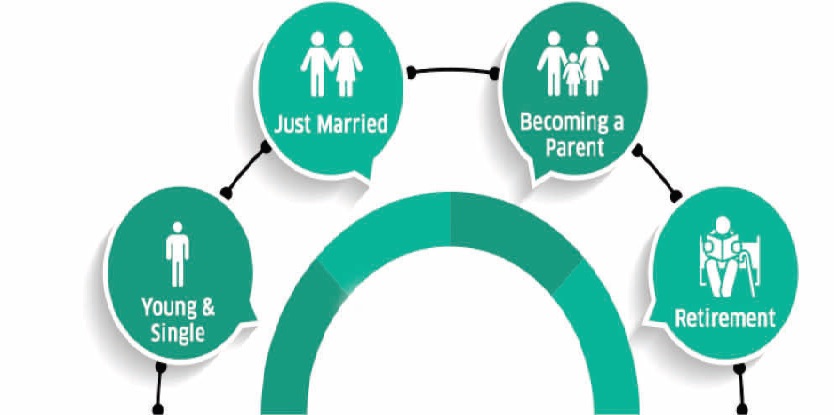
The various stages of life that we go through determine your investment pattern. Some of these are:
Young and Single — You often have a lot of expenditure to support your current way of living. Even though dining out, purchasing the latest gadget and hanging out with friends might be expensive, doing so can keep you motivated and upbeat. At the same time, it is a fantastic moment to begin investing since you have time on your side. Start investing early even if you can only invest a tiny amount. And do it as frequently as you can, perhaps by utilising the SIP route. Typically, during the accumulation stage of an investment, you may take more risks with your capital. You will be able to bounce back from any investment turbulence because time is on your side and you don’t have any dependents. Additionally, you may have certain short-term to medium-term goals which you would like to accomplish during this time, such as buying a car or re-skilling yourself, in which case smart investment may help you do so.
Just Married —This phase, which marks the start of a new, more responsible phase in your life, is a combination of accumulation and transition. You will probably be putting in a lot of effort to advance your job, amass wealth and pursue other goals like purchasing a home. You may need to withdraw money from your investments or savings when more expenditures such as a car or furniture for the house, come up over time. At this point, think about changing your risk profile. While you still need to invest in wealth-generating assets at this point, you might also want to think about some reduced volatility options that might help you pay for your home or any other short-term obligations. Additionally, you will need to think about purchasing life insurance to safeguard your family in the event of an unpleasant incident, particularly if you are the only earner and your spouse depends on you.
Becoming a Parent —This era of life is also one of accumulation and change. Your risk profile will now be determined by other priorities. You could have dependents and additional expenses such as health insurance or you may want to start saving money for your child’s education. Depending on how early you start, investing in a child’s higher education should have a medium-term time horizon of 10 years or longer. Calculate this expense by carefully researching the current costs and including inflation. Since your retirement is still more than 15-20 years away and you still have time and the force of compounding on your side, you should already be making plans for it. Retirement may be funded via exposure to equities, particularly through equity mutual funds.
Time to Reassess — Again, this investing cycle is one of accumulation and transition. Even while your objectives are changing, your career is probably at this moment in full swing. As your kids become older, you will need to consider their further education. You may also need to take into account their wedding plans. This necessitates a change in approach and, once more, a deliberate increase in contribution to your portfolio with a focus on equities but with a well-diversified viewpoint to avoid being overly aggressive or taking on too much risk. At the same time, keep in mind that your retirement is also drawing nearer, necessitating a suitable rebalancing of your portfolio.
Pre-Retirement — This is typically a transitional stage when retirement is just a few years away and the majority of your children’s needs have already been met, assuming that you had made the right investments at the right time. Now, since you are approaching retirement there would be a need to use part of your planned retirement assets. Therefore, preretirement is a time when you are likely to reduce the risks your portfolio may be exposed to. To ensure that you are prepared for the next part of your investing life, make sure to change and rebalance your investment portfolio as needed during this period.
The Prime Years have Arrived —The retirement life stage, often referred to as the distribution phase, is when you start to reap the benefits of all your hard work. It is the stage for which you have painstakingly and carefully prepared, making sure that you have enough money to support your lifestyle and the lifestyle of any dependents. Your accumulated retirement corpus will help to provide the necessary income for you because you could not now have active employment that generates money. It is generally recommended to prioritise lower-risk investment options, such as debt mutual funds, to retain wealth at this stage of life.
Success mantras of life stage investing
∎ Start early — The earlier you start investing, the better it is. This is because the power of compounding works in your favor over a long period of time.
∎ Diversify your portfolio — Diversification is key to managing risk. Invest in a mix of different asset classes such as equities, bonds, and real estate.
∎ Understand your risk appetite — Your risk appetite will determine the kind of investments you should make. If you are a conservative investor, you should focus on low-risk investments such as fixed deposits and bonds. If you are an aggressive investor, you can consider investing in equities and other high-risk assets.
∎ Invest for the long term — Investing for the long term can help you weather short-term market fluctuations and maximize your returns.
∎ Monitor your investments — Keep a close eye on your investments and track their performance regularly. This will help you make informed decisions about when to buy or sell.
∎ Consult with experts — Seek the advice of financial experts and professionals before making any investment decisions. They can provide valuable insights and help you make informed decisions.
A systematic withdrawal plan (SWP) can also be used to ensure regular income. However, due to advancements in medical care and a growing focus on health and fitness, people are living longer lives. As a result, it may be wise to allocate a portion of your portfolio – about 20-25 per cent – towards wealthgenerating asset classes like dependable stocks or welldiversified equity mutual funds. Additionally, cutting back on discretionary expenses can help create a financial buffer for unexpected costs like medical emergencies.
Conclusion
Depending on your financial goals and needs, different investment strategies are necessary for various stages of life. During the early stages of your career it’s crucial to prioritise growth. However, as retirement approaches, it becomes just as important to concentrate on preserving wealth and generating income. Adhering to these principles can help you establish a stable financial future and enjoy a phase of comfortable retirement. It’s important to remember that investing is a long-term endeavour and the key to success is to commence early, invest consistently and remain disciplined in your approach.
[EasyDNNnews:PaidContentEnd] [EasyDNNnews:UnPaidContentStart]
To read the entire article, you must be a DSIJ magazine subscriber.
Current print subscribers click here to login
Subscribe now to get DSIJ All Access
[EasyDNNnews:UnPaidContentEnd]