Jio Financials: Does the Demerger from Reliance Create Value?
Ninad Ramdasi / 27 Jul 2023 / Categories: DSIJ_Magazine_Web, DSIJMagazine_App, Special Report, Special Report, Stories
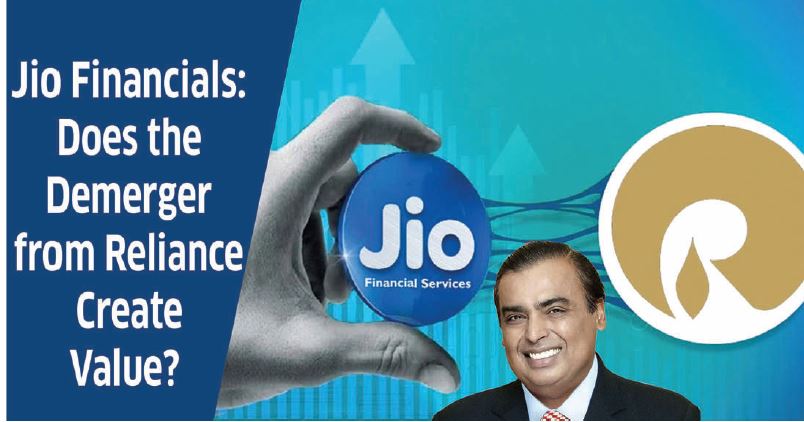
Assessing the demerger of Jio Financials from Reliance, Chetan Shah notes its intricacy, with possible gains and risks in tow. As the value for shareholders remains uncertain, this strategic move is anticipated to exert a substantial influence on the Indian financial services landscape.
Assessing the demerger of Jio Financials from Reliance, Chetan Shah notes its intricacy, with possible gains and risks in tow. As the value for shareholders remains uncertain, this strategic move is anticipated to exert a substantial influence on the Indian financial services landscape.
The demerger of financial services businesses of Reliance Industries is a very interesting development. A lot has been reported about it, however, much of it scratches the surface. Let’s focus on the key issues of this demerger. [EasyDNNnews:PaidContentStart]
Background to Demerger
RIL considers the following five as its main business segments:
• Hydrocarbon exploration and production
• Oil to chemicals
• Retail
• Digital services
• Financial services
There is not much synergy between the old brick-and-mortar businesses of oil, gas and petrochemicals and the new multichannel and consumer-focused businesses, namely retail, digital services and financial services.
The reasons for housing the new unrelated businesses under the RIL umbrella could have been (1) access to public and institutional equity and Debt Funds while in the early incubation stage and (2) access to RIL’s long-established shared resources such as HR, administration, office infrastructure and so on.
Why Demerge Now
Now in terms of the maturity of the new businesses i.e. asset and revenue size (if not strong profits), systems and other institutional aspects such as independent management strength, RIL considers these as ready to float on their own strength. Capital market reception to the financial services business is also key to the decision to demerge.
RIL provides the following rationale for demerger: (a) creation of an independent company focusing exclusively on financial services, (b) the independent company can attract different sets of investors, lenders and strategic partners having a specific interest in the financial services business, (c) the financial services company can have a higher leverage as compared to RIL, and (d) unlocking the value of RIL.
Here are some important things we notice as mergers and acquisitions veteran.
What is Being Demerged?
The three subsidiaries through which RIL carries on financial services business are:
1. Reliance Retail Finance Limited
2. Reliance Strategic Investments Limited
3. Reliance Ventures Limited
Further, there are financial services activities in RIL itself. Its demerger scheme (the scheme of arrangement) describes the business as an investment, non-banking financial services, insurance broking, payments bank, and payment aggregation, directly and through its subsidiaries and joint ventures other than the investments of RIL in Reliance Ventures Limited and Reliance Strategic Business Ventures Limited.
RIL and subsidiaries’ annual report for FY2023 are not yet published, so it is not possible to obtain the final accurate reported data on the asset size, revenue etc. of the three companies forming the financial services business.
The financial services segment information available in the FY2022 annual report of RIL shows the asset size at ₹ 1,08,597 crore.

There is a lack of availability of full financial statements of the financial services business, however, it should certainly have more assets than the last reported ₹ 1,09,000 crore as of March 2022.
Valuation and Market Cap of the New Company
Jio Financial Services Limited (JFSL) will house the demerged financial services business of RIL with a back date of March 31, 2023.
The share price of JFSL was determined in a special trading session in July 2023, where the opening price of RIL (including financial services business, before demerger) was ₹ 2,841.85, while the closing price (excluding financial services business, after an assumed demerger) was ₹ 2,580.
Hence, the difference between the two prices i.e. ₹ 261.85 was assigned as the constant stock price of JFSL until it actually gets listed. Given that JFSL shareholding will reflect RIL shareholding on a 1:1 basis, JFSL will have 635.32 crore shares each valued at ₹ 261.85, leading to its initial market capitalisation of ₹ 1.66 lakh crore.
Is JFSL Valued Fairly in Comparison with Peers?
We have tried making sense of the very limited financial data available on the proposed Jio Financial Services Limited, transferring from the business undertaking and assets of the financial services business of RIL.
A well-drafted demerger scheme document should usually include the parent conglomerate company’s consolidated balance sheet on the date of accounting separation – in this case March 31, 2023. It should then include that balance sheet split into two – the post-demerger conglomerate -in this case RIL, and the new company – in this case JFSL. This proforma balance sheet of JFSL should be the basis for its market valuation.
Neither RIL has published its FY2023 accounts nor it has provided proforma starting accounts of JFSL as of 31 March 2023.
Then how did the traders on BSE and NSE decide on a price to trade in post-demerger RIL? Why did the regulators allow such a situation? It certainly makes me unhappy.
Therefore, the basic company valuation comparison has been done with the 2022 assets and revenue for all peer group companies. Jio Financial appears valued pretty high at 1.5 times assets in comparison with its peers except for Bajaj Finance.
On the revenue multiple front, it is valued at 78.5 times - a number that perhaps should be ignored as being too high. We need to understand why the revenue is so low compared to assets – perhaps much of the asset build-up has not yet started generating revenue for some reason.

It may be fair to conclude that it is too early to pass judgment on JFSL valuation before knowing in depth about its nature of business, customer base, profitability and growth drivers. It may be fair to say that it will benefit immensely from the large and growing consumer base of Reliance Digital and Reliance Retail.
Conclusion
Demerger of sector-specific business from its conglomerate parent company is always a welcome step due to the three benefits mentioned above, namely (1) attracting sector-specific investors and lenders, including an enhanced borrowing power, (2) sharp business focus and quick response to opportunities, and (c) value unlocking for both parent and the new company.
Mukesh Ambani and his team can certainly be expected to make JFSL the country’s largest NBFC.
[EasyDNNnews:PaidContentEnd] [EasyDNNnews:UnPaidContentStart]
To read the entire article, you must be a DSIJ magazine subscriber.
Current print subscribers click here to login
Subscribe now to get DSIJ All Access
[EasyDNNnews:UnPaidContentEnd]