Maximum Pain Theory Explained: How Max Pain Is Calculated
Rithvik DSIJ / 22 Aug 2026 / Categories: Knowledge, Trending
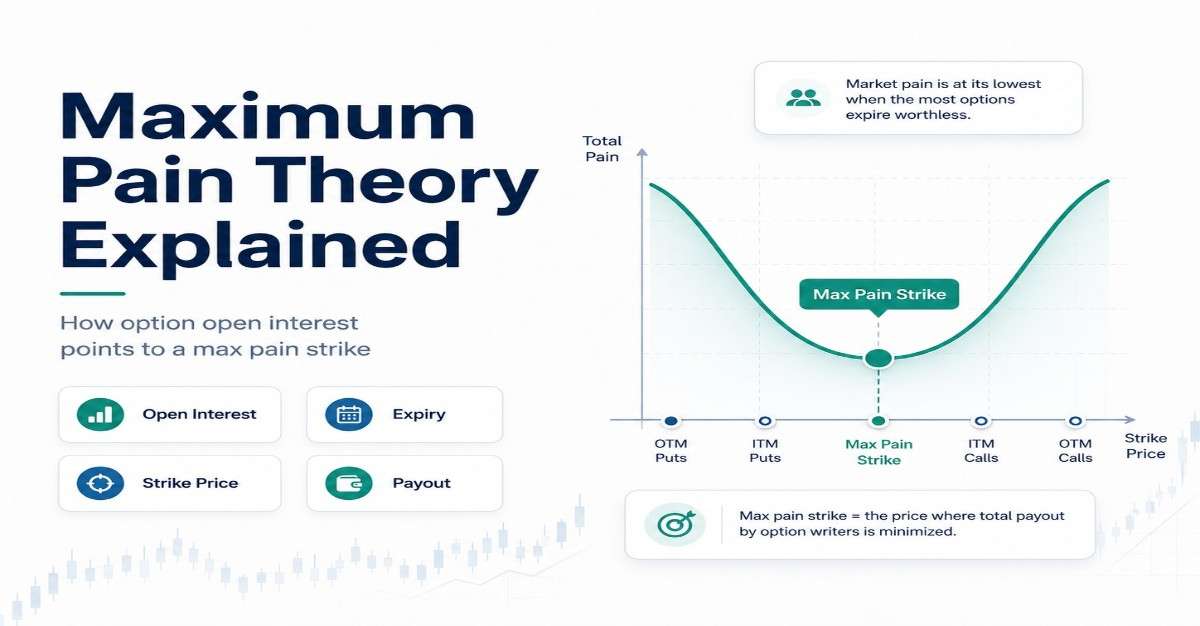
Understand how option open interest is used to estimate the strike with the lowest aggregate expiry payout.
Maximum Pain Theory is an options market concept used to estimate the strike price at which the combined loss of option buyers would be highest at expiry. The corresponding strike is called the maximum pain price or max pain level.
Traders compare max pain with the current index or stock price to understand expiry positioning. However, it is a theoretical calculation based on open interest, not a guaranteed expiry target or an exchange forecast.
What Is Maximum Pain Theory?
Every option has a strike price. A call can gain intrinsic value when the underlying closes above its strike, while a put can gain intrinsic value when the underlying closes below its strike.
Maximum Pain Theory assumes that the underlying may gravitate towards the strike at which the total payout owed to option buyers is lowest. Viewed from the buyers’ side, this is the price where the combined expiry loss is highest.
The idea is sometimes linked to the fact that many options expire without intrinsic value. It also assumes that option writers have an interest in settlements that reduce payouts. This assumption is debated because no participant group controls the market consistently and many writers hedge their risk.
How Is Max Pain Calculated?
The calculation uses call and put open interest at every strike for a selected expiry. NSE’s option chain provides strike wise open interest, volume, prices and implied volatility for calls and puts.
For each possible expiry price, the calculation estimates:
Call payout = Call open interest multiplied by the amount the expiry price exceeds the call strike
Put payout = Put open interest multiplied by the amount the put strike exceeds the expiry price
The payouts are added across all strikes. The assumed expiry price producing the lowest total payout becomes the maximum pain strike.
Lot size should be included when calculating the actual rupee payout, although the same strike may result when all contracts use an identical multiplier.
A Simplified Example
Assume an index has substantial open interest at 19,800, 20,000 and 20,200.
If it expires at 19,800, puts at 20,000 and 20,200 finish in the money. If it expires at 20,200, calls at 19,800 and 20,000 finish in the money.
If the combined payout across all strikes is lowest at 20,000, then 20,000 is the max pain level.
The complete calculation must include every relevant strike. Looking only at the highest call and put open interest can give the wrong answer.
Why Traders Follow Max Pain
Max pain summarises option positioning for a particular expiry. If the underlying trades close to the level near expiry, traders may view it as a possible centre of gravity.
It can also place support and resistance observations in context. If max pain is 20,000, heavy put open interest stands at 19,800 and heavy call open interest stands at 20,200, the market may appear positioned around that range.
Some traders follow changes in max pain. A shift from 20,000 to 20,200 may show that the open interest distribution has moved higher, but it does not prove that the underlying will follow.
Why Prices May Move Towards It
As expiry approaches, time value declines and hedging activity can affect short term price behaviour. Option writers and market makers may adjust futures or cash market hedges as the underlying moves between strikes.
When large open interest is concentrated around nearby strikes, these adjustments may sometimes contribute to price pinning. Profit taking and reduced directional conviction can create a similar effect.
This does not mean writers deliberately force the market to one price. The underlying remains influenced by cash market flows, futures positions, institutional activity, news and broader conditions.
Major Limitations
Open interest does not identify whether a participant is a buyer or writer, whether the position is hedged or when it was created. A large call position may be part of a covered strategy rather than a bearish view.
Max pain also changes as positions are added, closed or rolled. A level calculated in the morning may be outdated by the close.
Unexpected events can overwhelm options positioning. Earnings, central Bank decisions, elections, geopolitical developments or sharp global moves can push prices far from the calculated strike.
The theory may be more relevant close to expiry than several weeks earlier. Even then, it should remain one indicator rather than a trading rule.
Max Pain Versus Highest Open Interest
The strike with the highest open interest is not necessarily the max pain strike. Maximum pain is based on the combined payout across all strikes at each possible settlement price.
Likewise, the midpoint between the largest call and put open interest strikes is not automatically max pain. The full distribution matters.
Key Takeaway
Maximum Pain Theory Explained simply is the idea that an underlying may expire near the strike where aggregate option buyer payouts are lowest. The level is calculated from strike wise call and put open interest for a specific expiry.
Max pain can help investors understand options positioning, but it cannot capture every hedge, event or cash market flow. It works best when combined with price trend, volatility, support and resistance, open interest changes and broader market context.