Mid-Career Money Trap: Are You Prepared?
Arvind DSIJ / 14 May 2026 / Categories: DSIJ_Magazine_Web, DSIJMagazine_App, MF - Special Report, Mutual Fund, Special Report
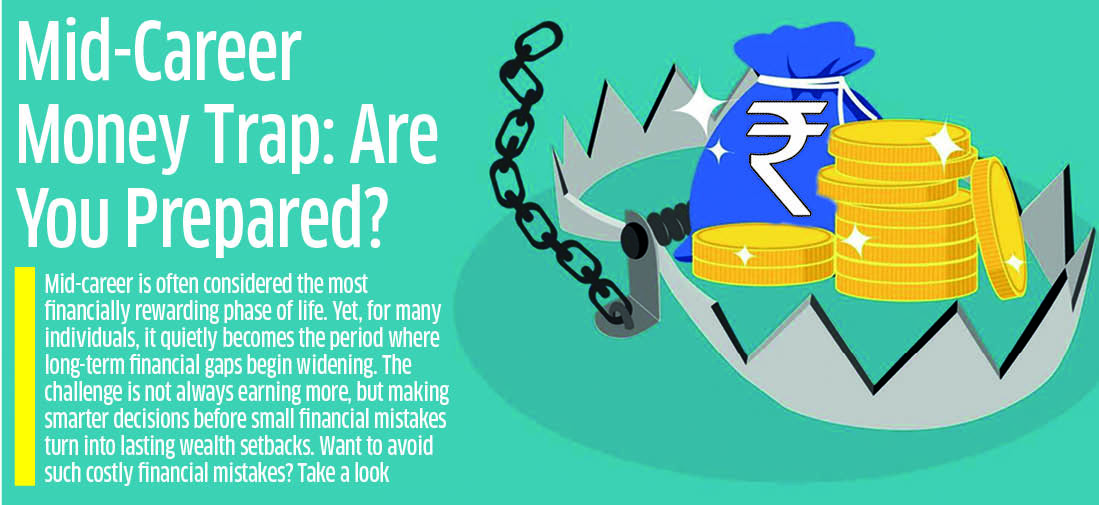
Mid-career is often considered the most financially rewarding phase of life. Yet, for many individuals, it quietly becomes the period where long-term financial gaps begin widening. The challenge is not always earning more, but making smarter decisions before small financial mistakes turn into lasting wealth setbacks. Want to avoid such costly financial mistakes? Take a look [EasyDNNnews:PaidContentStart]
There comes a stage in life when salaries rise, responsibilities multiply, and financial decisions become more complicated than ever before. For most people, this phase begins somewhere in their late 30s and continues through their 40s. Careers are relatively stable, income is stronger than in the early years, and there is growing confidence about the future. Ironically, this is also the phase where some of the biggest financial mistakes are made.
At the beginning of a career, mistakes are easier to recover from because time is on one’s side. Near retirement, people tend to become cautious and financially disciplined. But mid-career years often create a dangerous mix of confidence, pressure, and complacency. Bigger salaries encourage bigger spending. Easy access to loans creates an illusion of affordability. Market rallies fuel overconfidence in investments.
At the same time, responsibilities such as home loans, children’s education, ageing parents, and retirement planning start competing for the same pool of money. The result is that many professionals earning well still feel financially stressed. A senior corporate employee earning `30 lakh annually may still struggle with EMIs, inadequate retirement savings, rising expenses, and insufficient insurance cover. On the other hand, a moderately paid professional with disciplined investing habits may steadily build long-term wealth.
The difference often lies not in income levels, but in financial behaviour. Mid-career is perhaps the most crucial wealth building phase of life. Mistakes made during this period can delay retirement, increase financial vulnerability, and reduce long-term wealth creation. The good news is that most of these mistakes are reversible if identified early.
Here are some of the most common mid-career money mistakes and practical ways to fix them-
Underestimating the Cost of Lifestyle Inflation
One of the biggest traps of mid-career life is lifestyle inflation. As income rises, expenses rise equally or sometimes even faster. The first salary hike may bring a better smartphone. A bigger promotion may justify a luxury car. Another increment may encourage shifting to a larger apartment, premium vacations, club memberships, or expensive gadgets. Gradually, the entire lifestyle adjusts upward. There is nothing wrong with enjoying financial success. The problem begins when rising expenses consume all incremental income.
Consider the case of Rahul, a 40-year-old IT professional. Ten years ago, he was earning `12 lakh annually and managed to save nearly 35 per cent of his income. Today, his salary has risen to `38 lakh, but his savings rate has dropped below 15 per cent. A bigger home loan, two car EMIs, international vacations, private school fees, and luxury spending have left little room for wealth creation.
Despite earning more than ever before, Rahul constantly worries about money. Lifestyle inflation creates a dangerous illusion of prosperity. Income may rise substantially, but actual financial freedom does not improve proportionately.
How to Fix It...
The most effective solution is to increase investments alongside income growth. Every salary increment should automatically raise SIP contributions and retirement savings.
Another useful approach is maintaining a target savings ratio. Mid-career professionals should ideally aim to save and invest at least 25 to 35 per cent of post-Tax income, depending on goals and liabilities. Most importantly, distinguish between lifestyle upgrades and financial necessities. A better quality of life is important, but not at the cost of future financial security.
Over-Leveraging Through Loans
Easy credit availability has transformed borrowing behaviour. Today, home loans, personal loans, credit cards, consumer durable financing, and vehicle loans are widely accessible even to young professionals. Debt itself is not always harmful. A well-planned home loan can be a productive asset. Problems arise when liabilities exceed repayment capacity. Many mid-career professionals gradually accumulate multiple EMIs without evaluating overall financial stress. A person may simultaneously pay for a home loan, luxury car loan, education loan, personal loan, and multiple credit card dues.
As long as salary flows remain stable, the burden appears manageable. However, any disruption such as job loss, medical emergency, or economic slowdown can create serious financial strain. High debt levels also reduce investment flexibility. For instance, Neha and Amit, both working professionals, jointly earn `45 lakh annually. However, over 55 per cent of their monthly income goes toward EMIs. Despite strong salaries, they struggle to build emergency savings or increase long-term investments. This situation is becoming increasingly common among urban professionals.
How to Fix It...
Financial experts generally recommend keeping total EMIs below 35 to 40 per cent of monthly take-home income. Before taking additional loans, individuals should evaluate whether the purchase is genuinely necessary or merely lifestyle-driven. High-interest debt, especially credit card dues and personal loans, should be prioritised for repayment.
These instruments can severely damage long-term wealth creation because interest rates are extremely high. Whenever possible, surplus Bonuses or incentives should partly be used to reduce liabilities instead of funding discretionary consumption. Borrowing should support long-term financial stability, not undermine it.
Inadequate Emergency Funds
Mid-career professionals often assume their stable jobs and growing experience provide sufficient financial security. Unfortunately, economic disruptions can affect even highly skilled employees. Corporate restructuring, business downturns, layoffs, medical emergencies, or family crises can unexpectedly disrupt income flows. The Covid period offered a strong reminder of why emergency funds matter.
The recent wave of layoffs across global IT leaders, driven by automation and rapid adoption of AI technologies, has also reinforced the importance of maintaining strong emergency funds and diversified income sources, even for highly skilled professionals with stable careers. Without emergency savings, individuals may be forced to liquidate long-term investments at the wrong time or rely on expensive borrowing. Yet surprisingly, emergency planning remains inadequate across households.
How to Fix It...
An emergency fund should ideally cover at least four to six months of essential expenses. Professionals working in volatile sectors or variable-income businesses may require even larger buffers. Emergency funds should remain highly liquid and easily accessible. Savings accounts, liquid Mutual Funds, and short-term deposits are commonly used options. Importantly, emergency funds should not be mixed with investment portfolios or long-term savings goals. This money is not designed for returns. Its purpose is financial survival during difficult periods.
Delaying Insurance Planning
Insurance is often treated as an afterthought during mid-career years. Many individuals rely solely on employer-provided coverage without evaluating whether it is sufficient. This can become a major risk. Medical inflation in India continues to rise sharply. A single major hospitalisation can significantly disrupt finances. Similarly, inadequate life insurance can leave families financially vulnerable in the event of an unexpected tragedy.
Another common mistake is confusing investment products with pure insurance protection. Many individuals continue purchasing traditional endowment or money-back policies primarily for tax-saving benefits without fully understanding their limitations. While these products offer a combination of insurance and savings, they generally provide relatively low life cover and modest long-term returns compared to dedicated term insurance and market-linked investment options.
How to Fix It...
Investors should prioritise pure term insurance, as it provides substantial life coverage at a relatively low premium and helps secure the financial future of dependents in case of an unforeseen event. They should also maintain adequate health insurance because rising healthcare inflation can significantly impact savings and investments.
Mid-career individuals should periodically review insurance adequacy rather than assuming existing policies remain sufficient forever. A comprehensive health insurance policy is essential even for individuals covered by employer plans. Corporate coverage may become unavailable after job changes or retirement.
Depending Too Much on One Asset Class
Another common mid-career mistake is excessive dependence on a single asset class. Many investors remain heavily tilted toward Real Estate due to emotional comfort and the belief that property prices will always appreciate. While real estate can play an important role in wealth creation, overexposure may create liquidity constraints and concentration risk.
On the other hand, some investors aggressively increase equity exposure after witnessing strong market rallies, often ignoring debt allocation completely during bullish phases. This can expose portfolios to sharp volatility during market corrections. Meanwhile, highly conservative investors who keep most savings in fixed deposits may struggle to generate inflation beating returns over the long-term. Overdependence on any one asset class increases financial vulnerability.
How to Fix It...
Asset allocation should align with financial goals, risk tolerance, age, and investment horizon. Diversification across equity, debt, gold, and other assets remains one of the most effective tools for managing risk and creating balanced long-term wealth. Equity mutual funds can support long-term growth, while debt instruments provide stability and liquidity. Gold often acts as a hedge during uncertainty and inflationary periods. Periodic portfolio rebalancing is equally important. Diversification may not maximise short-term returns, but it significantly improves long-term financial resilience.
Ignoring Tax Efficiency
Many investors focus primarily on returns while ignoring the impact of taxation on overall wealth creation. However, post-tax returns matter far more than headline returns, especially during the mid-career phase when income levels and investment exposure rise significantly. Frequent portfolio churning, poorly timed redemptions, and excessive short-term trading can create unnecessary tax liabilities that gradually erode long-term gains.
Similarly, several individuals continue investing in traditional tax-saving products merely out of habit without evaluating whether more efficient alternatives are available. Poor tax planning also leads to last-minute investments made solely for deductions rather than financial suitability.
How to Fix It...
Investors should understand the tax implications of equity, debt, fixed income products, and capital gains before making decisions. Tax planning should become an integrated part of investment strategy rather than a year-end activity. Long-term investing generally improves tax efficiency compared to excessive trading. Investors should also utilise tax-advantaged instruments appropriately based on financial goals. They may additionally consider strategies such as tax-loss harvesting, where losses booked in underperforming investments are used to offset capital gains and reduce overall tax liability.
For example, if an investor books a `1 lakh gain in one stock and simultaneously realises a `40,000 loss in another investment, tax may apply only on the net gain of `60,000, subject to prevailing tax rules. Similarly, spreading redemptions across financial years, using long-term capital gains exemptions efficiently, and avoiding unnecessary portfolio churn can further improve post-tax returns over time. Professional tax advice may become valuable during mid-career years when income structures and investment portfolios grow more complex. The objective is not tax avoidance, but efficient tax management within legal frameworks.
Missing Out on Retirement Planning
Many professionals assume retirement planning can wait until their late 40s or early 50s. This is perhaps one of the most expensive financial mistakes. During mid-career years, immediate goals dominate financial attention. Home purchases, children’s education, family responsibilities, and lifestyle aspirations often take priority. Retirement remains a distant concept. But delaying retirement planning sharply increases the future financial burden. For example, a 35-year-old investing `40,000 monthly in equity mutual funds with a long-term annualised return of 12 per cent could accumulate around `7 crore by age 60.
If the same investment starts at age 45, the retirement corpus may shrink to nearly `2 crore despite identical monthly contributions. The power of compounding works best when time is available. Another major issue is underestimating retirement expenses. Inflation steadily erodes purchasing power over decades. A monthly expense of `1 lakh today may require over `3 lakh after 20 years assuming 6 per cent inflation. Healthcare costs further complicate retirement planning. Rising medical inflation can severely impact post-retirement savings.
How to Fix It...
Retirement planning should become a non-negotiable financial priority during mid-career years. Start by estimating future retirement needs realistically. Consider inflation, healthcare costs, increasing longevity, and lifestyle expectations. Retirement calculators can provide useful projections. Equity mutual funds remain one of the most effective long-term retirement tools because of their inflation-beating potential over long periods.
Systematic Investment Plans help create disciplined wealth accumulation. The key is consistency rather than timing the market. Employees should also fully utilise retirement-focused instruments such as Employees’ Provident Fund, National Pension System, and Public Provident Fund as part of a diversified retirement strategy. Most importantly, retirement investments should not be repeatedly interrupted for discretionary expenses.
Neglecting Children’s Education Planning
Education costs are surging significantly across India and globally. In many urban cities today, annual pre-school and nursery fees in premium schools are already approaching or even exceeding `1 lakh, highlighting how rapidly education costs are rising even at the very early stages of a child’s academic journey. Professional courses, international education, and specialised training can require substantial financial resources in future years.
Many parents underestimate this burden during the early stages of their careers. By the time children approach higher education, the required corpus often appears shockingly large. For instance, a professional course costing `10 lakh today may exceed `30 lakh after 20 years assuming 6 to 7 per cent annual inflation. Without advance planning, parents may resort to loans, retirement withdrawals, or distress asset sales.
How to Fix It...
Education planning should begin early and remain goal oriented. Equity mutual funds are commonly preferred for long-term education goals because they provide growth potential over extended horizons. SIPs help gradually build the required corpus. Importantly, parents should avoid sacrificing retirement entirely for children’s education. Education loans can support future earning potential, but retirement lacks similar financing options. Balancing both goals is essential.
Investors can also consider life-cycle or target-date funds while planning for long-term goals such as children’s education or retirement. These funds automatically adjust asset allocation over time by gradually reducing equity exposure and increasing debt allocation as the target year approaches. This helps investors maintain risk discipline without requiring frequent portfolio rebalancing. Such funds can be particularly useful for individuals seeking a relatively simpler and goal-oriented investment approach.
Failing to Review Financial Progress
One of the most ignored financial mistakes during mid-career years is financial inertia. Many individuals continue with the same investments, insurance policies, and savings patterns for years without assessing whether they still match their evolving financial goals. However, life circumstances change significantly over time due to career progression, marriage, parenthood, rising income levels, and changing market conditions.
As responsibilities increase, financial strategies also need timely adjustments. A portfolio that suited an individual in their late 20s may no longer remain appropriate in their 40s. Regular financial reviews and portfolio rebalancing are essential to ensure investments remain aligned with long-term goals, risk appetite, and future financial needs.
How to Fix It...
Financial reviews should become an important annual exercise for every mid-career investor. Individuals must periodically assess investment performance, asset allocation, insurance coverage, loan obligations, retirement readiness, progress toward financial goals, tax efficiency, and the adequacy of emergency savings.
Such reviews help ensure that financial strategies remain aligned with changing responsibilities and long-term objectives. Seeking professional financial advice can also help identify blind spots, improve portfolio discipline, and strengthen overall long-term financial planning. Regular reviews create financial awareness and reduce the probability of costly mistakes.
The Bigger Lesson
Mid-career financial success is not determined solely by salary size or market timing. It depends largely on discipline, planning, and behavioural control. The biggest challenge during this phase is balancing present lifestyle aspirations with future financial security. Excessive focus on either side can create problems. Ignoring current life enjoyment entirely may reduce quality of life, while uncontrolled spending can damage long-term stability. The ideal approach lies somewhere in between.
Financial planning should not feel restrictive or complicated. Instead, it should create flexibility, confidence, and peace of mind. The encouraging reality is that most mid-career money mistakes are correctable. Even delayed retirement planning can improve through higher savings discipline. Debt burdens can be reduced gradually. Portfolios can be diversified. Insurance gaps can be addressed. Emergency reserves can be built over time. What matters most is recognising the problem early and taking corrective action before financial pressure becomes overwhelming.
Mid-career years represent the strongest earning phase for many professionals. The decisions taken during this period often determine whether the later years of life bring financial independence or continued stress. Wealth creation is rarely about one extraordinary decision. More often, it is the outcome of consistent, sensible choices repeated over many years. And for mid-career investors, there may be no better time than now to reassess those choices. Let us know your thoughts and experiences as well, including the financial challenges you overcame and the key lessons you learnt along the way.
[EasyDNNnews:PaidContentEnd] [EasyDNNnews:UnPaidContentStart]
To read the entire article, you must be a DSIJ magazine subscriber.
[EasyDNNnews:UnPaidContentEnd]