Nifty 50 Slides 2.81%, Sensex Drops 2,134 Points Amid Crude Oil Spike Over $116 per barrel
Prajwal / 19 Mar 2026 / Categories: Mkt Commentary, Trending
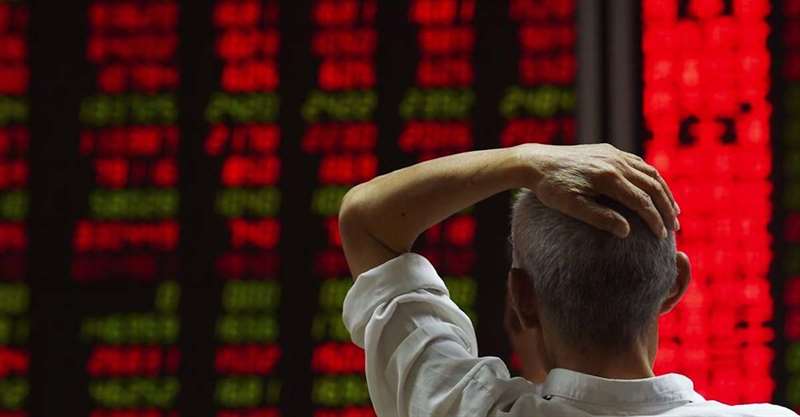
At 14:30 IST, the Nifty 50 was trading at 23,108.65, down 669.15 points or 2.81 per cent. The BSE Sensex was at 74,569.57, down 2,134.56 points or 2.78 per cent at 14:31 IST.
Market Update at 2:38 PM: The Nifty 50 and the Sensex continued their sharp decline on Thursday, as renewed tensions in the U.S.–Iran conflict drove oil prices higher and weighed on global equities.
At 14:30 IST, the Nifty 50 was trading at 23,108.65, down 669.15 points or 2.81 per cent. The BSE Sensex was at 74,569.57, down 2,134.56 points or 2.78 per cent at 14:31 IST.
Shriram Finance, Eternal, and Larsen & Toubro remained the Top Losers in the Nifty 50 index, reflecting broad-based selling pressure.
The Reserve Bank of India reiterated that HDFC Bank has strong financials, a professionally run board, and a competent management team. The regulator recently approved the bank’s request for a transition arrangement and continues to engage with the board.
Earlier, HDFC Bank shares opened 8.7 per cent lower at Rs 770 following the resignation of Chairman Atanu Chakraborty, which raised concerns among investors about management stability.
Volatility spiked, with the Nifty India Volatility Index rising 16.7 per cent to 21.84 shortly after market opening.
Broader markets fell in line with benchmark indices. The Nifty MidCap and Nifty SmallCap indices were down 2.32 per cent and 2.1 per cent, respectively.
Sector-wise, Nifty Realty was the worst performer, down 3.43 per cent, led by Godrej Properties and Lodha Developers. Nifty Oil and Gas and Nifty Media were relatively resilient, recording the least losses.
Brent crude futures surged nearly 8 per cent to USD 116 per barrel in late Asia trading after rising Middle East tensions. U.S. President Donald Trump threatened Iran’s South Pars gas field if Iran attacked Qatar, following Iran’s strike on a key Qatari LNG plant that accounts for one-fifth of global supply.
Market Update at 12:17 PM: India’s benchmark indices continued to trade sharply lower in the afternoon session on March 19, 2026, reflecting weak market sentiment.
The BSE Sensex was at 75,021.09, down 1,683.04 points or 2.19 per cent at 12:22 PM. Meanwhile, the Nifty 50 stood at 23,252.35, declining 525.45 points or 2.21 per cent at the same time.
Among the Nifty 50 constituents, Shriram Finance, Eternal, and Larsen & Toubro emerged as the top losers, weighing on the index.
On the stock-specific front, HDFC Bank remained in focus. The Reserve Bank of India stated that the lender has sound financials, a professionally run board, and a competent management team. The regulator also approved the bank’s request for a transition arrangement and said it continues to engage with the board. Earlier in the session, HDFC Bank shares opened 8.7 per cent lower at Rs 770 after the resignation of Chairman Atanu Chakraborty raised concerns over management stability among investors.
Market volatility spiked sharply, with the Nifty India Volatility Index surging 16.7 per cent to 21.84 shortly after the opening bell, indicating heightened uncertainty in the market.
Broader markets also mirrored the weakness in benchmark indices. The Nifty MidCap index was trading 2.32 per cent lower, while the Nifty SmallCap index declined 2.1 per cent.
On the sectoral front, the Nifty Realty index emerged as the worst-performing sector, falling 3.43 per cent, led by losses in Godrej Properties and Lodha Developers. Meanwhile, the Nifty Oil and Gas and Nifty Media indices were the best-performing sectors, although they still traded with relatively smaller losses compared to peers.
In the commodities market, Brent crude prices surged as strikes between Israel and Iran impacted critical energy infrastructure, raising concerns over prolonged supply disruptions from a key oil-producing region. Brent’s May futures contract was trading 5.7 per cent higher at USD 113.53 per barrel.
Adding to supply concerns, a key Qatari liquefied natural gas (LNG) plant, which accounts for nearly one-fifth of global supply, reportedly suffered severe damage amid the escalating conflict involving the U.S., Israel, and Iran.
Market Update at 09:31 AM: India’s benchmark indices, the Nifty 50 and the Sensex, opened sharply lower, tracking losses in global equities amid a fresh escalation in the U.S.–Iran conflict, which pushed oil prices higher and dampened investor sentiment.
As of 9:19 AM, the Nifty 50 was trading 2.03 per cent or 483.05 points lower at 23,294, while the Sensex declined 1,618.53 points or 2.11 per cent to 75,085.60.
Market volatility also spiked significantly, with the Nifty India Volatility Index rising 16.7 per cent to 21.84 shortly after the opening bell, indicating heightened uncertainty among investors.
Broader markets mirrored the weakness in benchmark indices. The Nifty MidCap index was down 2.37 per cent, while the Nifty SmallCap index slipped 2.01 per cent, reflecting widespread selling pressure across segments.
In the commodities market, Brent crude prices surged as escalating strikes between Israel and Iran impacted critical energy infrastructure, raising concerns over prolonged supply disruptions from a key oil-producing region. Brent’s May futures contract was trading 1.24 per cent higher at USD 112.6 per barrel.
Adding to supply concerns, a major Qatari liquefied natural gas (LNG) plant, responsible for nearly one-fifth of global supply, reportedly suffered severe damage amid the intensifying conflict involving the U.S., Israel, and Iran, according to Bloomberg.
Meanwhile, gold futures declined below the USD 5,000 mark following the U.S. Federal Reserve’s decision to hold interest rates steady while flagging an uncertain inflation outlook due to the ongoing geopolitical tensions. Gold futures were quoted at USD 4,848.71, down 1 per cent.
Pre-Market Update at 7:48 AM: India’s benchmark indices, the Sensex and Nifty 50, are likely to open sharply lower on Thursday, tracking significant losses in global markets amid concerns over rising crude oil prices. Weak global cues continue to weigh on investor sentiment, particularly after a sharp sell-off in U.S. equities.
Asian markets were trading in the red, while the U.S. markets tumbled overnight following the Federal Reserve’s policy decision. The S&P 500 closed at its lowest level in nearly four months, reflecting growing concerns around inflation and interest rate outlook.
As of 7:27 am, GIFTY Nifty was trading around the 23,250 level, a discount of nearly 550 points from the Nifty futures’ previous close, indicating a gap-down start for the Indian stock market indices.
Asian markets traded lower on Thursday, following overnight losses on Wall Street after the U.S. Federal Reserve policy announcement and escalating tensions in the U.S.–Iran conflict, which pushed oil prices higher. Japan’s Nikkei 225 declined 2.87 per cent, while the Topix fell 1.82 per cent. South Korea’s Kospi plunged 2.05 per cent and the Kosdaq dropped 1.34 per cent. Hong Kong’s Hang Seng index was trading 1.45 per cent lower.
Among the key triggers, the U.S. Federal Reserve kept benchmark interest rates unchanged in the 3.5 per cent–3.75 per cent range for the second consecutive meeting. The Federal Open Market Committee (FOMC), led by Jerome Powell, signaled expectations of higher inflation, stable unemployment, and only one rate cut during the year.
Geopolitical tensions escalated further as the U.S.–Iran conflict intensified, with Israel also involved. Iran reportedly struck gas facilities in Qatar after Israel targeted Iran’s South Pars offshore gas field in the Persian Gulf. Reports also suggested that Israel killed Iran’s intelligence minister and continued targeting key leadership and energy infrastructure.
On the macroeconomic front, U.S. producer prices rose at their fastest pace in seven months in February. The Producer Price Index (PPI) for final demand climbed 0.7 per cent, following a 0.5 per cent increase in January and exceeding expectations of 0.3 per cent. On a year-on-year basis, PPI advanced 3.4 per cent, marking its highest growth in a year.
The U.S. dollar index edged down 0.1 per cent to 100.11, holding near its highest levels in the last four months.
From a derivatives perspective, the Put-Call Ratio (PCR) stands at 1.06. On the Put side, the 23,500 strike saw meaningful addition in open interest, along with the 23,700 strike, making 23,500 a key support level. On the Call side, significant open interest addition was observed at 23,700, 24,800, and 25,000 strikes, indicating resistance around 23,800 and 24,000 levels.
Technically, Tuesday’s low of 22,970 is expected to act as immediate support for the Nifty 50. A fall below 23,000 could trigger further downside towards 22,700 and 22,500 levels. On the upside, 23,550 is likely to act as resistance.
In the derivatives segment, Sammaan Capital and SAIL remain under the F&O ban list for March 19.
Institutional activity remained mixed on March 18. Foreign Institutional Investors (FIIs) were net sellers, offloading equities worth Rs 2,714.35 crore, while Domestic Institutional Investors (DIIs) purchased shares worth Rs 3,253.03 crore. Notably, FIIs have been net sellers for the last 14 consecutive trading sessions.
Despite global concerns, Indian markets ended higher on Wednesday, extending gains for the third straight session. The Sensex rose 633.29 points, or 0.83 per cent, to close at 76,704.13, while the Nifty 50 gained 196.65 points, or 0.83 per cent, to settle at 23,777.80.
However, U.S. equity markets closed sharply lower. The Dow Jones Industrial Average declined 1.63 per cent to 46,225.15. The S&P 500 fell 1.36 per cent to 6,624.70, while the Nasdaq Composite dropped 1.46 per cent to 22,152.42. Among major stocks, NVIDIA slipped 0.84 per cent, Apple fell 1.69 per cent, Microsoft declined 1.91 per cent, and Amazon dropped 2.48 per cent. Tesla was down 1.63 per cent, while Micron Technology plunged 4.3 per cent. AMD, however, gained 1.6 per cent.
In the bond market, U.S. Treasury yields edged higher, with the two-year yield rising to 3.69 per cent and the 10-year yield trading around 4.21 per cent.
In commodities, gold prices steadied after a sharp fall in the previous session. Spot gold rose 0.78 per cent to USD 4,857 per ounce, while silver gained 1.12 per cent to USD 76.25.
Crude oil prices remained elevated amid Middle East tensions. Brent crude rose 0.48 per cent to USD 107.65 per barrel, while U.S. West Texas Intermediate (WTI) crude surged 2.97 per cent to USD 99.18 per barrel.
Disclaimer: The article is for informational purposes only and not investment advice.