SEBI’s New Life Cycle Funds Arrive: Zerodha and ICICI Prudential Lead First Filings
DSIJ Intelligence / 10 Jun 2026 / Categories: Mindshare, Trending
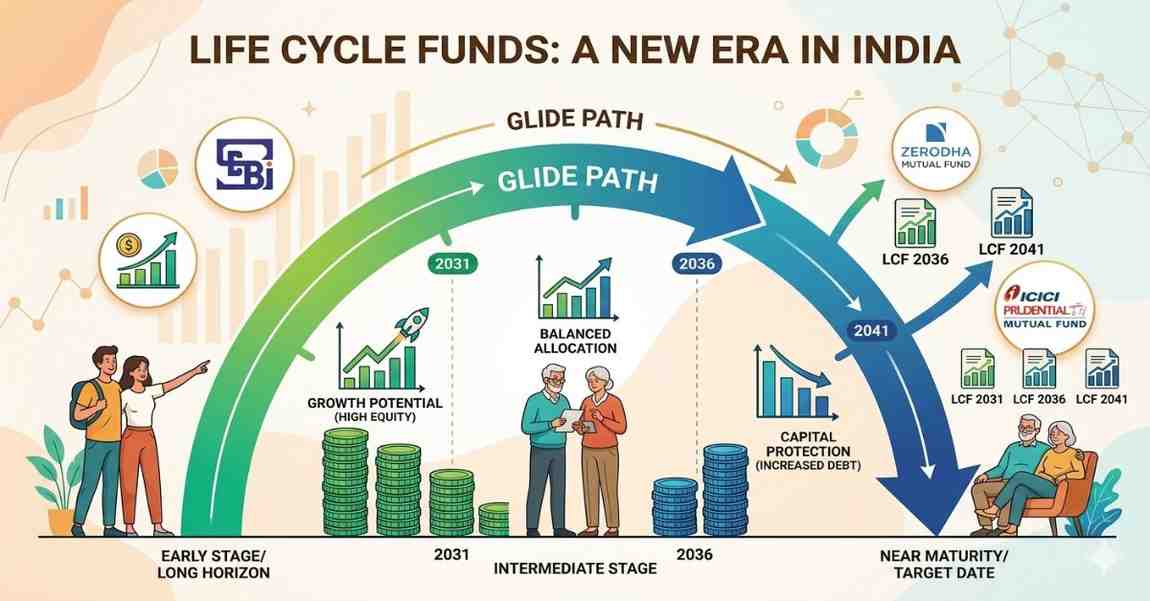
SEBI's new Life Cycle Fund category has received its first filings, with Zerodha Mutual Fund proposing two schemes and ICICI Prudential Mutual Fund filing three.
The Indian Mutual Fund industry is now heading towards a new era. The Securities and Exchange Board of India (SEBI), on February 26, 2026, came up with a new kind of mutual fund called 'Life Cycle Funds'.
The fund houses have reacted swiftly to this change in regulations. Two asset management companies filed their drafts with the SEBI in the first week of June 2026.
With the filing of these drafts, the old solutions-based schemes have come to an end. SEBI has replaced them with a more dynamic structure. Investors will now get access to automated asset allocation that adapts to a specific time horizon. The new filings show that fund houses want to capture long term retail capital through this goal-based investment route.
What Is a Life Cycle Fund?
A Life Cycle Fund is an open-ended mutual fund with a pre-defined maturity year. Unlike a traditional Hybrid Fund, the asset allocation does not remain static.
Instead, the fund follows a "glide path". This means the portfolio gradually becomes more conservative as it approaches maturity.
In the initial period, the portfolio can contain a larger share of equity investments in order to achieve growth. With the approaching target date, the investment becomes more conservative through an increase in debt or other fixed-income investments.
Why Did SEBI Introduce This Category?
The new category emerged after SEBI decided to discontinue Solution Oriented Schemes, which included retirement funds and children's funds.
SEBI felt there was a need for a more structured goal-based product. As a result, Life Cycle Funds were introduced as a separate category within the mutual fund framework.
Under the regulations, these funds must have a pre-determined maturity period ranging from 5 years to 30 years. The maturity year must also be disclosed in the scheme name.
A Global Solution for Indian Retail Investors
This concept is not entirely new to the financial world.
These products have achieved great popularity among western investors under the brand name Target Date Funds. This trend has already become quite popular in the United States. As per available industry reports, assets managed through target date funds had increased to $4.8 trillion in 2025 with a growth of 20.3% compared to the previous year. In the past decade, the sector has grown annually by 11.9%.
Through the introduction of Life Cycle Funds, SEBI aims to bring a similar goal-based investing framework to Indian investors.
Inside the First SEBI Filings
The information available on the official SEBI website indicates that there have been five drafts of offer documents that have been put forth.
Zerodha Mutual Fund was the first to move, filing draft documents for two schemes on June 05, 2026. These include the Zerodha Life Cycle Fund 2036 and the Zerodha Life Cycle Fund 2041.
A few days later, on June 08, 2026, ICICI Prudential Mutual Fund submitted draft papers for three schemes. The proposed offerings are the ICICI Prudential Life Cycle Fund 2031, ICICI Prudential Life Cycle Fund 2036, and ICICI Prudential Life Cycle Fund 2041.
A Closer Look at the 5 Individual Schemes
1. Zerodha Life Cycle Fund 2036
This fund targets a 10 year investment horizon from the time of its filing. It is built for investors who have important financial goals coming up around the middle of the next decade. This will be done using a passive approach by investing in Index Funds and exchange traded funds in order to ensure low operating costs. The benchmark portfolio will consist of 50% Nifty 200 TRI, 40% CRISIL 10-Year Gilt Index, and 5% each of the Indian gold and silver indices.
2. Zerodha Life Cycle Fund 2041
This scheme gives investors a longer timeline of 15 years to grow their capital. Because the target year is further away, the fund starts with a more aggressive stance. Its benchmark is weighted heavily toward growth, tracking 65% Nifty 200 TRI, 25% CRISIL 10-Year Gilt Index, and 5% each in physical gold and silver. If you are a younger investor planning for long term wealth creation, this longer glide path allows the fund manager to maximize equity exposure during the first few years.
3. ICICI Prudential Life Cycle Fund 2031
The ICICI Prudential Life Cycle Fund 2031 is aimed at investors seeking long-term wealth creation through a diversified portfolio. The open-ended scheme comes with a target maturity year of 2031 and follows a glide path strategy as well. In tis scheme, the asset allocation changes gradually over time. The fund has been classified under the 'Very High' risk category. Its benchmark comprises the Nifty 200 TRI with a 50% weight, the Nifty Composite Debt Index with a 45% weight, domestic gold prices with a 3% weight, and domestic silver prices with a 2% weight.
4. ICICI Prudential Life Cycle Fund 2036
This intermediate scheme matches the 10-year timeline of the Zerodha 2036 fund, but it will use an active management style. Its benchmark comprises the Nifty 200 TRI with a 65% weight, the Nifty Composite Debt Index with a 30% weight, domestic gold prices with a 3% weight, and domestic silver prices with a 2% weight.
5. ICICI Prudential Life Cycle Fund 2041
This final scheme offers a 15-year investment window under an active management umbrella. It provides a long runway for investors who want professional fund managers to actively trade and rebalance their assets over the next decade and a half. As per the draft filing, the scheme can invest across equities, debt instruments, InvITs, REITs, Gold ETFs and Silver ETFs. The fund has been classified under the 'Very High' risk category. Its benchmark is a composite index comprising the Nifty 200 TRI with a 65% weight, the Nifty Composite Debt Index with a 30% weight, domestic gold prices with a 3% weight, and domestic silver prices with a 2% weight.
What Lies Ahead for Investors
The entry of Zerodha and ICICI Pru Company is just the beginning. Many other asset management firms are expected to file their draft documents in the coming months. Investors will soon have a wide variety of target years to choose from, ranging from 2031 to 2056.
When these funds open for public subscription, you should evaluate them based on your financial timeline. Look at your final goal, calculate the remaining years, and pick the corresponding fund. It offers a true financial autopilot experience for the common investor.
Disclaimer: The article is for informational purposes only and not investment advice.