SIFs: The Third Path
Ratin DSIJ / 30 Apr 2026 / Categories: Cover Stories, DSIJ_Magazine_Web, DSIJMagazine_App, MF - Cover Story, Mutual Fund
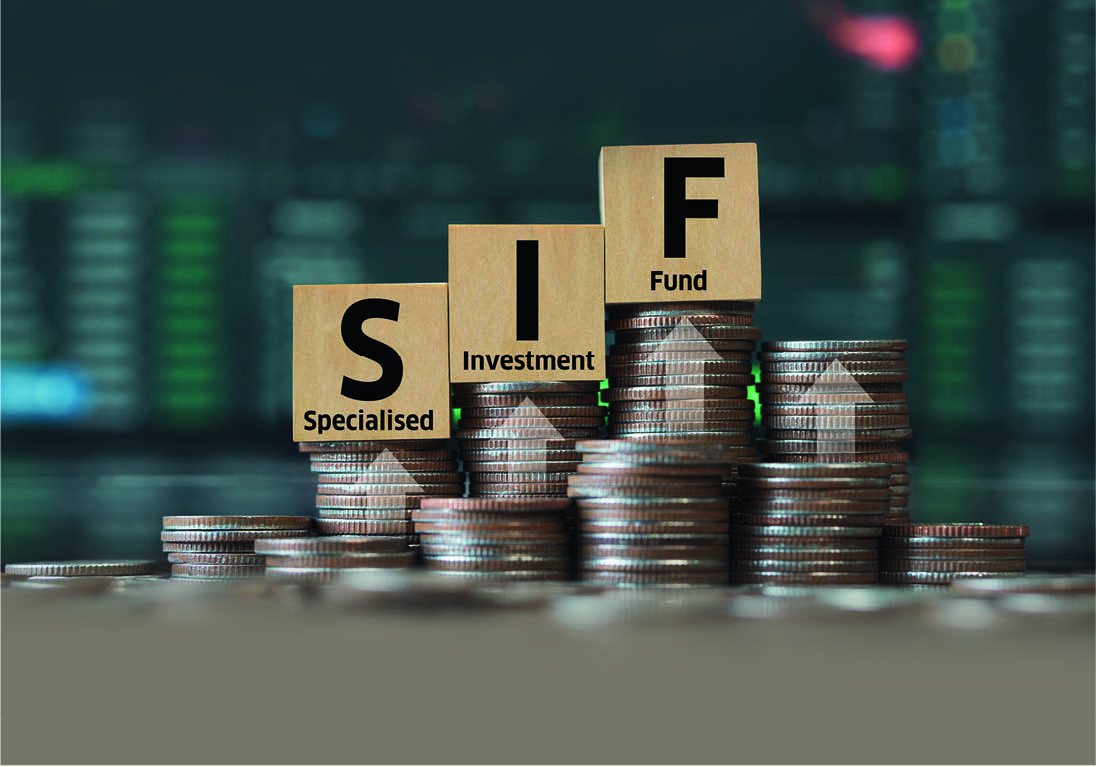
Specialised Investment Funds are SEBI’s answer to a long-ignored gap in India’s investment landscape.
Specialised Investment Funds are SEBI’s answer to a long-ignored gap in India’s investment landscape. Positioned between Mutual Funds and high-ticket PMS or AIF products, SIFs promise greater flexibility, tighter regulation, and access to more sophisticated strategies. But are they a genuine breakthrough for affluent investors, or simply a polished new wrapper for old complexity?[EasyDNNnews:PaidContentStart]
India's capital market regulator has quietly unveiled a new investment category designed to sit between the mass-market efficiency of mutual funds and the opacity of private wealth management. Specialised Investment Funds (SIFs), a framework SEBI formalised in 2025, are meant to serve a specific cohort: affluent investors hungry for exotic strategies but wary of the ₹50 lakh minimums, complex fee structures, and regulatory ambiguity that still characterise Portfolio Management Services (PMS) and Alternative Investment Funds (AIFs).
The question investors face now is whether SIFs represent genuine innovation or merely regulatory window-dressing for products that already exist.
A Widening Appetite, a Narrowing Path
It started with a growing sense of frustration among many investors. Across the country, a familiar dilemma now plays out among high-net-worth individuals, business owners, experienced traders, and small-time entrepreneurs who have built wealth. They are left choosing between two imperfect options from their perspective.
On one side are mutual funds, mass-market products bound by fund mandates, limited flexibility, and largely conventional strategies such as Large-Cap equities, government securities, or standard balanced funds. On the other side lie PMS and Alternative Investment Funds (AIFs), more tailored and sophisticated, but often complex, less transparent, and typically accessible only with a minimum investment of ₹50 lakh or more.
That gap, the missing middle, has been widening for years. And for the first time in India's investment architecture, a regulator appears to be acting on it. In 2025, the Securities and Exchange Board of India (SEBI) formalised the framework for SIFs, a new category that occupies a deliberate middle position. SIFs are stricter and more transparent than AIFs or PMS offerings. They are more flexible and strategy-rich than mutual funds. They target accredited investors willing to embrace complexity in exchange for access to strategies, long-short equities, tactical asset allocation, derivatives strategies, structured products, that the retail-focused mutual fund regime simply does not permit.
Whether SIFs will become a durable, valuable investment category or merely a marketing artefact of Indian financial engineering remains genuinely uncertain at the current juncture. But their emergence signals something clearer: the Indian investment landscape, long dominated by the massmarket efficiency of fund houses and the boutique opacity of private wealth managers, is getting a new category. The affluent middle-class, educated, globally aware investor, increasingly sceptical of traditional gatekeeping, is demanding a third path. And for the first time, regulators are attempting to build one, complete with guardrails.
The Gap That Nobody Wanted to Acknowledge
To understand why SIFs exist, you first have to understand what was missing. The Indian investment industry, for nearly three decades, has been shaped by two distinct ecosystems operating in parallel, almost in denial of one another.
On one side: mutual funds. Regulated to the hilt, transparent to the point of prescription, available to anyone even with ₹500 to invest and a KYC form. Mutual funds, whether equity, debt, or balanced, operate under SEBI's strict mandate. Their portfolios are disclosed. Their fees are capped. Their strategies are defined narrowly: fund managers operate within defined investment universes. A large-cap Equity Fund manager cannot suddenly short stocks or deploy leverage. Structure matters more than skill.
On the other hand, PMS and AIFs operate in a different league altogether. They offer far greater flexibility compared to mutual funds, but are still regulated by the SEBI. A PMS manager can take concentrated positions, move between asset classes, and adjust strategy dynamically based on conviction. However, this flexibility is not entirely unrestricted, there are regulatory and mandate-level boundaries in place.
Access, however, is tightly gatekept. PMS mandates a minimum investment of ₹50 lakh (as per SEBI regulations), though in practice, meaningful participation often starts upwards of ₹2–5 crore depending on the strategy and manager.
AIFs, being pooled vehicles, also require a minimum investment of ₹1 crore per investor (₹25 lakh for employees/ directors), making them largely accessible to HNIs and institutional investors. Both PMS and AIFs offer limited transparency compared to mutual funds, disclosures are periodic rather than frequent, fee structures can vary, and strategies are typically shared in detail only with enrolled investors.
What existed in between? Nothing. An investor with ₹10 lakh who wanted something more sophisticated than a mutual fund but was not yet ready for PMS indeterminacy had no legitimate, regulated home. Someone with a higher investable sum moved to AIFs anyway, overpaying on fees. Some settled for mutual funds despite chafing at constraints. Others experimented with unlisted securities or direct equity, paths that minimised regulatory oversight but maximised personal risk.
This was not just a product gap. It was a signal of market segmentation that the regulator had never formally acknowledged. SEBI built mutual funds for the masses and PMS/AIFs for the elite. The Indian wealth managers in between, the accomplished investors who wanted both flexibility and structure, who could understand complexity but valued transparency, had nowhere to go.
The Architecture of SIFs: What They Are and What They Are Not
On paper, SIFs are defined narrowly. They are pooled investment vehicles, closer in structure to mutual funds than to AIFs, but designed to offer greater strategy flexibility. They can pursue a wider range of investment strategies than traditional mutual funds, including the use of derivatives, limited short-selling, and more concentrated positions.
However, they are not lightly regulated. SEBI’s framework prescribes detailed disclosure norms, clearly defined strategy buckets, fee caps (stricter than AIFs but more flexible than mutual funds), and investor suitability requirements.
SIFs are intended for relatively sophisticated investors, but not strictly limited to accredited investors. High-net-worth individuals are the primary target segment. Minimum investment thresholds is higher than mutual funds, typically starting around ₹10 lakh and going upwards depending on the strategy and structure.
Permitted SIF strategies in India broadly include SEBI-defined equity, debt and hybrid long-short structures, such as Equity Long-Short, Debt Long-Short, Sector Rotation Long-Short, Sectoral Debt Long-Short, Active Asset Allocator Long-Short and Hybrid Long-Short. These can use exchange-traded derivatives for hedging, rebalancing and limited unhedged short exposure. However, the framework remains tightly controlled: unhedged short exposure is capped at 25 per cent of net assets, cumulative gross exposure is generally capped at 100 per cent of net assets, and investments in unlisted or privately placed instruments remain subject to applicable SEBI mutual fund/SIF rules, disclosures and portfolio limits.
In India, SIFs are best understood not as a loose bucket of 'concentrated' or 'derivatives-led' products, but as a tightly regulated set of SEBI-recognised long-short strategies across equity, debt and hybrid formats. The current framework gives fund managers more room than traditional mutual funds to express tactical views while still operating within defined regulatory boundaries.
Costs, too, sit in a middle zone: SIFs follow a mutual-fund-style total expense ratio framework rather than an open-ended performance-fee model, with TER limits linked to AUM slabs. Liquidity is also more structured than many assume, with launched open-ended strategies offering dealing on business days rather than the long lock-ins associated with many AIFs. At the same time, disclosure standards remain robust, with daily NAV publication, regular portfolio disclosures, dashboard-based reporting and half-yearly financial updates forming part of the framework. Fees are an important differentiator.
Liquidity also sits in the middle. Unlike mutual funds, which offer daily liquidity, SIFs are likely to offer periodic liquidity (monthly, quarterly, or longer intervals), but generally more frequent than traditional AIF lock-ins.
On transparency, SIFs are expected to maintain higher disclosure standards than AIFs, including periodic fact sheets, portfolio disclosures, and clear fee reporting, while still allowing more flexibility than mutual funds.
Comprehensive Study Guide: Specialized Investment Funds (SIF) in India
An SIF is a SEBI-regulated investment category designed to bridge the gap between retail mutual funds and high-ticket Alternative Investment Funds (AIFs) or Portfolio Management Services (PMS). It allows for more sophisticated, flexible strategies, such as long-short positions, targeted at experienced investors with a higher risk appetite. The Minimum Investment Threshold requires an aggregate investment of not less than ₹10 lakh per investor across all strategies offered by an SIF at the PAN level. This threshold is mandatory for general investors but does not apply to 'Accredited Investors'.
While traditional mutual funds primarily use derivatives for hedging and rebalancing, SIFs are permitted to take unhedged derivative exposure. Specifically, SIFs can allocate up to 25 per cent of their net assets to exchange-traded derivative instruments for tactical purposes other than hedging. To provide investors with an exit option, SEBI mandates that units of all close-ended and interval investment strategies of SIFs must be listed on recognised stock exchanges. The subscription and redemption frequencies for these units must be clearly disclosed in the fund's offer documents.
Distributors must pass the National Institute of Securities Markets (NISM) Series-XIII: Common Derivatives Certification Examination. This ensures that those selling SIF products understand the complex derivative-based strategies often employed by these funds. Equity Long-Short SIFs have demonstrated greater resilience than the broader market. This outperformance is attributed to their ability to take short positions that cushion the downside during market corrections.
or investment strategies that do not offer daily redemptions, AMCs have the authority to implement a notice period. This notice period is designed to help manage liquidity and can have a maximum duration of 15 working days. SIFs use a pictorial 'Risk-band' with five distinct levels to depict potential risk, similar to the risk-o-meter used in mutual funds. This risk-band is evaluated monthly and must be disclosed on the AMC and AMFI websites, with any changes communicated to unitholders.

Why Now? The Regulatory Calculus
SEBI's intervention was no mere coincidence, several key factors were at play. Wealth redistribution in India is accelerating, with the number of individuals holding between ₹5 crore and ₹50 crore increasing sharply. This group includes early tech startup winners, those benefiting from Real Estate appreciation, successful pharma enterprises, and thriving tradeable businesses. As of 2024, around 3.8 lakh HNWIs (High-Net-Worth Individuals, investable assets of USD 1 million or more), which has increased steadily in the last few years, exist in India, many of whom are more globally aware and increasingly sceptical of traditional financial gatekeepers. These individuals are less inclined to settle for the limitations of mutual funds or the opacity of private wealth management. Instead, they are actively seeking alternative avenues, moving their money towards international managers, complex investment strategies, or, unfortunately, exploitative schemes.
Second, the financial services industry has been evolving rapidly. Independent registered investment advisors have proliferated, offering advisory on diverse strategies. Fintech platforms have democratised market access. International investors have brought expectations for regulatory transparency, operational sophistication, and strategic flexibility that the old binary, mutual funds or opaque private wealth, could not meet. The market was fragmenting, and regulatory arbitrage was increasing.
Third, SEBI understood a broader imperative: if the Indian middle-affluent segment could not find a regulated, transparent home for sophisticated strategies, money would flow to unregulated spaces, overseas platforms, dubious AIFs, direct stock trading that masqueraded as strategy. By creating SIFs, SEBI was not merely accommodating demand; it was capturing it within a regulatory perimeter where suitability, transparency, and accountability could be enforced.
This was sophisticated regulatory thinking. SIFs are not the same as mutual funds because they cannot be. Affluent investors need flexibility. But unlike AIFs, which have historically operated with minimal transparency and maximum discretion, SIFs came with teeth. The regulator insisted on fact sheets, performance disclosures, clear fee schedules, and documented investor suitability. The trade-off: managers got latitude to pursue sophisticated strategies; investors got assurance that operators would not disappear into operational opaqueness.
The Opportunity: Real or Illusory?
For investors, the theoretical case for SIFs is compelling. The access argument alone is significant: sophisticated strategies that once required ₹10–25 crore commitments and endured six-month lock-ins are now available at much lower thresholds, with more frequent liquidity. This is a true democratisation of investment opportunities.
Consider the appeal of a long-short equity SIF in a volatile market. A traditional mutual fund manager, constrained to net long positions, is structurally vulnerable in downturns. A SIF manager can maintain long exposure to conviction picks while hedging tail risk through shorts. In a ₹15 crore investment, that flexibility, the ability to navigate both bull and bear markets through tactical positioning rather than forced buy-and-hold, has non-trivial value.
Consider the case of the Diviniti Equity Long-Short Fund offered by ITI AMC, launched in December 2025, which has generated a negative return of 3.82 per cent since the start of the year. In the same period, Nifty 500 has generated negative return of 6.81 per cent. This shows outperformance or alpha of around three per cent. Similar is the case with Hybrid Funds. For example, qsif Hybrid Long-Short Fund, sponsored by ICICI Pru. AMC, has generated return of around 3.71 per cent since the start of the year compared to negative returns generated by most of the Hybrid category in the same period.
Another benefit of SIF is the Tax dimension. In the case of equity mutual funds, long-term capital gains apply after a holding period of one year, currently taxed at 12.5 per cent on gains above ₹1.25 lakh annually. While there is no explicit regulatory cap on portfolio turnover in mutual funds, the structure of open-ended schemes and associated disclosure expectations tend to discourage highly tactical, high-frequency positioning.
A SIF manager, on the other hand, while still operating within SEBI’s regulatory perimeter, is likely to enjoy greater flexibility in portfolio Construction. This opens the door to more dynamic approaches such as tax-loss harvesting, opportunistic rebalancing, and staggered profit booking. In theory, such tools could improve post-tax efficiency. In practice, however, whether these advantages meaningfully translate into superior net returns, once higher fees and execution complexity are accounted for, remains an open, empirical question. Since SIF has yet to complete its one year, this needs to be watched if this investment instrument generates better returns.
The portfolio construction case for high-net-worth individuals is equally compelling. Consider a household managing ₹50 crore in investable assets. The allocation may already span domestic equity via mutual funds, international exposure through global funds, debt through fixed income instruments, and real estate as a long-duration asset class. Within this framework, a long-short SIF can serve as a satellite allocation, perhaps a ₹5 crore tactical sleeve aimed at thematic bets, concentrated conviction ideas, or hedged multi-asset strategies that would typically be difficult to accommodate within the constraints of traditional mutual fund mandates.
For asset management firms as well, the opportunity set is becoming increasingly visible. Many established fund houses have long been constrained by the product architecture of mutual funds, even as investor sophistication has evolved. A ₹5,000 crore AUM manager may already operate PMS and AIF strategies, but those channels often remain niche, constrained by distribution reach and a predominantly ultra-HNI focus. SIFs, in contrast, offer a potential bridge into the mass affluent and upper retail segments, without the steep brand and distribution intensity required for PMS scaling.
The Risks: Complexity, Suitability, and Disappointment
But the risks rise in proportion to the sophistication of the product.
■ The first is a complexity-versus-suitability risk. A SIF built around long-short equity strategies and derivative overlays is fundamentally different from a plain-vanilla index mutual fund or actively managed mutual fund schemes. It demands genuine investor understanding of leverage, hedging, short-selling and the ways volatility can magnify both gains and losses. That is where the gap emerges: the accreditation framework is primarily a financial filter, not a test of investment literacy. An investor may qualify on paper and still lack the experience required to assess the strategy properly. A business owner with substantial wealth tied up in real estate, for example, may meet the eligibility threshold yet still be exposed to confusion, expectation mismatch and poor product fit.
Second is the mis-selling risk. In mutual fund distribution, we have seen instances of AMCs incentivising agents to sell unsuitable products, churning portfolios, and masking fee opacity through complexity. The SIF category, being newer, offers a fresh field for these patterns. A distributor selling a concentrated equity SIF to an investor who believed they were buying a diversified fund, or selling a leveraged strategy to someone unfamiliar with forced liquidations in volatile markets, is a foreseeable outcome. SEBI has outlined suitability norms, advisors must certify investor understanding, but enforcement remains a question.
■ Third is the performance risk, which is peculiar to active, concentrated strategies. A long-short SIF delivered by a talented manager during a stable bull market may appear to justify its expense ratio. But a downturn, or even a period of mean reversion, can expose whether the manager's outperformance was skill or luck. The more concentrated a fund (as many early SIFs are), the more volatile performance becomes. An investor comfortable with a mutual fund's 10-15 per cent annual swings may find a concentrated SIF's 20-30 per cent volatility psychologically unsustainable, leading to forced redemptions at precisely the wrong moment.
■ Fourth is product proliferation risk. The SIF category is new enough that fund houses will inevitably experiment, launching SIFs in niche strategies with limited manager experience, or SIFs pursuing themes (AI, fintech, biotech) in which the Indian investment universe is too small to support meaningful diversification. A ₹200 crore SIF betting on 'digital infrastructure' in India may sound opportunistic; in reality, it may be dangerously concentrated. As the category grows, weaker offerings will proliferate faster than regulatory scrutiny can realistically catch them.
■ Finally, there is the danger of false sophistication. An affluent investor with limited market experience can mistake 'more complex' for 'better'. A SIF claiming to deploy derivatives strategies and market-neutral positioning may feel like a superior product to a simple equity mutual fund. But complexity itself is not an advantage. A fund charging 2.5 per cent annually while underperforming a 0.5 per cent index mutual fund by 3-4 per cent has merely created a fee drag, regardless of its strategic sophistication. The investor's job is to ask whether the complexity is earning its cost. The honest answer, for many offerings, will be no
The Real Test: Market Behaviour
Early adoption patterns in Specialised Investment Funds are beginning to offer meaningful signals, but the story is best told with the timeline set right. SIFs were introduced under SEBI’s framework on February 27, 2025, with the regime taking effect from April 1, 2025, and the first strategies entering the market only in October 2025. From there, the trajectory has been encouraging: SIF assets stood at about ₹2,010 crore in October 2025, rose to ₹4,892 crore by December 2025, and climbed further to ₹9,711 crore in February 2026, before reaching ₹10,620 crore in March 2026. That is a healthy start for a new category, but it also underlines how early the journey still is. Against India’s mutual fund industry, which managed ₹65.74 lakh crore in March 2025 and ₹73.73 lakh crore in March 2026, SIFs remain a niche segment for now, more notable for their strategic promise than for their current scale.
Distribution patterns are already revealing the shape of the SIF market, but the picture is more nuanced than a simple institutional-versus-retail divide. At this stage, SIFs are clearly being built through specialist channels rather than broad-based mass distribution. The category carries a ₹10 lakh minimum investment threshold, SEBI has required SIFs to maintain branding distinct from regular mutual funds, and AMFI has created a separate SIF distributor registration framework that requires additional certification and AMC empanelment. That naturally tilts early distribution towards advisors, wealth platforms, and better-equipped intermediary networks.
Even so, it would be too strong to say SIFs are largely absent from the traditional mutual fund distribution ecosystem, because AMFI has explicitly opened the route for mutual fund distributors to register for SIF distribution, and retail-facing access has also started to expand, with FYERS positioning itself in October 2025 as the first stockbroking platform to offer SIFs to retail investors.
That creates a double-edged starting point for the category. On the one hand, specialist gating can help reduce the risk of casual mis-selling of products that are structurally more complex than conventional mutual funds. On the other hand, this remains a formative phase for the advisory ecosystem itself, because the additional derivatives-oriented certification requirement has acted as a real bottleneck in scaling distribution. Performance, meanwhile, is still too early to judge with confidence. The first SIF strategies were launched only in October 2025, and by March 2026, the category had grown to 14 schemes with assets of ₹10,620 crore, leaving investors with only a short live track record to assess. Early outcomes have been mixed rather than uniform, with hybrid long-short strategies showing greater resilience in the recent correction while returns across equity-oriented strategies have varied more widely. That, in turn, reinforces the central reality of SIF investing, manager selection matters immensely. In this segment, investors are not merely buying market exposure; they are underwriting a manager’s process, risk controls, and ability to use shorting, derivatives, and tactical allocation with discipline.
What Smart Investors Should Take Away
SIFs fill a genuine gap. Mass affluent investors seeking sophisticated strategies have long been underserved. While backed by a sound regulatory framework and transparent fees, SIFs are not automatically suitable for every investor.
Consider SIFs if: You have ₹50 lakh or more in investable assets and genuinely understand the strategy you are backing. You have the temperament to hold volatile, concentrated positions for multiple years without panic selling. You are seeking true portfolio diversification, adding something genuinely different from your core equity and debt holdings. You want tactical positioning in specific market conditions, long-short hedging in expensive equity markets, for instance, but not a permanent bet. And critically, you believe the manager's skill and process are worth the additional 1-2 per cent in annual fees relative to a passive equivalent.
Avoid SIFs if: You are being sold them by a distributor who may be motivated by higher commissions, without adequate explanation of strategy mechanics. You cannot articulate precisely what the fund is doing and why it differs meaningfully from alternatives. You expect SIFs to reliably outperform markets because they are 'more sophisticated'. You would panic sell if the fund declined 25 per cent in a market downturn, or become euphoric if it jumped 30 per cent in a bull run. You are drawn to a SIF primarily because it feels like an 'insider' or 'advanced' product-that is precisely the inverse of sound investing.
Before investing, ask these questions: What precisely is the fund's strategy, and do you understand it fully? What is the track record of this specific manager in this specific strategy, not just the firm's overall performance? What is the liquidity structure if you need to exit early? Who exactly is making investment decisions, one manager or a team?
The larger question SIFs raise is whether regulated, transparent, sophisticated investing can scale in India without the gatekeeping and opacity of traditional private wealth management. The early evidence suggests yes, but the category is still evolving. Over the next 2-3 years, several things will matter: whether the early SIF launches deliver on their return promises, or whether performance volatility exposes them as unnecessarily complex; whether mis-selling becomes rampant, triggering regulatory crackdowns; whether the investor base becomes more sophisticated in SIF selection or remains vulnerable to marketing; and whether SEBI maintains transparent, consistent oversight or allows the category to drift towards the opacity that has long characterised AIFs.
For now, SIFs are what they claim: a middle path. They are neither revolutionary nor merely coSMEtic. They fill a gap and offer access that did not previously exist. But access without understanding is dangerous. An affluent investor is not automatically sophisticated. Complexity should never be mistaken for quality. The investor's job remains unchanged: to know what you own, to understand why you own it, and to demand that the returns you receive justify the complexity and cost you are bearing.
SIFs work for investors who approach them with that discipline. They are a trap for those who treat them as badges of financial sophistication. Which category you fall into will determine whether the new category becomes, for you, an advantage or merely an expensive detour.
[EasyDNNnews:PaidContentEnd] [EasyDNNnews:UnPaidContentStart]
To read the entire article, you must be a DSIJ magazine subscriber.
[EasyDNNnews:UnPaidContentEnd]