Superstars Portfolios & Performance
Ninad Ramdasi / 17 Nov 2022 / Categories: Cover Stories, Cover Story, DSIJ_Magazine_Web, DSIJMagazine_App, Stories
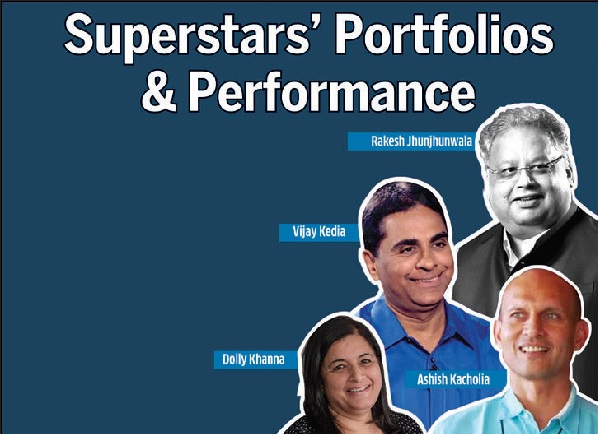
Are you the kind the investor who follows the purchase and selling decisions of ace investors, as for example, Rakesh Jhunjhunwala? And have you either made good money or burnt your fingers in doing so? The question is whether it is a wise choice to track the dealings of superstar investors or carry out due diligence on your own and then invest in independently carried out choices? Yogesh Supekar discusses the pros and cons of following the footsteps of any ace investor while also highlighting the performance in 2022 of some of the most renowned investors in India
Are you the kind the investor who follows the purchase and selling decisions of ace investors, as for example, Rakesh Jhunjhunwala? And have you either made good money or burnt your fingers in doing so? The question is whether it is a wise choice to track the dealings of superstar investors or carry out due diligence on your own and then invest in independently carried out choices? Yogesh Supekar discusses the pros and cons of following the footsteps of any ace investor while also highlighting the performance in 2022 of some of the most renowned investors in India
There can be two kinds of investors you would normally come across. The first kind is the type that thoroughly enjoys the investment process and enjoys a kick out of it when the result is fabulous or in other words ‘above average’. The other type of investor is the one who is simply focused on the results and may not always derive the same pleasure by meticulously following the investment process and carrying out due diligence. The second type of investor does not mind skipping the investment process and may simply buy or sell because someone has recommended it. And more or less, the latter is more in favour, especially with novice investors who go by what they have heard.
One may agree that it is rare to find an individual investor who is an independent thinker and enjoys following the investment process in detail passionately. However, it is common to find people buying and selling a stock just because someone has either bought it or has recommended it. Say regular investor Gautam Diwani, “I come from a Tier III city in Maharashtra and am a member of the Nagar Club which is the one of the posh clubs in my city. I go there 3-4 days every week. I hang around with friends from various fields, some of whom are athletes while some are doctors, businessmen or full-time investors.”
“In the last few years I have seen these investors making a decent amount of money both in real estate and in the stock market. These so called ‘full-time investors’ have gained respect over the years and I get to see that they interact with an increasing number of people and whatever they say about the markets or the economy is always listened to with rapt attention. I have also noticed that most of those who flock to such investors take the tips quite seriously and tend to buy stocks based on such advice. It comes as no surprise then that almost everyone ends up buying more or less the same stocks but at different price points,” he adds.
“All the club members thus have more or less a similar portfolio. A majority of the investors I meet in the club are not inclined to carry out any due diligence and simply buy a stock based on the talks that go around. I had been doing the same thing for many years until I realised that one must engage in due diligence independently and buy or sell stocks only after building conviction in the stock. Stock market gossip can damage portfolio returns badly and I have experienced that several times in recent years. I personally believe that following ace investors’ stocks is a much better option rather than taking an investment ride on the basis of recommendations,” he further states.
Indeed, investors tend to buy stocks based on casual inputs and market rumours. Rumour of a celebrity buying a particular stock also acts as a trigger for many investors to buy or sell a particular stock. Tracking celebrity portfolio has become a penchant of sorts for investors in India. There are of course more than enough social media or television channels or websites that provide a regular flow of information about stocks bought and sold by celebrity investors. And given the habit of the media to make all such news ‘sensational’, potential investors are often caught in the net. The question is whether it is really useful for investors to follow celebrity investors’ portfolio actions? And how do we know what the celebrity investors are doing?
Many investors keep a close eye on the companies where big investors invest. These big investors, also known as ace investors and superstar investors, at times have a proven track record, and it can be always useful to keep tabs on which companies or sectors these investors are investing in so as to obtain an insight into their general thesis and investing framework. These investors are known for their expertise and success in the stock market and have created a surplus amount of money for themselves, which is always good motivation for many investors. Thus, following successful investors can add value to your investment process.
Tracking the Biggies
One way to track the big investors is to regularly visit the NSE and BSE websites. Have you ever heard of block deals and bulk deals? It is an important transaction to take note of as an active investor. It is normal to expect some price action once the block deals and bulk deals are concluded. The list of block and bulk deals are disclosed publicly on the NSE and BSE websites. Investors need to check the block and bulk deal list to see where the big investors are investing. The information is readily available on several financial websites as well. Investors can definitely benefit by tracking such big ticket transactions.
Apart from the big ticket transactions, one must check the latest shareholding pattern that is published on the stock exchanges’ websites. The quarterly updates in the shareholding patterns are of great use for long-term investors. Investors simply have to check if the ace investor being tracked and followed has increased or trimmed his stake in the current portfolio holdings. Logically, any increase in stakes by an ace investor should help investors build conviction in the stock. However, it should in no way be considered as the only trigger to buy the stock. There are various other parameters that you should have on your list to check before you park your precious funds.
Portfolios and Performances
Let us understand how the portfolios of some of the most popular investment gurus have performed in 2022. For discussion sake we have studied the performance of the portfolios of Rakesh Jhunjhunwala, Ashish Kacholia, Dolly Khanna and Vikay Kedia. What is interesting to observe is the sectoral preference of these highly successful investors. Rakesh Jhunjhunwala’s portfolio has a clear bias towards textiles, apparels and accessories, banking and finance and the retail sector. If you are bullish on the chemical sector in India, chances are that you have been following Ashish Kacholia’s portfolio of multi-bagger stocks from the chemical industry.
His portfolio is overweight on chemicals and petrochemicals, textiles and accessories and consumer durables. On the other hand, Vijay Kedia has been betting on telecom services, metals and mining and media while ace investor Dolly Khanna has been taking exposure to cement and construction, oil and gas, commercial services and supplies. We find that the average return delivered by the stocks held in Jhunjhunwala’s portfolio is 7.1 per cent on YTD basis. This information is gleaned after considering the average returns of all the 30 stocks held in the portfolio in 2022. Out of these 30 stocks we find that at least 16 stocks have generated negative returns. It is important to note that the portfolio performance does not consider the actual weightages and is analysed assuming an equal weightage portfolio.
The average return of Kacholia’s portfolio stands at close to 30 per cent. At least three stocks from his portfolio have managed to more than double in value with Moongipa Securities jumping higher by more than 529 per cent in CY 2022 so far followed by Fineotex Chemicals and Safari Industries which are up by 134 per cent and 116 per cent, respectively. Elecon Engineering Company is one of the top performing stocks in Kedia’s portfolio of 12 stocks. The company’s stocks shot up by more than 141 per cent in 2022 while Innovators Façade Systems and Mahindra Holidays are up by 41.3 per cent and 40.99 per cent in 2022.
The average return of the stocks in Kedia’s portfolio is 14.25 while six out of 12 stocks held by him managed to deliver positive returns so far. Dolly Khanna’s portfolio has managed to generate returns of 5.16 in CY 2022 so far assuming an equal weightage portfolio. Tinna Rubber and Infrastructure that gained by 160 per cent is the only stock in this portfolio stock that managed to more than double in CY 2022. Her other top performing stocks in 2022 include Chennai Petroleum and J Kumar Infraprojects that gained by 95.66 per cent and 66.43 per cent, respectively.
Overall, going by the average performance of the portfolio stocks where the investments comprise more than 1 per cent of the company’s shares and assuming an equal weightage portfolio, we find the performance of Kacholia’s portfolio stocks being the best in 2022 so far followed by that of Kedia. Investors at times also stand to gain from the knowledge of fresh purchases made by ace investors. Whether it is newly added stocks in the portfolio or stake increase, investors can time their purchase and generate some market-beating returns. The following table highlights the performance of some of the portfolio stocks of ace investors which were added recently.


Note : Nifty was up by 5.88 per cent in the one-month period and was up by 2.81 per cent in a three-month period while the BSE Mid-Cap gained by 3.13 per cent in one month and 2.90 per cent in the three-month period and BSE Small-Cap was up by 1.95 per cent in one month and 4.2 per cent in the three-month period that has been compared to the portfolio stock performance.
We can see that the average performance of stocks that are newly added or where the stakes have increased is competitive. Recently, Knowledge Marine and Engineering Works’ shares were in the news because of stake purchase by Ashish Kacholia. Such a development sent the stock soaring by almost 40 per cent in one month. Believe it or not, there is traction seen in stock prices whenever an ace investor purchases a big stake in a small to mid-sized company. However, it’s not always a rosy picture for ace investors.
What if the ace investor sells his or her stakes? It is not uncommon to see stocks tumble based on fresh selling by an ace investor. With reference to the below table we can see that some of the stocks witnessed some selling pressure after the ace investors trimmed their stakes, as for example, those of Pondy Oxides and Chemicals, Rama Phosphates, Chennai Petroleum, Genesys International Corporation, Parag Milk Food, etc., which delivered negative performance by a sizeable margin. One can assume some selling pressure in small-cap illiquid counters when ace investors exit either completely or trim their stakes.
"Respect the market. Have an open mind. Know what to stake. Know when to take a loss. Be responsible."
-Rakesh Jhunjhunwala

Conclusion
There is no harm in following the investment decisions of ‘superstar investors’ especially when your investment philosophy and temperament matches with that of the ace investor who you decide to follow. But rather than blindly follow such an investor’s movies, it is important you study the investing style of your investment guru. Is he a micro-cap investor, a small-cap investor or simply tends to invest in blue chip companies? Once you have identified one or more superstar investors you wish to follow, it is important to predefine your stock selection process that must include factors and filters beyond ownership of shares by the superstar investor.
Simply buying a stock just because your favourite ace investor has newly added it to his portfolio may prove to be risky strategy. The reason being you will always be late in buying a stock even if we assume it is a fundamentally well-screened stock. Another element of risk emerges from the fact that you will never know when your favourite ace investor has started to download his holdings. Agreed that these days there are various sources to precisely know the action taking place on the bulk deal front, yet there is always a risk of higher slippages – thus reducing the attractiveness of expected returns.
With too many unknowns in the game, why add one more uncertainty in the decision-making process? The uncertainty is about whether the ace investor you have chosen is going to dump the stock after you have bought it or whether he is going to add more to the original quantity which may jack up the stock prices. Even if you end up buying a share in alignment with your superstar investor’s portfolio, the selling decision will always be very difficult as you will once again be dependent on the lead you are eagerly waiting for. The right choice would be to carry out your own due diligence while buying or selecting stocks rather than follow the herd mentality.