Swiggy, Zomato, & the Challengers
Sayali Shirke / 26 Jun 2025/ Categories: Cover Stories, Cover Story, DSIJ_Magazine_Web, DSIJMagazine_App, Stories
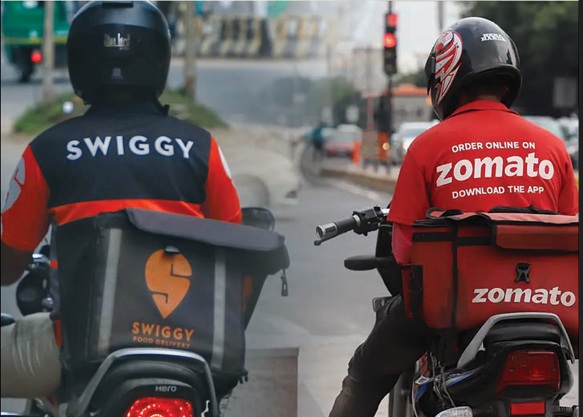
This detailed cover story explores how the fundamentals of Swiggy and Zomato have evolved and diverged.
India’s food delivery battleground has crystallized into an Eternal (Zomato)-Swiggy duopoly— but the war is far from over. Controlling over 90 per cent of the market, both giants are now defending their turf against agile challengers like Rapido and IPO-bound Zepto. As they chase profitability through scale and ecosystem synergies, the quick commerce boom is redrawing competitive lines. In this story, Abhishek Wani unpacks the industry’s Porter Five Forces, shifting economics, evolving margin strategies, and Rapido’s disruptive pricing model to explore whether the next wave of delivery disruption is already underway [EasyDNNnews:PaidContentStart]
Introduction
India’s food delivery ecosystem has transformed from a fragmented startup battleground into a strategic duopoly, largely led by two tech behemoths – Eternal (Zomato) and Swiggy. What began as an experiment in digital ordering has matured into a vital cog of urban consumption. These platforms, backed by billions in venture funding and relentless innovation, now dominate over 90 per cent of India’s food delivery market. Yet, their dominance is increasingly being tested not just by each other, but by the reimagined ambitions of smaller challengers such as Rapido, and IPO-bound quick commerce upstarts like Zepto.
This detailed cover story explores how the fundamentals of Swiggy and Zomato have evolved and diverged. It investigates whether the entry of a challenger with a radically different model, like Rapido, can alter the dynamics of a market that has long functioned as a tightly held duopoly.
Industry Outlook
India’s digital consumption landscape is undergoing a bifurcated transformation. The online food delivery segment, now a duopoly between Zomato and Swiggy, is entering a maturity phase. With a market size of ₹6,40,000 crore as of CY23, the sector is expected to grow at a steady 18 per cent CAGR through CY28, underpinned by increasing urbanization, smartphone penetration, improved unit economics, and tier-2/3 market expansion. Both players have turned contribution-margin profitable and are actively optimizing delivery costs, fleet utilization, and average order values (AOVs).
However, the Quick Commerce (QC) segment presents a different picture altogether. Projected to grow at 50 per cent+ CAGR, QC is an aggressive, high-churn battlefield, burning cash even as demand surges. Zomato’s Blinkit currently leads in gross order values (GOVs), store utilization, and order density, but Swiggy Instamart is catching up, having doubled its dark stores within a year. While consumer adoption is rising due to convenience and impulsive buying behaviour, profitability remains structurally challenged.
Porter’s Five Forces: Competitive Anatomy of India’s Food-Tech Duopoly
1. Competitive Rivalry – Very High
Zomato and Swiggy form a near-perfect duopoly in food delivery, yet the rivalry is far from dormant. While their faceoff is intense but contained in food delivery, the battlefront in quick commerce is expanding rapidly. Blinkit, Instamart, Zepto, Amazon, and Flipkart are engaged in a cutthroat contest where brand identity takes a backseat to speed and affordability. This commoditization of service has driven up churn and forced players to rely heavily on loyalty schemes and discounting. Thin margins and high fixed costs further elevate the stakes, making this one of the most competitive verticals in India’s consumer internet landscape. Rivalry is intense but stable. In QC, multiple players including Zepto, Amazon, and Reliance create volatility.
2. Threat of New Entrants – Moderate to Low
While new entrants regularly emerge in hyperlocal commerce, the sheer intensity of capital burn and logistical precision needed to scale makes food-tech a high-barrier sector. Setting up last-mile logistics, dark store operations, and building consumer trust all require deep war chests. However, the threat cannot be dismissed entirely; conglomerates like Tata, Reliance, and Amazon possess the muscle to underwrite early-stage losses and enter the ring with bundled offerings. On the regulatory front, tightening FDI norms and gig economy rules may help insulate the incumbents from newer, foreignfunded rivals. Deter most startups, but large tech conglomerates can enter via burn strategies.
3. Bargaining Power of Suppliers – Moderate
In food delivery, supplier power is fragmented. Most restaurants are highly dependent on platforms for visibility and volume, which restricts their bargaining clout. Conversely, in quick commerce, the platforms increasingly control the supply chain through private labels and B2B procurement (as seen with Zomato’s Hyperpure). This vertical integration offers pricing control and backend visibility, but also invites operational complexity. As in-house brands grow and B2B ecosystems mature, we may see a rebalancing in supplier dynamics across segments. Restaurants are fragmented, QC gives platforms more control via private labels and B2B integration.
4. Bargaining Power of Buyers – High
End consumers in this space remain fiercely price-sensitive. Switching platforms requires little effort, and loyalty is largely dictated by price incentives, delivery time, and app experience. The dependence on couponing, free deliveries, and referral programs is a byproduct of this high buyer power. In quick commerce especially, where repeat usage is driven more by impulse than brand affinity, the balance of power heavily tilts toward the buyer. Low switching costs and heavy reliance on offers create an intense loyalty tug-of-war.
5. Threat of Substitutes – High
The competitive moat of food delivery and quick commerce platforms is also eroded by a multitude of real-world and digital substitutes. Traditional kiranas and supermarkets continue to thrive, offering personalized credit and deep neighbourhood integration. Meanwhile, platforms like ONDC and WhatsApp-led commerce are steadily advancing, promising to disintermediate aggregators entirely. The ease with which consumers can revert to cooking at home, dine out, or source groceries offline continues to pose a lingering threat to platform-based models. Supermarkets and ONDC threaten platform stickiness in the long run.
About Zomato & Swiggy
Zomato’s strategy rests on tight ecosystem integration — food, quick commerce, B2B (Hyperpure), and entertainment (Zomato District). Its FY25 food delivery contribution margin stands at 8 per cent, with Blinkit nearing breakeven. Its platform investments (Paytm’s ticketing vertical, Uber Eats India, etc.) aim to reinforce user stickiness and diversify monetisation streams. Blinkit’s 1P (first party) model and higher AOVs help Zomato scale quickly in metros with operational visibility.
Swiggy operates on a unified platform model combining food delivery, quick commerce (Instamart), and Dineout. Its 35 per cent cross-service usage among 110 million+ users builds high lifetime value (LTV). Bolt - Swiggy’s 10-minute food delivery feature — now accounts for 12 per cent of Swiggy’s total delivery volumes. Swiggy’s differentiation lies in fleet centralisation and convenience branding.

Eternal (Zomato) commands a broader and deeper ecosystem across all major metrics — from total revenue and GOV to user engagement and quick commerce traction. However, that scale has come at a cost. While Zomato outpaces Swiggy in unit economics and efficiency, its aggressive investments in Blinkit and newer verticals have widened net losses. Swiggy, on the other hand, is showing disciplined financial execution with profitability in its core business and strong AOVs despite trailing in GOV.
Blinkit’s superior unit metrics position it ahead of Instamart in margin recovery and operational leverage. However, Swiggy’s broader dark store footprint and sharper AOVs signal that it is better positioned to attract premium users. Ultimately, Zomato may be building for scale and ecosystem dominance, while Swiggy appears more focused on near-term profitability and service density.
Rapido’s Entry: A Disruptor with Pricing Power, But Can It Scale?
Rapido’s flat-rate delivery model with ₹25 for orders under ₹400, ₹50 for larger ones has ignited interest among both price-sensitive customers and small-scale restaurants. The model sharply undercuts the 20–30 per cent commission-based pricing structure used by Zomato and Swiggy, potentially setting the stage for pricing disruption in India's food delivery sector.
Launched as a pilot in Bengaluru in mid-2025, Rapido's entry comes with immediate appeal. By offering restaurants full margins and consumers a predictable delivery charge, it taps into dissatisfaction with incumbent commission models. Its transparent pricing structure could resonate especially well in Tier 2 and mid-income neighbourhoods, where sensitivity to both menu markup and delivery fees is highest.
However, as the India Dispatch report outlines, the model’s scalability is under scrutiny. While the bullish case imagines Rapido successfully targeting low-cost, high-volume clusters leveraging its existing fleet from bike taxis, the bear case highlights systemic challenges. These include the absence of a loyalty ecosystem, limited delivery infrastructure, weak brand recall in food ordering, and lack of dark-store or supply-chain integration. Moreover, the success of food delivery in India hinges as much on experience and retention as on price.
In short, Rapido’s entry may pressure incumbents to revisit pricing in targeted zones. But whether it emerges as a true third force in food-tech or merely as a catalyst for margin compression will depend on how quickly it scales density, trust, and user retention—these three levers that Zomato and Swiggy have spent years perfecting.

Zepto and the IPO Edge
Zepto’s metro-first strategy, premium SKU portfolio, and IPO momentum may allow it to claim a share of the top-tier consumer base. For incumbents, this increases the urgency to secure high-margin segments before Zepto’s war chest expands.
Customer Behaviour: Moving Beyond Discounts
Discounts remain relevant, but loyalty now hinges on app user experience, delivery reliability, subscription services, and platform breadth. Zomato Gold and Swiggy One are retention anchors. Rapido, despite pricing appeal, lacks ecosystem hooks to guarantee repeat use.

Management Outlook: Eternal (Zomato) vs Swiggy – In Brief
Eternal Ltd (Zomato) ― Eternal is cautious but methodical, targeting 20 per cent+ long-term GOV CAGR in the next 4–5 years in food delivery, while avoiding short-term projections due to affordability and delivery constraints. Non-viable pilots like 10-minute delivery and Zomato Everyday have been shuttered. The focus is now on improving delivery times (20–25 minutes) and sustaining 5 per cent EBITDA margins.
Blinkit is projected to grow over 100 per cent in FY26, with breakeven driven by scale efficiencies despite real estate and marketing pressures. While Blinkit won’t enter private labels, inventory ownership is seen as a long-term margin lever. District and Hyperpure are growing, though District will remain loss-making. New ventures like Bistro and Nugget are still in early investment phases.
Swiggy ― Swiggy views food delivery as a long-term play, aiming for 18–22 per cent annual GOV growth in the same period as Eternal and improved profitability through cost control and 100–150 bps margin gains. Unlike Eternal, it reports no fleet issues and is focused on product innovation via Bolt and Snacc.
Instamart projects 5–6x market growth in 3–4 years, with breakeven targeted in 3–5 quarters after peaking losses in FY25. Strategy shifts include densifying stores over expanding geography, and tools like Maxxsaver and Megapods to boost AOV. Swiggy sees limited upside in a 1P model but remains open. Dine-out margins are stable at 4–5 per cent, while new initiatives like Snacc and Pyng continue in experimental mode with expected early losses.
Final Reflections
India’s food-tech landscape is entering a phase where strategic clarity outweighs sheer scale or aggressive burn. Both Zomato and Swiggy have engineered resilient, multi-vertical models, but profitability may come under pressure as competitive intensity in food delivery increases.
The entry of Rapido, with its fixed-fee model, lean cost base, and ability to repurpose its existing rider fleet, could shake up short-term pricing dynamics. Its model may appeal to small restaurants looking to cut costs. However, the absence of deep restaurant partnerships, limited app sophistication, and lack of customer trust infrastructure makes disrupting the entrenched duopoly a steep challenge. Over the long term, Rapido may find a niche as a localized, lean alternative—not a dominant force, but a viable challenger in a market large enough for specialization.
Currently, Zomato’s ecosystem-first strategy—with an integrated approach across food delivery, quick commerce, and B2B supply—is designed for long-term dominance, albeit with short-term execution sacrifices. On the other hand, Swiggy’s disciplined pivot toward profitability reflects a more measured yet potentially more resilient stance. As the space matures, execution—not expansion—will separate leaders from laggards. Ultimately, success will depend not on who spends more, but on who creates lasting value for users, partners, and shareholders.
What Should Investors Consider?
From an investment lens, Eternal Ltd (Zomato) currently stands out as the stronger structural bet. It commands an EV-to-Revenue multiple of 12x, highlighting investor confidence in its scalability and margin profile. In contrast, Swiggy is valued at a more modest 6.26x multiple, reflecting greater execution and balance sheet risk.
Zomato’s edge lies in:
Dual market leadership in both food delivery and quick commerce A superior cost structure, driving stronger unit economics A healthier balance sheet, which reduces the likelihood of further equity dilution (Zomato’s Debt to Equity is at 0.07x and Swiggy’s 0.17x)
While Swiggy is likely to claw back market share in Q-commerce through densification and infrastructure investments, the market may begin pricing in execution divergence more sharply from here on. Zomato, having already delivered industryleading food delivery EBITDA margins, is now showing early signs of stabilization in its quick commerce vertical. Given that both food delivery and quick commerce represent two of the largest total addressable markets (TAMs) in India’s digital ecosystem, Zomato is well-positioned to compound value over the long term. For investors looking to ride India’s delivery-led digital consumption wave, backing Blinkit via Zomato may offer a safer and more scalable approach—anchored in leadership, operating leverage, and ecosystem synergies.
[EasyDNNnews:PaidContentEnd] [EasyDNNnews:UnPaidContentStart]
To read the entire article, you must be a DSIJ magazine subscriber.
[EasyDNNnews:UnPaidContentEnd]