The Hidden Value in Spin-offs and Demergers!
DSIJ Intelligence-6 / 13 Oct 2025 / Categories: General, Knowledge, Trending
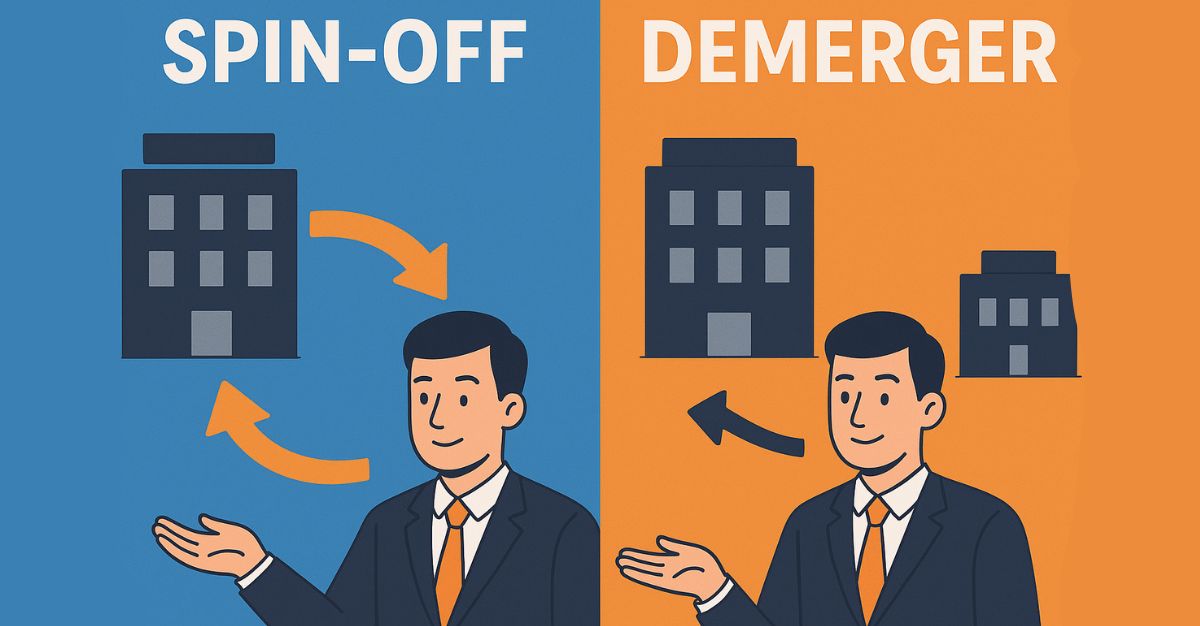
Spin-offs and demergers, when executed for the right reasons, can reveal hidden value trapped within complex conglomerates.
Understanding Spin-offs and Demergers
Spin-offs and demergers are corporate restructuring events where a company separates part of its business into an independent entity. While these moves may seem like mere financial engineering, they often unlock substantial value for shareholders. The logic is simple — when two distinct businesses operate under one roof, management focus and capital allocation can get diluted. By separating them, each unit can pursue its own strategic priorities, improving efficiency, profitability, and investor visibility.
Difference Between Spin-offs and Demergers
A spin-off and a demerger both involve separating a business unit from its parent company, but they differ in structure. In a spin-off, a company creates a new independent entity and distributes its shares to existing shareholders, as seen in ITC’s hotel business separation. A demerger, however, is a broader restructuring where part of a company’s business is transferred to another entity, which may or may not remain under the same ownership. Simply put, every spin-off is a demerger, but not all demergers are spin-offs.
Why Companies Opt for Separation
Companies pursue spin-offs or demergers for several reasons. Sometimes, a conglomerate may have fast-growing and slow-growing divisions that don’t fit well together. Separating them allows investors to value each on its own merits. In other cases, regulatory or competitive pressures make focused entities more agile. Demergers also help attract investors who prefer a specific business profile — for example, a technology spin-off from a traditional manufacturing parent.
Additionally, a key driver behind such restructuring is the conglomerate discount, where markets undervalue diversified businesses due to their complexity. By demerging, companies unlock hidden value as each unit gains clearer focus, independent management, and transparent financial performance.
India has witnessed several such examples: Reliance Industries separating Jio Financial Services, Piramal Enterprises separating Piramal Pharma and ITC separating their ITC Hotels Ltd each unlocking fresh shareholder value and improving strategic clarity.
How Spin-offs Create Shareholder Value
The newly listed entity, post spin-off, often receives better market recognition as investors can evaluate its true potential. Management incentives also align better since the leadership of each company is directly accountable for its performance. Studies in global markets show that spin-offs tend to outperform the parent company in the three years following separation. This happens because the “hidden gem” within a diversified business finally gets independent market visibility and investor attention.
Moreover, both companies can pursue tailored capital allocation — the parent might focus on cash generation while the spin-off reinvests for growth. This separation of risk profiles enhances overall capital efficiency.
Risks and Considerations
Not every spin-off creates value. If the parent company sheds a weak or debt-laden division, shareholders may suffer in the short term. Similarly, small spin-offs may face liquidity issues and limited analyst coverage. Investors must assess fundamentals — the quality of management, debt levels, and business potential — before participating. It’s also important to hold the investment long enough to allow post-restructuring benefits to play out.
Conclusion
Spin-offs and demergers, when executed for the right reasons, can reveal hidden value trapped within complex conglomerates. They offer investors opportunities to participate in focused, growth-oriented businesses with sharper management accountability. As India’s corporate landscape matures, more companies are turning to this strategy — making it an essential theme for investors seeking long-term wealth creation through structural transformation.