Trent: From Flawless Execution to Valuation Reality
Ratin Biswass / 22 Jan 2026 / Categories: Analysis, Analysis, DSIJ_Magazine_Web, DSIJMagazine_App, Regular Columns
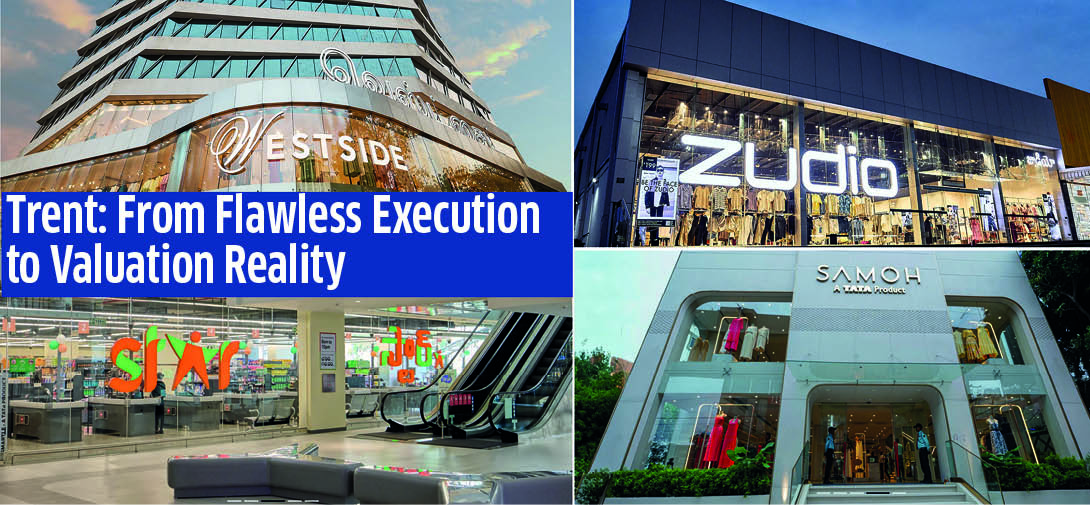
From a quiet compounder to a momentum behemoth and back to sobriety,
From a quiet compounder to a momentum behemoth and back to sobriety, Trent’s journey mirrors the life cycle of a great business meeting an unforgiving market. This deep dive unpacks the structural strengths that remain intact, the growth levers that are slowing, and the valuation assumptions that finally cracked, offering a cleareyed view of what lies ahead for long-term investors[EasyDNNnews:PaidContentStart]
The landscape of Indian retail has historically been a graveyard for ambitious projects that failed to grasp the nuances of the domestic consumer. However, Trent Limited, the retail arm of the Tata Group, has spent the last decade rewriting the rules of engagement in fashion and lifestyle. For the seasoned investor who has followed this stock from its nascent stages to its current status as a market behemoth, the journey has been nothing short of a masterclass in operational excellence and capital discipline.
Five years ago, the stock was a quiet performer trading at around ₹600. What followed was a meteoric, momentum-fuelled ascent that saw the price peak above ₹8,000 in late 2024. For many retail investors, the upward trajectory felt permanent, with social media echo chambers calling for targets of ₹20,000.

Yet, as we stand in early 2026, the narrative has shifted. The exuberance that characterised the bull run of 2021 through 2024 has been met with a sobering reality check in 2025. In a precipitous retreat, the stock has plunged to the ₹4,000 level. This 50 per cent collapse did not just bruise portfolios; it eviscerated ₹1.5 lakh crore in market capitalisation. The most striking detail? This crash was triggered by a quarter where the company reported 17 per cent revenue growth—a figure most firms would envy, but one that proved fatal for a stock priced for perfection.
This analysis deconstructs the financial engine of Trent, analyses the core question of capital deployment, and explores the strategic pivots that will define the next decade for this retail giant.

The Share Price Odyssey: From multibagger to Correction
The performance of Trent Limited on the National Stock Exchange (NSE: TRENT) and Bombay Stock Exchange (BSE: 500251) over the past five years has been a study in extreme momentum. In the post-pandemic recovery phase of 2021, Trent began to decouple from the broader retail sector, driven by the early successes of its value-fashion brand, Zudio. By 2023, the stock had become a darling of both institutional and retail investors, delivering a return of approximately 126.07 per cent in that year alone. This momentum accelerated further in 2024, with the share price surging by another 133.17 per cent, as the market priced in near-perfect execution and a massive expansion of the retail footprint.
However, the calendar year 2025 introduced a dramatic reversal of this trajectory. After reaching a high of ₹7,300 in January 2025, the stock entered a sustained period of correction. By December 2025, the share price had plummeted by over 46 per cent, marking the first annual decline for the stock in 12 years. The last annual fall the company’s share price saw was in the year 2013 of around four per cent.
Segmental Mastery: Westside, Zudio, and Star
Trent’s portfolio is strategically segmented to cover the entire spectrum of Indian consumption, from aspirational lifestyle to mass-market value fashion and high-frequency grocery.
Westside: The Lifestyle Anchor
Westside remains the bedrock of Trent’s profitability. As a destination for fashion, beauty, and home decor, it operates on a near-exclusive brand model. In FY25, Westside added a net of 16 stores, focusing on larger formats that can accommodate emerging categories such as footwear and innerwear.
Westside’s strategy is increasingly focused on 'WestStyle Club' members, who now number over 19 million. This loyal customer base provides a cushion against broader market volatility. In Q2FY26, despite muted sentiment, Westside’s online revenues grew by 56 per cent, reflecting the brand's successful integration with the Tata Neu platform.

Zudio: The Billion-Dollar Phenomenon
Zudio has been the primary growth engine for Trent over the last four years. By offering high-trend fashion at sharp price points (mostly under ₹999), Zudio has captured the imagination of the mass market. In FY25, the brand crossed the monumental milestone of ₹100 crore in annual sales.

Zudio’s expansion has been relentless, with a retail area addition of 58 per cent year-on-year in FY25. The third-order impact of this expansion is the creation of a 'cluster-based' dominance, where the brand saturated a micro-market to drive Logistics efficiency. However, the 2025 slowdown highlighted the risks of this strategy; as store density increased in Tier 2 and Tier 3 cities, same-store sales growth (SSSG) moderated to mid-single digits by Q4 FY25.
Star Bazaar: The High-Frequency Play
The Star supermarket business, a 50:50 joint venture with Tesco UK, has transitioned from a loss-making experimental format to a significant contributor to the Trent ecosystem. Focusing on fresh produce and own-brand staples, Star has seen a marked improvement in its operating performance.

The Star business is pivotal because grocery is the ultimate 'frequency driver'. By bringing customers into the ecosystem for daily needs, Trent can cross-leverage data for its fashion segments. In FY25, Star reported a healthy 24 per cent year-onyear growth in revenue, although Q2 FY26 saw a slight decline due to store upgrades and closures. Own-branded contribution has now scaled up to about 73 per cent, reinforcing Star’s margin profile and customer stickiness.
Operational Moats: Cost Drivers and Technology
Trent’s superior margins are not merely a function of brand power; they are the result of an obsessive focus on operational efficiency. The management has successfully variabilised a significant portion of its cost structure.
Main Cost Drivers
1. Rent and Occupancy: A defining characteristic of Trent's model is its approach to store rentals. The company utilises a 'variable payout' structure for many of its properties, aligning occupancy costs directly with store revenues. This ensures that in leaner months, the fixed cost burden is minimised.
2. Manpower and Automation: Despite the rapid addition of stores, employee costs as a percentage of revenue have remained contained. This is due to the integration of RFID (Radio Frequency Identification) technology across the entire supply chain. RFID has unlocked layers of productivity, allowing for faster stock-taking, reduced shrinkage, and more efficient billing processes.
3. Supply Chain Scaling: In FY25, Trent handled a volume growth of over 40 per cent. To manage this, the company transitioned from one-time-use cardboard boxes to reusable plastic totes in its distribution centres, significantly reducing logistics costs and waste.
Capital Reinvestment and Capex
Trent is a capital-hungry business because it is constantly building for the future. The company’s Capex plans are almost entirely funded through internal accruals, reflecting a strong cash-flow-from-operations (CFO) profile.

In FY25, Trent’s CFO rose to approximately ₹16.6 billion, up from ₹13.49 billion in the previous year. However, Free Cash Flow (FCF) moderated to ₹7.99 billion from ₹9.55 billion because the company chose to plough more capital into new stores and supply chain infrastructure. This is a strategic choice; Trent is prioritising land-grab and market share over shortterm cash accumulation.
The UAE Expansion and New Concept Launches
The 2024-2025 period saw Trent making its first serious foray into international markets, launching Zudio in the UAE. As of December 2025, there were four Zudio stores in the UAE, serving as a test case for whether the brand’s value proposition can be exported beyond the Indian subcontinent. Furthermore, Trent continues to seed new concepts. Samoh, launched in 2023, addresses the premium occasion-wear market, while Burnt Toast (2024) focuses on youth-led lifestyle and community. These concepts are currently in the incubation phase, much like Zudio was five years ago. For the retail investor, these represent the 'optionality' in the Trent story—small bets today that could become billion-dollar segments by 2030.
Sustainability and Governance: The Tata Legacy
Under the leadership of the late Mr. Ratan Tata and the current Chairman Mr. Noel Tata, Trent has maintained a moral compass that differentiates it from many aggressive retail competitors. The company’s 'Sustainability Strategy' is built on three pillars: being resource efficient, responsible by design, and people-conscious.
1. Environmental Stewardship: Trent has implemented IoT (Internet of Things) solutions in 395 stores to optimise energy consumption. Around 40 per cent of the electricity demand at its distribution centres is now met through renewable energy sources.
2. Social Impact: The company’s 'Do Good Bags' initiative, which upcycles fabric waste into bags made by women in marginalised communities, has reached over 7,00,000 customers.
3. Governance: Trent was awarded the 'Golden Peacock Award for Excellence in Corporate Governance' in 2024, a testament to its commitment to transparency and ethical business conduct.
The Core Question: Where Does the Money Go?
For a retail enterprise scaling at the pace of Trent, capital allocation is the most critical determinant of long-term value creation. The question of 'where the money goes' is best answered by examining the company’s reinvestment cycle, its aggressive store roll-out strategy, and its commitment to technology. Trent does not merely spend capital. It builds an infrastructure designed for speed and scale.
Historical Financial Performance (FY21 - FY25)
The following table summarises the consolidated financial performance of Trent Limited over the last five fiscal years. This period encompasses the pandemic-induced contraction and the subsequent explosive growth phase.

The financial architecture revealed here is one of increasing operating leverage. As revenues grew at a CAGR of over 58 per cent between FY21 and FY25, EBITDA margins expanded from 8.3 per cent to 17.9 per cent. This was achieved through a disciplined focus on own-branded merchandise and a reduction in raw material price volatility, combined with the aggressive scaling of Zudio.
The 2026 Outlook: Valuation & Verdict
Trent’s growth trajectory has visibly normalised after an exceptional run-up into FY24. The company delivered very high double-digit revenue growth in the years leading up to FY25, with consolidated revenue rising about 83 per cent in FY23 and about 50 per cent in FY24. In FY25, however, growth moderated to about 38 per cent, and the early trend in FY26 suggests a continuation of this slower run-rate.

A key underlying signal is the plateauing of store productivity. Revenue per sq. ft., which had scaled sharply in earlier years, shows clear moderation, moving from about ₹6,824 in FY21 to about ₹8,996 in FY22 and about ₹12,878 in FY23, before flattening around ₹12,891 in FY24 and declining marginally to ₹12,787 in FY25. This loss of momentum in revenue density indicates that incremental growth is increasingly being driven by footprint addition rather than strong like-for-like expansion, and this is consistent with the softer Like-for-Like (LFL) trajectory visible through H1FY26.
Key Observations on Growth Trends
◾Moderation in Fashion: The fashion portfolio saw explosive SSSG in FY23 (approximately 58 per cent) as it rebounded from pandemic lows. Within this period, the Westside brand specifically registered 49 per cent LFL growth. However, this rate normalised to 10 per cent in FY24 and shifted to a 'mid-to-low single-digit' trajectory through the first half of FY26 as the base became significantly larger and store density increased.
◾Star Bazaar Performance: The grocery segment delivered strong LFL growth of 27 per cent in FY24, driven by a successful pivot towards own-brand products and a 'Fresh' produce strategy. Growth moderated to 10 per cent by Q3 FY25 and turned flat in Q1 FY26, reflecting the broader slowdown in discretionary and frequency-led consumption in 2025.
◾2025 Headwinds: Management cited muted consumer sentiment, unseasonal rainfall, and a transition to a new GST regime as primary factors impacting SSSG in the 2025 periods. During this time, shoppers appeared to prioritise high-ticket items with GST reduction benefits over smaller-ticket lifestyle purchases.
◾The 'Micro-Market' Shift: In recent filings, management has emphasised that they now prioritise total revenue growth within comparative 'micro-markets' over the traditional single-store SSSG metric. This strategy involves intentionally increasing store density, even if it cannibalises individual store sales, to maximise the total wallet share in a specific geographic area.
This shift matters because Trent’s prior valuation had embedded an assumption of sustained hyper-growth from a combination of aggressive store expansion and strong same-store throughput. At peak optimism, the stock was trading at nearly 200 times its earnings, effectively pricing in prolonged compounding at an elevated pace. As growth moderated and like-for-like momentum softened, the valuation reset has been sharp, with the TTM P/E contracting to approximately 87 times, implying a 57 per cent de-rating from peak levels. Going forward, given the higher base and the likelihood of only moderate LFL contribution, we expect revenue growth to remain more measured. This will limit the probability of a meaningful P/E re-expansion. That said, Trent’s asset-light model and strong execution continue to translate into a healthy ROCE of approximately 30 per cent, supporting robust cash flow generation and enabling expansion through internal accruals. With the stock now re-rated to reflect moderate growth rather than hyper-growth, we expect valuations to stabilise in a peer-consistent band, broadly in line with DMart’s approximately 86 times P/E given a comparable growth profile, leaving limited scope for further re-rating unless productivity and LFL trends re-accelerate materially.
Therefore, it is recommended that readers should stay away (Avoid) from the stock as of now despite such fall in its share price from its peak.
[EasyDNNnews:PaidContentEnd] [EasyDNNnews:UnPaidContentStart]
To read the entire article, you must be a DSIJ magazine subscriber.
[EasyDNNnews:UnPaidContentEnd]