TVS Motor
Ratin / 06 Aug 2026 / Categories: Analysis, Analysis, DSIJ_Magazine_Web, DSIJMagazine_App, Regular Columns
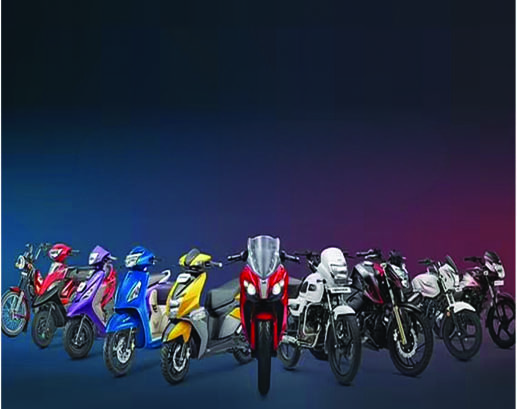
TVS Motor has emerged as one of the strongest re-rating stories in India’s automobile sector.
A stronger product mix, rising market share, and expanding mobility platforms are powering TVS Motor’s growth momentum [EasyDNNnews:PaidContentStart]
TVS Motor has emerged as one of the strongest re-rating stories in India’s automobile sector. Over the 12 months ended July 29, 2026, the stock gained nearly 45 per cent, outperforming the Nifty Auto index’s 16.6 per cent rise. It was trading at an all-time high of around ₹4,066 on July 29, 2026. This reflects company-specific execution across volumes, product mix, margins, and new profit pools.
TVS Motor is no longer primarily dependent on commuter motorcycles. Scooters, premium motorcycles, electric vehicles, three-wheelers, exports, and TVS Credit now form a broader mobility ecosystem, helping it outpace the domestic industry while improving profitability. The investment case rests on converting these engines into sustained consolidated earnings and cash flow growth.
What Drove the Rerating?
Between FY24 and FY26, vehicle sales increased from 41.9 lakh units to 58.9 lakh units, implying a CAGR of around 18.6 per cent. Revenue from operations rose faster, from ₹31,776 crore to ₹47,270 crore, translating into a CAGR of approximately 22 per cent.
Profit growth was substantially stronger. EBITDA increased from ₹3,514 crore to ₹6,079 crore, while PAT rose from ₹2,083 crore to ₹3,615 crore. Both compounded at more than 31 per cent annually. EBITDA margin expanded from 11.1 per cent to 12.9 per cent, while PAT margin improved from 6.6 per cent to 7.6 per cent.
This divergence between volume, revenue, and profit growth is central to the investment case. TVS Motor earned more per vehicle through pricing, a favourable product mix, and operating leverage. A higher contribution from scooters,
premium motorcycles, electric vehicles, and exports helped revenue outpace volumes, while improved fixed-cost absorption allowed EBITDA to grow faster than revenue.
Financial Performance

The June 2026 quarter extended this trend.
◾ Vehicle sales increased by 28 per cent year on year to 16.3 lakh units.
◾Revenue rose by 38 per cent to ₹13,896 crore.
◾EBITDA grew by 41 per cent to ₹1,779 crore.
◾EBITDA margin expanded by 30 basis points to 12.8 per cent despite higher commodity costs.
◾PAT increased by 51 per cent to ₹1,174 crore.
On a broad per-vehicle basis, blended revenue improved by around 8 per cent and EBITDA per vehicle by nearly 11 per cent. Although these measures include spare parts and other operating revenue, they show that Q1FY27 growth was driven by mix and margins, not volumes alone. Price increases, cost optimisation, and operating leverage also offset part of the raw material inflation. Sustaining EBITDA margin around 12.8 to 13 per cent would support earnings growth even if industry volumes normalise.
Positioned in Attractive Industry Segments
India’s two-wheeler industry reached record domestic wholesale volumes of around 2.17 crore units in FY26, supported by improving rural demand, affordability, scooter growth, and premiumisation. Including exports, total industry volumes stood at approximately 2.68 crore units. CRISIL Ratings expects this combined volume to grow by around 7–9 per cent to nearly 2.9 crore units in FY27 because of the high base and monsoon-related risks. The market’s structural shift remains favourable for TVS Motor.
Scooters are gaining importance with expanding urban mobility, while premium motorcycles benefit from demand for larger engines, connected features, improved safety, and better styling. TVS Motor is well placed in both categories: Jupiter provides family-scooter scale, Ntorq targets younger buyers, Apache anchors premium motorcycles, and Raider and Ronin cover commuter-premium and lifestyle segments. Their higher realisations and product differentiation can support revenue and EBITDA growth ahead of industry volumes.
The company operates plants in Hosur, Mysuru, Nalagarh, and Indonesia and exports to more than 60 countries. Its partnership with BMW Motorrad provides access to global premium platforms, while the acquisition and revival of Norton extend its addressable market beyond mass and mid-premium mobility.
TVS Motor’s domestic two-wheeler share increased to 20 per cent in FY26 from 18 per cent in FY25. Its expanding presence in premium motorcycles and electric scooters, supported by strong product acceptance and a widening portfolio, has contributed to this improvement.
Electric Mobility: From Scale to Profitability
TVS Motor has built a meaningful electric two-wheeler scale through iQube and Orbiter. Installed capacity is around 40,000 units per month, with plans to move towards 50,000 units. It also has an established dealer and service network, manufacturing scale, and access to customer financing through TVS Credit.
The opportunity is important because scooters are expected to dominate electric two-wheeler adoption. TVS can leverage its existing customers, supplier relationships, and distribution network at a lower execution risk than an entrant building these capabilities from the beginning
The next phase is about unit economics. Localisation of batteries, electronics, and other critical components can lower costs, while scale can improve fixed-cost absorption. Delivery, gig, and commercial applications also offer a stronger total cost of ownership case. Battery as a Service, bundled maintenance, connectivity, and financing could increase lifetime earnings. The key trigger is evidence that EV growth improves consolidated profitability, supported by clearer disclosure of EV revenue, contribution margin, localisation, and break-even timelines.
The profitable internal combustion engine portfolio allows TVS Motor to fund EV product development, capacity, and distribution, reducing dependence on external funding and providing greater flexibility in pricing and investment decisions.
Exports and Global Premium Platforms
TVS Motor has expanded two-wheeler and three-wheeler exports across Africa, Latin America, and parts of Asia as foreign exchange availability and macroeconomic conditions improved. Exports reduce dependence on the Indian demand cycle and allow common products and platforms to be used across geographies, improving scale economics and R&D payback.
The company is also moving up the global premium curve through BMW Motorrad and Norton. These initiatives provide access to higher-value products and international customers. Profit contributions from Norton and BMW-linked platforms could lift realisations and strengthen the export franchise.
Exports remain cyclical, with currency shortages, political disruptions, inflation, and regulatory changes affecting demand and profitability, while Norton requires continued investment. The test is whether these businesses generate acceptable returns across a complete cycle. Even so, exports widen the addressable market, improve asset utilisation, and reduce dependence on one geography
Commercial Mobility Adds an Emerging Profit Pool
TVS Motor’s three-wheeler business is smaller than its twowheeler operations but is growing significantly faster, providing exposure to passenger transport, cargo movement, last-mile delivery, urban Logistics, and self-employment.
Electric cargo and passenger three-wheelers may achieve economic viability earlier than several personal EV categories because commercial operators focus on running costs and utilisation. Growth in e-commerce, organised logistics, and gig employment could support the segment. TVS Motor’s engineering capability, service network, and captive financing platform may provide a competitive advantage as volumes scale.
The segment could add operating leverage and diversify the company beyond personal mobility. Investors should monitor pricing discipline, fleet financing, after-sales support, and profitability rather than focusing only on unit growth.
TVS Credit: From Sales Enabler to Earnings Engine
A large proportion of two-wheelers in India is financed through Banks and non-banking financial companies. Owning a lender embedded within the dealer network allows TVS Credit to support sales, serve customers underserved by traditional banks, and monetise relationships through repeat loans and cross-selling. Interest and fee income also diversify earnings beyond manufacturing margins.
In FY26, TVS Credit’s assets under management stood at ₹30,639 crore, up 15 per cent. Total income reached ₹7,196 crore, profit before Tax rose to ₹1,238 crore, and PAT increased 19 per cent over FY25 to ₹913 crore.
If asset quality and funding costs remain controlled, TVS Credit can increasingly act as a profit engine rather than merely a sales support function. The lending business, however, changes the group’s risk profile. Consolidated leverage is substantially higher than standalone leverage because borrowings support the finance company’s loan book, and this debt should not be viewed like manufacturing debt.
Investors must still track gross non-performing assets, credit costs, borrowing costs, liquidity, and capital adequacy. Rapid AUM growth will create value only if underwriting and collection remain disciplined. TVS Credit can also support EV adoption through specialised financing, improve customer retention, and provide repayment and vehicle-usage data as the group expands into connected mobility and subscription-based services.
Cash Flow and Capital Allocation
TVS Motor continues to invest in electric vehicles, Norton, premium platforms, exports, and technology. R&D expenditure increased from ₹645 crore in FY24 to ₹1,254 crore in FY26, almost doubling in two years.
Operating free cash flow meanwhile improved to approximately ₹3,805 crore in FY26 from around ₹2,586 crore in FY25. Management has indicated that FY27 investments could be ₹500 crore to ₹600 crore lower than the approximately ₹2,400 crore deployed in FY26. Rising free cash flow alongside moderating incremental investment suggests that earlier spending is beginning to translate into cash generation, supporting return ratios and reducing the need for higher standalone leverage.
Capital allocation is becoming more complex as domestic cash funds EV platforms, overseas subsidiaries, Norton, and strategic investments. Their success should be judged by whether they narrow the gap between standalone and consolidated profitability. Prolonged group losses would weaken earnings quality, whereas lower subsidiary losses and better global returns could become catalysts. Strong return ratios provide comfort, but investors must increasingly evaluate capital deployment at the consolidated level.
Valuation Reflects Strong Expectations
TVS Motor trades at a trailing price-to-earnings multiple of around 54.6 times, compared with a three-year median of approximately 61.3 times. The stock is below its historical multiple but remains expensive in absolute terms and relative to listed peers.

TVS Motor trades at roughly a 50 per cent premium to Eicher Motors and more than double the multiples of Bajaj Auto and Hero MotoCorp. Strong recent earnings growth, high return ratios, and multiple growth engines partly support the premium, but the stock consequently has the least valuation cushion among the major listed two-wheeler manufacturers. The valuation assumes share gains, stable margins, improving EV economics, and profitable overseas investments. Any slowdown could trigger earnings downgrades and multiple compression. Yet earnings compounded at more than 31 per cent between FY24 and FY26, Q1FY27 EBITDA rose 41 per cent, return on equity is above 30 per cent, and the growth profile is broader than several traditional peers. Continued delivery can therefore support the premium and drive returns through profit growth.
Key Risks and Monitorables
Domestic demand could slow in FY27, while weaker rural income or an adverse monsoon may affect entry-level motorcycle and scooter demand. Persistent increases in steel, aluminium, electronics, or battery inputs could also pressure profitability if price increases weaken demand.
Competition in electric vehicles remains intense. Aggressive pricing by traditional manufacturers and pure-play EV companies, alongside changes in subsidies and regulations, could delay profitability. Exports remain vulnerable to currency shortages, political disruptions, and changing import rules, while Norton and other global platforms carry execution and capital allocation risks.
TVS Credit introduces credit-cycle risk, making disciplined underwriting and collection essential as AUM grows. Key monitorables include domestic market share in scooters and premium motorcycles, EV volumes and margins, export profitability, three-wheeler economics, TVS Credit’s asset quality, free cash flow, and consolidated EPS relative to standalone EPS.
Investment View
TVS Motor’s investment case remains anchored in strong execution and a broader earnings base. Between FY24 and FY26, revenue compounded at about 22 per cent, while EBITDA and PAT grew at more than 31 per cent annually. The momentum continued in Q1FY27, with volumes increasing 28 per cent, revenue 38 per cent and EBITDA 41 per cent, reflecting healthy demand, a favourable product mix and operating leverage.
The company is well positioned across several attractive segments. Scooters and premium motorcycles support better realisations, while electric vehicles, exports, three-wheelers and global platforms such as Norton offer additional growth opportunities. TVS Credit strengthens the ecosystem by supporting vehicle sales and generating income beyond the initial purchase.
Cash generation has improved, while moderation in incremental investment may support returns and consolidated profitability. However, much of this growth potential appears reflected in the current valuation. The stock trades at a sizeable premium to major listed peers, leaving limited room for earnings disappointment, margin pressure or delays in improving returns from EV and overseas investments.
We recommend a HOLD for existing investors. The company’s business fundamentals and long-term growth prospects remain strong, but the elevated valuation and recent momentum restrict near-term upside and raise the risk of volatility. Fresh buying may be considered after it starts trading near its 20-day moving average. Key monitorables include EV profitability, Norton and subsidiary performance, TVS Credit’s asset quality, free cash flow and consolidated earnings growth.
[EasyDNNnews:PaidContentEnd] [EasyDNNnews:UnPaidContentStart]
To read the entire article, you must be a DSIJ magazine subscriber.
[EasyDNNnews:UnPaidContentEnd]