UPI MDR Rollout Deferred: NPCI Pushes 0.4% Charge Beyond Diwali
DSIJ Intelligence / 14 Oct 2026 / Categories: Mindshare, Trending
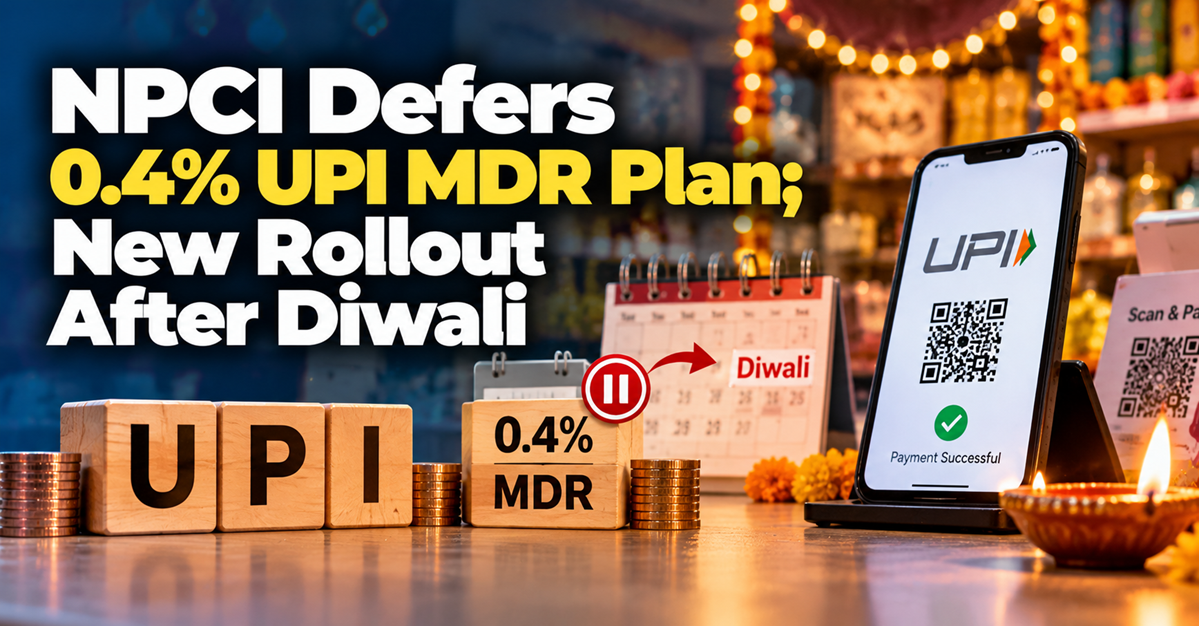
NPCI has deferred the proposed 0.4 per cent MDR on select UPI merchant transactions above Rs 2,000 until after Diwali, giving merchants and payment companies more time to prepare.
The proposed 0.4 per cent merchant discount rate on select UPI payments above Rs 2,000 will not kick in from October 15 as planned. NPCI has pushed the rollout to immediately after Diwali, giving merchants, Banks and payment companies more time to prepare.
The National Payments Corporation of India (NPCI) has pushed back the introduction of Merchant Discount Rate (MDR) on select UPI transactions, just two days before the proposed October 15 implementation date.
The decision was taken by the UPI and Services Steering Committee on October 13, with NPCI saying the festive season was the reason for the delay. The new implementation date has not been announced yet, but the organisation has said the charges will be introduced immediately after Diwali. Diwali falls on November 8 this year.
For merchants, this means there will be no immediate change to the existing UPI payment structure on October 15. For the payments industry, however, the delay is more than just a short-term breather. The proposed MDR framework remains intact; only its implementation has been pushed back.
What Was Supposed to Change?
Under the framework announced in September, select Person-to-Merchant (P2M) UPI transactions above Rs 2,000 were to attract an MDR of 0.4 per cent.
The charge would be paid by the merchant rather than the consumer. For a Rs 5,000 eligible transaction, for instance, the proposed MDR would work out to Rs 20. A Rs 10,000 payment would attract Rs 40. For transactions of Rs 75,000 and above, the MDR would be capped at Rs 300 per transaction.
The framework does not mean that every UPI payment will suddenly become chargeable. Person-to-person transfers remain free, while merchant transactions up to Rs 2,000 remain outside the proposed MDR framework. NPCI has also said that more than 95 per cent of UPI merchant transactions by volume are below the threshold and would remain unaffected.
Why Has NPCI Delayed the Rollout?
NPCI's official explanation is simple: the festive season.
That timing matters. Diwali is one of the busiest periods of the year for retailers, e-commerce platforms, restaurants, travel businesses and other merchants. Introducing a new payment cost in the middle of the shopping season could have created additional confusion just as transaction volumes were picking up.
The decision also comes after concerns from merchant bodies and participants across the payments ecosystem. Businesses had sought more time to understand the proposed framework and prepare their systems for the change.
The Confederation of All India Traders had also raised concerns around the timing of the proposed fee, particularly for traders and small businesses operating on tight margins. The group welcomed the postponement, calling it a relief during the crucial festive and wedding season.
This Is a Delay, Not a Withdrawal
NPCI has not scrapped the proposed MDR. The framework will still be implemented after Diwali, with the exact date to be notified separately. The original framework was designed to introduce a commercial revenue stream into an ecosystem that has operated with zero MDR on UPI merchant transactions for years.
NPCI says the revenue would remain within the UPI ecosystem and help support infrastructure, cybersecurity, innovation and customer service. The objective is to make the payments network financially more sustainable as transaction volumes continue to grow.
Most Everyday UPI Payments Will Remain Free
There is no new charge for making a normal UPI payment. Consumers will continue to be able to use UPI without paying a transaction fee. Person-to-person transfers will remain free regardless of transaction size. Merchant payments up to Rs 2,000 will also remain outside the proposed MDR framework.
Looking for Quality Mid-Cap Growth Opportunities?
Explore DSIJ’s Mid Bridge - a research-driven service focused on fundamentally strong mid-cap companies with robust business models and long-term growth potential.
Download Service BrochureSmall merchants operating under the P2PM framework are also protected from MDR under the proposed structure, subject to the applicable eligibility conditions. This means the change is aimed primarily at selected higher-value merchant transactions rather than everyday payments such as buying groceries, paying for a meal or making a small retail purchase.
Some Sectors Get a Different Treatment
The proposed framework also recognises that a single MDR rate may not work equally well across every industry. For specified categories such as Railways, telecom services, insurance, fuel and agricultural inputs, the proposed MDR is a flat Rs 5 per transaction for eligible payments above Rs 2,000.
Capital-market transactions have an even lower proposed rate of 0.02 per cent, subject to a maximum of Rs 300. This category covers payments involving Mutual Funds, securities, stockbrokers and dealers. The differentiated structure is intended to prevent the proposed fee from becoming disproportionately expensive in sectors where margins or transaction economics are different.
Why the Move Matters for Fintech Companies
Companies such as Paytm, Pine Labs and One MobiKwik Systems have been closely watched by the market because the introduction of MDR could eventually create a new revenue stream across the digital payments ecosystem.
The proposed framework had been viewed as an important development for payment companies that have spent years operating in a market where UPI transactions did not provide a direct merchant-fee revenue stream.
When the postponement was announced, shares of some fintech companies initially came under pressure before recovering from the day's lows. The market reaction reflects the fact that investors are now having to push their expectations for the revenue impact beyond the festive season.
UPI Has Become Too Large to Ignore the Cost Question
According to NPCI's September framework, UPI processed 2,451 crore transactions worth Rs 29.9 lakh crore in August 2026 alone.
Running a payments network at this scale requires large investments in technology infrastructure, cybersecurity, fraud prevention, network capacity and banking systems. NPCI has argued that relying entirely on government support is not a sustainable long-term funding model for such a rapidly expanding ecosystem
The other side of the debate is equally important. UPI's success has been built partly on its simplicity and low cost. Merchants have become accustomed to accepting digital payments without a transaction fee, and businesses are concerned that introducing charges could increase their costs or alter customer payment behaviour.
The Real Test Comes After Diwali
Banks, payment aggregators, fintech companies and merchants now have additional time to prepare for the new system. They can also use the period to clarify operational questions around fee collection, settlement and the treatment of different merchant categories.
For the government and NPCI, the challenge will be to introduce a revenue model without weakening one of India's most widely used digital payment systems.
For merchants, the key issue will be whether the relatively low MDR can be absorbed as a normal payment-processing cost or whether it eventually affects pricing decisions and payment preferences.
For consumers, the important point is that UPI itself remains free. The proposed MDR is a merchant-side charge and has now been pushed beyond Diwali.
The next major announcement will therefore be the revised implementation date. Until then, the existing UPI payment structure remains in place, giving merchants and the wider payments ecosystem a festive-season reprieve.
Disclaimer: The article is for informational purposes only and not investment advice.