Why IPOs List Above or Below the Issue Price
Rithvik / 19 Sep 2026 / Categories: Knowledge, Trending
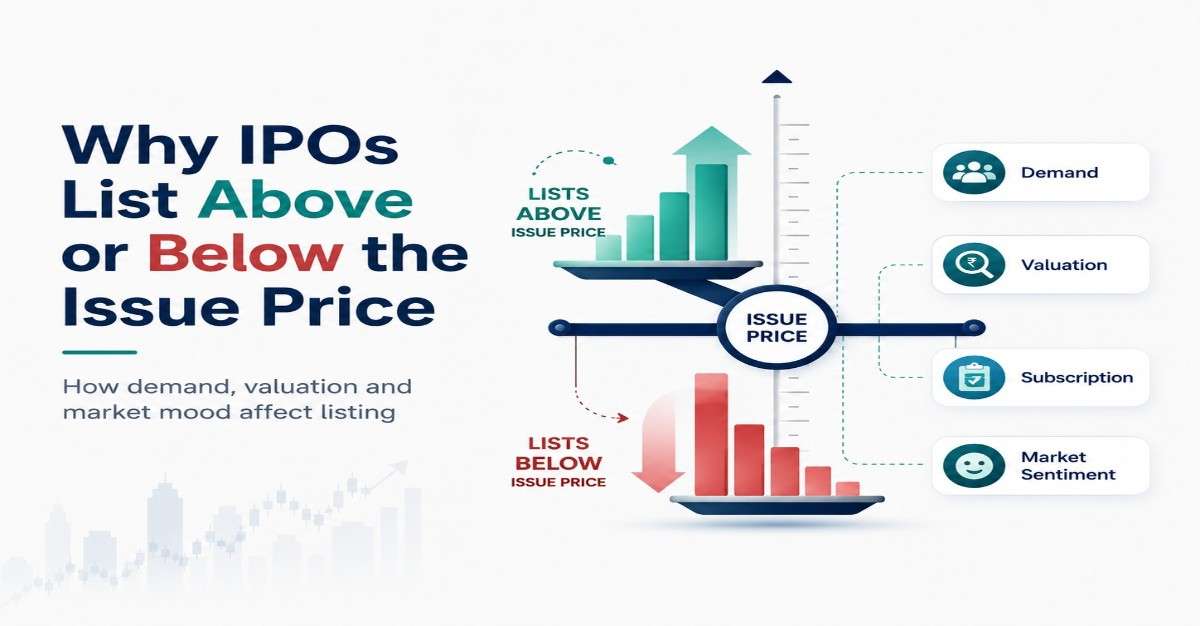
Understand how demand, valuation, subscription and market conditions influence an IPO’s listing price.
An IPO’s issue price is fixed before listing, but its first traded price is determined by market demand and supply. This is why some IPOs open at a premium while others begin below the issue price. The difference is commonly described as a listing gain or listing loss.
Understanding why IPOs list above or below the issue price requires investors to separate the price discovered during the offer from the price discovered on the exchange. The first reflects bidding during the IPO. The second reflects what buyers and sellers are willing to accept on listing day.
How the IPO Issue Price Is Decided
In a book built IPO, the company and its Book Running Lead Managers announce a price band. Investors submit bids within that range, and demand is recorded across investor categories and price levels. The final issue price is determined after bidding closes. SEBI describes book building as a price discovery process in which bids are collected within the announced band.
The issue price is influenced by financial performance, growth prospects, industry outlook, peer valuations, investor feedback and the capital being raised. However, it remains an offer price and does not guarantee that the market will assign the same value after listing.
How the Listing Price Is Discovered
Newly listed shares participate in a special pre open session. Buy and sell orders are collected, and an equilibrium price is calculated from the Order Book. NSE states that the equilibrium price discovered in this session becomes the opening price.
If demand above the issue price is much greater than the available sell quantity, the stock may list at a premium. If buying demand is weak and sellers accept lower prices, it may list at a discount.
Subscription Can Influence Demand
Heavy subscription can signal strong interest. When many investors receive no allotment, some may try to buy after listing, adding demand in the secondary market.
However, subscription data should not be read alone. An issue may appear heavily subscribed because of large bids from a limited number of applicants or demand concentrated near the close. Retail participation and institutional demand are useful indicators, but neither guarantees a listing gain.
Valuation Matters
A good business can still list weakly if the issue is priced aggressively. Investors compare the IPO valuation with listed peers, historical growth, margins, return ratios and expected earnings.
Suppose an IPO is priced at a price to earnings ratio of 40 while comparable companies trade near 25. The premium may be justified if the issuer has faster growth, stronger margins or a better balance sheet. If those advantages are unclear, investors may resist paying the higher valuation.
A reasonably priced issue leaves more room for positive price discovery. An expensive offer requires the company to meet high expectations quickly.
Market Conditions Can Change
An IPO may close during a strong market but list after a correction. Changes in interest rates, crude oil, global markets, currencies, geopolitics or domestic policy expectations can alter sentiment within days.
When the broader market becomes risk averse, investors may avoid newly listed companies because they have limited trading history. Even a well subscribed issue can list below expectations. Improving sentiment between closure and listing can have the opposite effect.
Issue Size and Tradable Supply
The number of shares available for trading can influence volatility. A small public float combined with strong demand may create a sharp premium because few shares are offered for sale.
A large issue requires more buying interest to absorb the supply. This does not mean large IPOs always perform poorly, but more capital is needed to support a strong listing. Lock in requirements and restricted holdings may also affect the quantity immediately available for trading.
Company Specific Developments
News after the IPO closes can alter listing demand. This may include sector regulation, major contracts, legal developments, earnings updates or promoter related news.
The purpose of the issue also matters. Fresh capital used for expansion or debt reduction may be viewed differently from an offer dominated by shareholder exits. Investors assess whether the transaction improves the company’s financial position and future earnings capacity.
Why Grey Market Premium Is Unreliable
Grey market premium, or GMP, is an unofficial indication of prices discussed before listing. It is not an exchange traded, regulated or guaranteed price.
GMP can change quickly and may be based on limited transactions. It should not replace analysis of valuation, financials, risks and subscription quality. The actual opening price is discovered through exchange orders.
Key Takeaway
Why IPOs list above or below the issue price comes down to demand and supply on listing day. Subscription, valuation, market conditions, issue size, tradable supply and new information all influence that balance.
A premium listing does not prove that an IPO is a good long term investment, just as a discount listing does not automatically indicate a weak company. Over time, the share price will increasingly reflect earnings, execution and valuation.