Worried in Weak Markets? Let This Ratio Reveal the True Quality of Your Investments
Mandar / 11 Mar 2026 / Categories: Mutual Fund, Trending
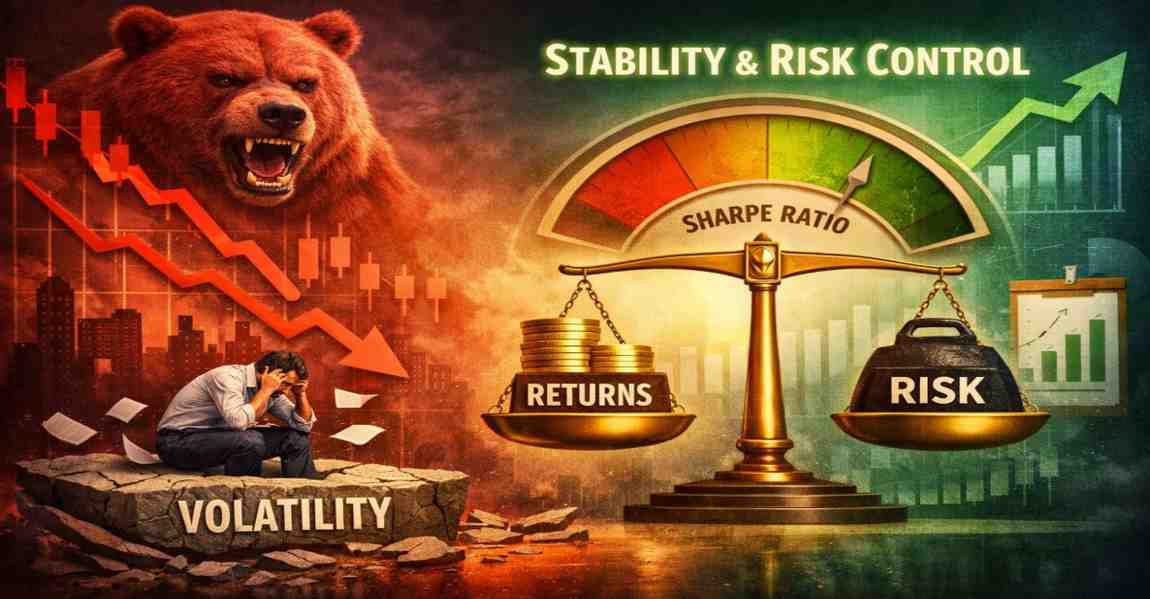
It is a simple way to judge whether your investments are delivering returns that truly justify the risks you take. Take a look!
When markets are rising, investors often focus only on one number, the return generated by a Mutual Fund. However, experienced investors know that return alone does not tell the complete story. The real question is how much risk a fund manager took to generate that return. This is where the ‘Sharpe Ratio’ becomes an important tool for evaluating mutual fund performance.
What is the Sharpe Ratio?
The Sharpe Ratio measures the risk-adjusted return of an investment. In simple terms, it indicates how much excess return an investor earns for each unit of risk taken. The concept was developed by Nobel Prize-winning economist William F. Sharpe. The formula compares the return generated by a fund over the risk-free rate, usually represented by government securities, and divides it by the fund’s volatility.
Sharpe Ratio = (Expected portfolio return - Risk free rate of return) / Standard Deviation
For investors, the interpretation is straightforward. A higher Sharpe Ratio indicates that a fund has delivered better returns for the level of risk it has taken. A lower ratio suggests that the returns may not adequately compensate for the volatility experienced by investors.
Understanding Through a Simple Example
Consider a simple example. Suppose Fund A and Fund B both deliver annual returns of 12 per cent. At first glance, they appear equally attractive. But if Fund A achieved this return with significantly lower volatility while Fund B experienced sharp ups and downs, Fund A would have a higher Sharpe Ratio. In other words, investors in Fund A enjoyed a smoother journey.
Why the Sharpe Ratio Matters in Weak Markets
The importance of the Sharpe Ratio becomes even more evident during weak or volatile markets. When markets correct or move sideways, several funds struggle to maintain strong returns. During such periods, the ability of a fund to control downside risk becomes crucial. Funds with higher Sharpe Ratios tend to manage volatility better and often protect capital more effectively than those chasing aggressive returns.
For instance, a fund that generates 10 per cent return with moderate fluctuations may have a stronger Sharpe Ratio than another fund that delivers 14 per cent but experiences large drawdowns. In turbulent markets, investors often prefer consistency over occasional bursts of high performance.
Using the Sharpe Ratio Wisely
The Sharpe Ratio is also useful when comparing funds within the same category. Two Large-Cap funds may show similar long-term returns, but their risk-adjusted performance may differ significantly. Looking at the Sharpe Ratio helps investors identify funds that have delivered returns more efficiently.
Investors can find the Sharpe ratio in mutual fund factsheets, fund research platforms, and financial websites, where it is listed under risk-adjusted performance metrics.
However, the metric should not be used in isolation. It is based on historical data and may not fully capture future risks. Investors should combine it with other indicators such as portfolio quality, consistency of returns and the fund manager’s investment strategy.
The Bigger Picture
In the end, the Sharpe Ratio offers an important perspective that many investors overlook. It shifts the focus from chasing the highest return to understanding the quality of those returns. Especially in uncertain markets, this shift in perspective can make a meaningful difference in long-term investment outcomes.