The Pharma Pyramid: Why Not Every Drug Company Is in the Same Business - Part 1
 Join Us
 Follow Us
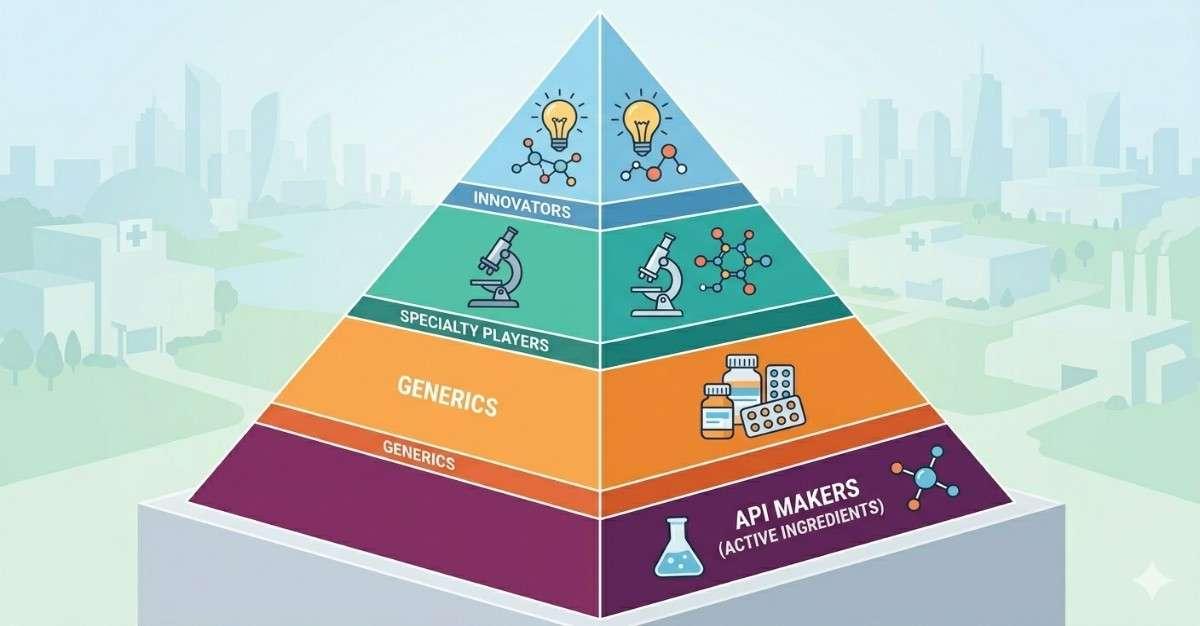
Innovators, generics, specialty players, and API makers understanding the difference could change how you look at every pharma stock in your portfolio.Innovators, generics, specialty players, and API makers understanding the difference could change how you look at every pharma stock in your portfolio.
✨ Key Takeaways
The Companies That Own Their Drugs
The Pharma Industry Is Not One Business. It Is Several.
Most people, when they think of a pharmaceutical company, picture a lab coat, a blockbuster pill, and a massive ad campaign. That image fits maybe five percent of the industry. The rest is a dense, interconnected web of companies doing very different things, some discovering drugs, some testing them, some making them, and some just selling them. Understanding who does what is genuinely useful if you want to make sense of any pharma stock.
Let's walk through it from the beginning.
Where It All Starts: The Innovators
At the top of the food chain are the innovator companies, the ones that actually discover new medicines. They spend billions funding basic research, often spending a decade or more before a drug ever reaches a patient. For every compound that makes it to market, dozens die in trials. The economics are brutal, but the payoff, when it works, is a patent-protected monopoly that can generate extraordinary returns for years.
Pfizer, Eli Lilly, Roche, AstraZeneca these are the names most people recognise. In India, the innovator model is still early. Sun Pharma has made moves in specialty therapy with its dermatology pipeline. Zydus developed Saroglitazar for NASH, a liver condition with no approved treatment for a long time. Biocon has built a credible biologics franchise. But honest disclosure: most Indian pharma companies are not innovators in the traditional sense, and their valuations do not reflect that kind of pipeline risk or reward.
The Generic Engine
This is the heart of Indian pharma, and it is worth understanding properly rather than dismissing it as "just copying drugs."
When a branded drug's patent expires, other companies are legally allowed to manufacture and sell the same molecule. They do not redo the original safety and efficacy trials but they do have to prove that their version performs the same way in the body, which requires real formulation work, bioequivalence testing, and regulatory approval. In the US, this happens through the ANDA route at the FDA. In India, the domestic market works largely on branded generics, where ten different companies might sell the same molecule under ten different brand names.
The companies that built India's pharma reputation Sun Pharma, Cipla, Dr. Reddy's, Lupin, Aurobindo, Torrent are primarily generic players. What separates them is not access to molecules (the molecule is free once the patent expires) but execution: how fast they file, how clean their plants are, how wide their doctor networks reach, and how efficiently they manage costs when five competitors enter the same market.
Specialty Pharma: The Higher-Margin Middle Ground
Not every generic plays at the commodity end. Some companies focus on therapeutic areas where the drug is off-patent but the formulation, delivery mechanism, or clinical complexity creates a natural moat. An injectable chemotherapy drug is technically off-patent but requires sterile manufacturing expertise that most companies cannot replicate overnight. A complex dermatology formulation may need years of development before it can reliably substitute the original.
This is broadly what "specialty pharma" means and it commands better margins than plain generics. Natco Pharma built much of its reputation in oncology. Alkem is strong in gastroenterology and central nervous system drugs. The differentiation here is less about chemistry and more about which difficult-to-make categories you choose to compete in.
API: The Hidden Foundation
Before anyone can make a tablet, somebody needs to make the active molecule the substance that actually does the therapeutic work in your body. That is the API, or Active Pharmaceutical Ingredient, and there is an entire industry built just around manufacturing these raw drug substances.
India is a globally significant API supplier, which is a quiet source of competitive strength. But here is the catch that investors often underappreciate: India itself sources a meaningful chunk of its key starting materials, the chemical precursors to APIs from China. That dependency has been a recurring risk theme since the supply disruptions of 2020, and it is the underlying reason the government's PLI scheme for APIs exists.
Divi's Laboratories is probably the most followed API name on Indian exchanges. Aarti Drugs, Solara, and Granules India are others with meaningful API exposure.
The Takeaway from Part 1
Think of these four categories as a spectrum. Innovators take the most risk and, in theory, earn the most reward. Generic companies take far less scientific risk but face relentless pricing pressure. Specialty pharma sits in between lower R&D risk than innovators, better margins than plain generics. API manufacturers underpin the whole system but are exposed to raw material costs, China dependence, and commodity-style pricing cycles.