Market Mayhem: Understanding the Sensex-Nifty Crash and What Investors Must Do Now
 અમારી સાથે જોડાઓ
 અમને અનુસરો
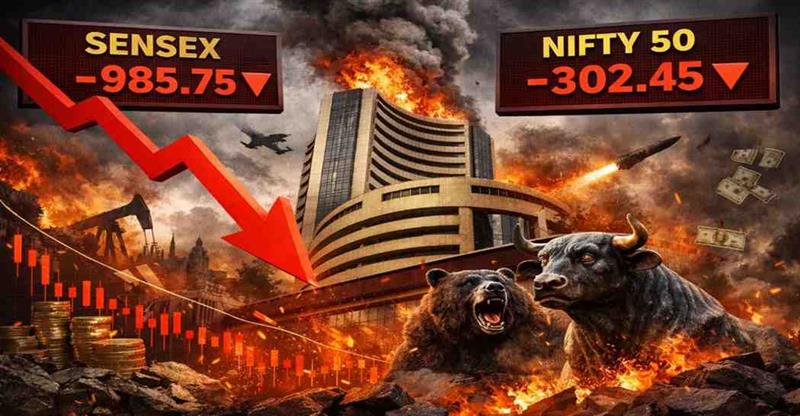
When geopolitics meets year end seasonality, markets don't just correct they recalibrate. Here's what's driving the decline, what history tells us and how disciplined investors should respond.
✨ આઇ સંચાલિત સારાંશ
Indian equity markets are enduring one of their sharpest corrections in over a year. The BSE Sensex has plunged 1,403 points to 74,630, while the Nifty 50 has fallen 470 points to 23,168 marking losses of nearly 2 per cent in a single session. For the week, indices are down 4.5–4.8 per cent, the steepest weekly decline since December 2024. Over 3,000 stocks declined against just 743 advancing, painting a vivid picture of broad based selling pressure. This isn't isolated volatility. This is a confluence of factors like geopolitical, structural and seasonal that demands investor attention and discipline.
The Seven Forces Behind the Decline
Crude Oil Surge and Supply Fears: Brent crude has crossed the psychologically critical USD 100 per barrel mark after Iranian strikes on two oil tankers raised fears of supply disruptions through the Strait of Hormuz. For India, which imports over 80 per cent of its crude oil requirements, this is a direct hit. Higher crude prices widen the current account deficit, fuel inflation and compress corporate margins particularly in sectors like aviation, Logistics, paints and chemicals. When oil becomes expensive the entire economy feels the strain.
Weak Global Cues and Risk-Off Sentiment: Global markets are hemorrhaging. The Dow Jones fell over 700 points, slipping below 47,000 for the first time this year. Asian indices — KOSPI, Nikkei, Hang Seng and SSE Composite are all trading lower. The escalating West Asia conflict has pushed global investors into a defensive posture, triggering risk-off trades worldwide. When the world's largest markets retreat, emerging markets like India rarely escape unscathed.
Persistent Foreign Institutional Investor (FII) Selling: FIIs offloaded Rs 7,050 crore worth of equities on Thursday alone. For March so far, foreign investors have sold over Rs 46,000 crore in Indian equities. Looking at the broader picture, FIIs have been net sellers in 8 out of the 11 months in FY26, with cumulative outflows exceeding Rs 2.10 lakh crore. This relentless selling pressure, even in Large-Cap blue chips reflects deep structural concerns about valuations, global liquidity tightening, and geopolitical uncertainty.
Rupee at Record Low: The Indian rupee hit a fresh all-time low of 92.37 against the US dollar, driven by elevated crude prices, FII outflows, and a strengthening dollar. A weaker rupee raises import costs especially for crude oil adding to inflationary pressures and corporate cost structures. For India Inc., a depreciating currency is both a symptom of capital flight and a trigger for margin compression.
US Federal Reserve Policy Uncertainty: The Fed's March 17 policy meeting looms large. While interest rates are expected to remain unchanged at current levels, investors are scrutinizing updated economic projections for revised inflation estimates. The crude spike from the 13 day old West Asia conflict hasn't yet filtered into official data. If energy prices reignite inflation as they did post Russia-Ukraine war, central Banks globally may keep rates higher for longer, pressuring equity valuations and straining energy importing economies like India.
Banking and Auto Sector Weakness: Bank Nifty crashed around 2.5 per cent trading below the 54,000 mark with PSU banks like Union Bank, PNB, and Canara Bank falling 2.3–2.7 per cent. Private banks weren't spared either. IndusInd Bank dropped 2.6 per cent. The auto sector, already under pressure from rising input costs, fell over 3 per cent as concerns around crude prices, potential gas shortages and supply chain disruptions intensified. When banks and autos two heavyweight sectors underperform, index level damage amplifies.
India VIX Spikes: The volatility index (India VIX) surged nearly 6 per cent to 22.66, signaling heightened fear and uncertainty among market participants. Rising volatility often precedes further downside or extended consolidation, as investors reassess risk and positioning.
March Seasonality: History Offers Context, Not Comfort
March is historically one of the most volatile months for Indian equities. Data shows that the S&P BSE 500 and Nifty 500 post average March returns of around -0.6 per cent to -0.7 per cent the lowest monthly average. This isn't coincidence. March marks the financial year end in India, triggering portfolio rebalancing, Tax loss harvesting and window dressing by institutional investors. Mutual Funds and pension funds adjust allocations, creating short-term liquidity imbalances.
However, March volatility doesn't guarantee negative outcomes. Over the last 10 years, the Nifty has closed March in positive territory 8 times. The standard deviation a measure of volatility is highest in March, meaning price swings are wider, but direction is not predetermined. Bulls have historically had the edge over longer timeframes, even when March starts turbulent.
What this means: March corrections are structurally common, but they rarely define the year. Investors who panic-sell during March volatility often miss the recovery that follows in April-May.
What Should Investors Do Now?
Market corrections are not anomalies. They are features, not bugs. The question is not whether markets will fall they will, repeatedly, across decades. The question is how investors respond when they do.
Avoid Panic Selling: Selling into fear locks in losses and destroys compounding. If your investment horizon is 5+ years and your asset allocation was appropriate before the fall, nothing fundamental has changed about your long-term plan. Markets recover. Always have. Panic rarely does.
Assess Portfolio Quality Not Just Portfolio Value: Use corrections to evaluate holdings. Are you overexposed to oil sensitive sectors like paints, aviation, or logistics? Do you hold fundamentally weak companies that were riding momentum? Corrections expose fragility. Trim weak positions. Hold quality.
Rebalance Tactically: If equity allocation has fallen below your target due to the correction, consider deploying cash reserves or rebalancing from debt to equity. Corrections are buying opportunities for disciplined investors with liquidity. Quality large-caps trading at 5–10 per cent discounts from recent highs rarely stay cheap for long.
Keep SIPs Running: Systematic Investment Plans (SIPs) are designed precisely for this environment. When markets fall, your fixed monthly investment buys more units, lowering average cost. Stopping SIPs during corrections is the single biggest mistake retail investors make. Don't interrupt compounding.
Watch FII-DII Flows: While FIIs have sold Rs 46,000 crore in March, Domestic Institutional Investors (DIIs) have bought Rs 60,549 crore, providing critical support. This divergence has been a pattern throughout in the first 11 months of FY26, FIIs sold over Rs 2.10 lakh crore while DIIs absorbed Rs 7.07 lakh crore. Domestic flows are keeping the market from collapsing. As long as DIIs remain buyers, sharp sustained downside is unlikely.
Focus on Sectors with Pricing Power: In an inflationary, high crude environment, companies with pricing power outperform. FMCG, pharma, IT services, and select infrastructure plays can pass on costs or operate on dollar revenues. Defensives like HUL, ITC, and Tata Consumer have gained even as broader markets fell. Rotate toward resilience.
Keep Cash for Opportunities: If you're not fully invested, don't rush. Markets in correction mode often test lower levels before stabilizing. Keep 10–15 per cent cash to deploy if Nifty tests support near 23,090 or Sensex falls toward 73,500–74,000. Buying in tranches during corrections beats timing the exact bottom.
The Bigger Picture: This Too Shall Pass
Markets don't move in straight lines. Bull markets experience corrections. Geopolitical crises create volatility. Crude oil spikes and retreats. FIIs sell and return. Currencies depreciate and stabilize. These are cycles, not endings.
India's structural story remains intact: strong domestic consumption, rising formalization, improving infrastructure and robust domestic institutional flows. FY26 earnings growth is projected at 8–10 per cent, and FY27 estimates remain in the 13–15 per cent range. Valuations while elevated are supported by visible earnings visibility and policy continuity.
The current correction painful as it feels is a recalibration, not a collapse. For long-term investors, this is not the time to exit. This is the time to exercise discipline, assess quality and prepare for recovery.
Conclusion
The market has fallen. It will fall again. And it will rise again. That is the nature of equity investing. The investors who build wealth are not those who avoid corrections they are those who survive them with portfolios intact and conviction strengthened.
Don't let March volatility dictate long-term decisions. Don't let crude spikes or FII selling shake your strategy. And most importantly, don't let fear override discipline. Markets reward patience. Always have. Always will.
Disclaimer: The article is for informational purposes only and not investment advice.