Cracking the Debt-to-Income Code
 हमसे जुड़ें
 हमें फ़ॉलो करें
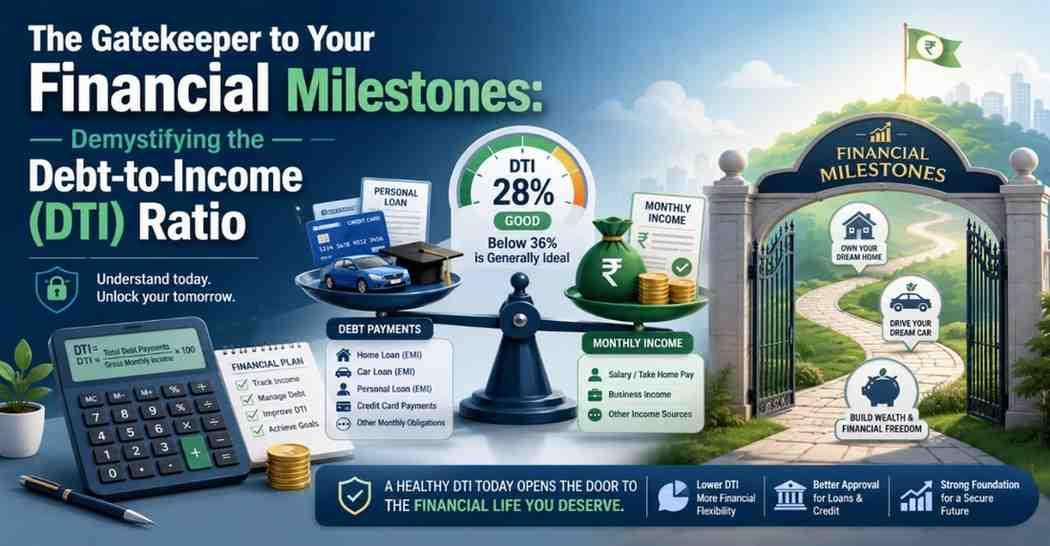
How lenders measure your financial bandwidth, why it controls your biggest milestones, and how to master it before you apply.
✨ मुख्य निष्कर्ष
The Gatekeeper to Your Financial Milestones: Demystifying the Debt-to-Income (DTI) Ratio
When you apply for a major loan, whether it is a mortgage for your dream home, a car loan, or a personal line of credit, lenders do not just look at your credit score or the balance in your savings account. They look at a quiet, incredibly powerful metric that sits at the very heart of their decision-making process: your Debt-to-Income (DTI) ratio.
While a credit score tells lenders how reliably you pay your bills, your DTI ratio tells them how much room you actually have in your monthly budget to take on new debt.
If you have ever wondered why some people with excellent credit get turned down for loans, or how lenders decide exactly how much home you can afford, the answer almost always lies in this single percentage. Let's break down exactly what the DTI ratio is, how it is calculated, and how you can optimise yours to unlock major life milestones.
What Exactly is the Debt-to-Income (DTI) Ratio?
At its simplest, your DTI ratio compares how much money you owe every month to how much money you earn. It is expressed as a percentage.
Lenders use this number to gauge your financial bandwidth. If your DTI is too high, it signals to lenders that you are stretched thin and that a minor financial emergency, such as a car repair or temporary job loss, could make it difficult for you to make your monthly loan payments.
Crucial Distinction: Your DTI ratio only looks at your recurring debt payments, not your overall living expenses. It does not include things like groceries, utilities, streaming subscriptions, or gas, even though those are real monthly costs.
How Lenders Calculate Your DTI Ratio
Lenders look at your DTI through two different lenses: the Front-End Ratio and the Back-End Ratio. When you apply for a mortgage, both of these numbers come into play.
1. The Front-End Ratio (The Housing Ratio)
This percentage represents the portion of your gross monthly income that would go toward your future housing expenses. This includes:
- Your monthly mortgage principal and interest
- Property Taxes
- Homeowners insurance
- Homeowners Association (HOA) fees (if applicable)
To find this percentage, you divide your proposed monthly housing expenses by your gross monthly income, and then multiply the result by 100.
2. The Back-End Ratio (The Total Debt Ratio)
This is the number lenders care about the most. It includes your proposed housing expenses plus all your other recurring monthly debt obligations. These obligations typically include:
- Minimum credit card payments
- Student loan payments
- Auto loans
- Personal loans
- Child support or alimony payments
To calculate this ratio, you divide your total monthly recurring debt payments (including the new housing payment) by your gross monthly income, and then multiply the result by 100.
A Step-by-Step Calculation Example
To see how this works in the real world, let's look at a hypothetical scenario.
Imagine Sarah earns an annual salary of Rs 90,000. She wants to buy a home, and her estimated monthly mortgage payment (including taxes and insurance) would be Rs 2100.
Step 1: Calculate Gross Monthly Income
Gross income is your earnings before taxes and deductions. For Sarah, this is Rs 90,000 divided by 12 months, which equals Rs 7500 per month.
Step 2: Sum Up Recurring Monthly Debts
Sarah has the following monthly minimum payments:
- Car Loan: Rs 350
- Student Loans: Rs 250
- Minimum Credit Card Payments: Rs 100
- This makes her total existing monthly debt Rs 700.
Step 3: Calculate the Ratios
To find Sarah's Front-End DTI, divide her proposed mortgage of Rs 2,100 by her gross income of Rs 7,500. This results in a Front-End DTI of 28 per cent.
To find Sarah's Back-End DTI, add her proposed mortgage of Rs 2,100 to her existing debt of Rs 700 to get a total monthly debt of Rs 2,800. Divide Rs 2,800 by her gross income of Rs 7,500. This results in a Back-End DTI of 37.3 per cent.
What Lenders Look For: Understanding the Ranges
While different loan programs have different criteria, lenders generally adhere to standard benchmarks when evaluating your DTI ratio. Here is how lenders typically view your numbers:
- 36 per cent or less is considered excellent. This indicates your debt is highly manageable. You will easily qualify for the best interest rates and loan terms.
- 37 per cent to 43 per cent is considered good or fair. You have a manageable amount of debt, but you are approaching the limit. You can still qualify for most mortgages, but you may face extra scrutiny or slightly higher rates.
- 44 per cent to 50 per cent is a warning zone. Your budget is tight. You may need specific loan types (like FHA loans) or a co-signer to qualify, as options become limited.
- Over 50 per cent is considered high risk. Over half of your income goes to paying off debt. At this level, it is extremely difficult to qualify for a standard mortgage or major loan.
Historically, the gold standard for a conventional mortgage is the 28/36 rule: a front-end ratio of no more than 28 per cent, and a back-end ratio of no more than 36 percent.
Why DTI Acts as a Gatekeeper to Major Milestones
Your DTI is a direct indicator of your financial stability. Here is why it holds so much power over major life milestones like homeownership:
- It Determines Your Maximum Loan Amount: Lenders do not decide how much to lend you based on what you feel you can afford. Instead, they use your DTI to calculate the absolute maximum monthly payment you can take on, which dictates your home-buying budget.
- It Impacts Your Interest Rates: A higher DTI makes you a riskier borrower. To compensate for that risk, lenders may charge you a higher interest rate. Over a 30-year mortgage, even a small difference in your interest rate can cost you tens of thousands of dollars.
- It Protects You from Being House Poor: While it might feel frustrating to be capped by a DTI limit, the ratio exists to protect you. Being house poor means so much of your income goes to your housing payment that you cannot afford to travel, save for retirement, or handle emergency expenses.
Actionable Strategies to Optimize Your DTI
If you are planning a major purchase in the next 12 to 18 months and your DTI is higher than you would like, there are two primary levers you can pull: lower your monthly debt payments or increase your gross income.
Here is how to strategically optimize both sides of the equation:
1. Target Low-Balance, High-Payment Debts First
If you want to quickly drop your DTI, look at your recurring monthly payments rather than just the total balance. For example, if you have a credit card with a Rs 1,000 balance and a Rs 100 minimum payment, and a student loan with a Rs 10,000 balance and a Rs 150 payment, paying off the credit card completely wipes out a Rs 100 monthly obligation instantly. This lowers your DTI much faster than chipping away at the larger student loan.
2. Avoid New Debt Obligations
In the months leading up to a mortgage or major loan application, freeze all new borrowing. Do not finance new furniture, do not sign a new car lease, and avoid opening new credit cards. Even a small Rs150 monthly car payment can significantly lower the maximum mortgage amount you can qualify for.
3. Recast or Refinance Existing Loans
If you have an auto loan with only a year left, see if you can pay it off early to eliminate that monthly payment entirely. Alternatively, refinancing high-interest debt into a lower-interest loan with a longer term can reduce your immediate monthly payment, lowering your DTI, though you should weigh this against paying more total interest over time.
4. Document All Streams of Income
When lenders calculate your gross monthly income, they do not just look at your base salary. Make sure you provide documented proof of all stable income sources, including consistent Bonuses or commissions, alimony or child support, rental property income, and side hustle or freelance earnings. Note that freelance income usually requires a two-year history of tax returns to count toward your qualification.
The Bottom Line
Your Debt-to-Income ratio is a dynamic snapshot of your financial health. By understanding how lenders calculate this metric, you can take proactive control of your budget well before you sit down with a loan officer. Focus on paying down high-payment debts, keeping your credit lines clear, and maximising your documented income. When the time comes to make your next major life move, a clean DTI will ensure the doors of opportunity swing wide open.
Disclaimer: The article is for informational purposes only and not investment advice.