The Petrodollar: Why Oil Is Always Traded in Dollars and Why It Matters More Than Ever
 हमसे जुड़ें
 हमें फ़ॉलो करें
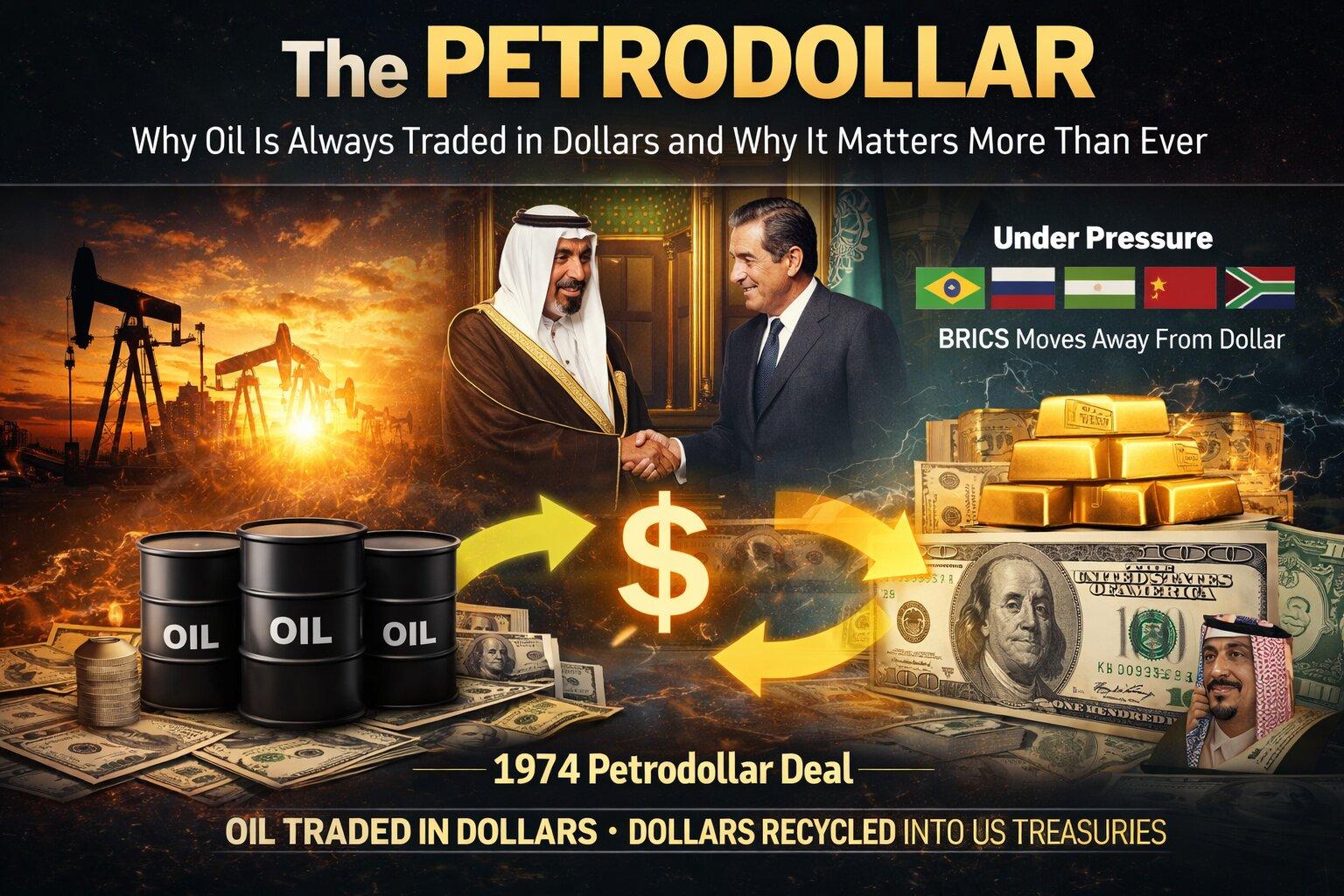
One deal struck in a Saudi palace in 1974 built the architecture of American financial dominance that still shapes global capital flows today
✨ एआई संचालित सारांश
In 1971, the United States was quietly on the edge of Bankruptcy. After World War II, America had built the global financial system on a simple promise. Every dollar in the world was backed by gold. Countries could walk into the US Treasury with USD 35 and walk out with an ounce of gold. That promise made the dollar the world's reserve currency. Every country trusted it because it was as good as holding gold.
But America took that trust for granted. Over the next 25 years, the US printed far more money than it had gold to back. By 1970, central banks around the world were holding USD 40 to USD 50 billion in dollar reserves while the US vault had only USD 10 billion worth of physical gold. The gap was not a rounding error. It was a Ponzi scheme. If three large countries had shown up simultaneously demanding gold for their dollars, the US would have had nothing to give them.
France figured this out first. In 1965, President de Gaulle started dumping dollars and demanding gold from the US Treasury. Switzerland followed. Then in August 1971, Britain walked in with USD 3 billion in cash and asked for gold. That was the moment Richard Nixon understood that the game was over. On the evening of August 15, 1971, he went on national television and ended the convertibility of the dollar into gold. Just like that, the dollar went from being backed by the most trusted commodity in the world to being backed by nothing but faith in the United States government.
The question that followed was brutal and immediate. If the dollar was no longer backed by gold, why would Japan, Germany, France or Britain continue using it for global trade? Why not simply use their own currencies? And if countries around the world had collectively dumped their USD 60 billion in dollar reserves on the US simultaneously, America would have faced hyperinflation and economic collapse. What saved the dollar was not military power. It was one insight that America's sharpest financial minds landed on at exactly the right moment.
Any country can survive without gold. No country can survive without oil. Japan cannot run its factories without oil. Germany cannot heat its homes without energy. Britain cannot fuel its cargo ships without crude. Gold sits in a vault. Oil runs the world. And in 1974, the US Treasury Secretary was quietly sent to Saudi Arabia to negotiate what would become the most consequential financial deal of the twentieth century.
The Deal That Created the Petrodollar
The offer America put on the table was straightforward. The United States would provide the Saudi royal family with unconditional military protection and access to the most advanced American weapons. In exchange, Saudi Arabia had to agree to two conditions. First, every single barrel of oil Saudi Arabia sold to the world had to be priced and settled in US dollars. Not gold, not marks, not yen. Dollars only.
Second, Saudi Arabia had to take its billions in oil revenues and invest them back into US Treasury bonds. The same dollars that flowed out to buy oil had to flow right back into the American financial system. This recycling of oil money into American debt became known as petrodollar recycling, and it was the mechanism that kept the dollar alive after the collapse of the gold standard.
The genius of this arrangement was that it created demand for the dollar that had nothing to do with American gold reserves. If Germany wanted Saudi oil to keep its auto factories running, it had to first buy US dollars. If Japan needed crude to power its industrial economy, it had to acquire dollars before it could acquire oil. Every country on earth that needed energy, which meant every country on earth, had to hold and use dollars. The dollar became indispensable not because of what America produced or promised but because of what Saudi Arabia sold.
And Saudi Arabia was not just one supplier. It was the leader of OPEC, the cartel that included Kuwait, Iraq, Iran and the UAE. So even if Japan tried to bypass Saudi Arabia and buy from Kuwait, it still had to pay in dollars. The system was airtight.
How Saudi Arabia Kept America Locked In
The petrodollar arrangement could have collapsed the moment the US no longer needed Saudi oil or found the relationship inconvenient. Saudi Arabia understood this and spent decades making itself impossible to abandon.
When Saudi Arabia wanted ownership of its own oil fields back from American companies, it did not nationalize like Libya or Venezuela did. It bought its way out, purchasing stakes in Aramco incrementally from 1973 through 1980 until it owned the company completely, paying roughly USD 1.5 to USD 2 billion in total. It kept American companies involved as operators, paying them billions in service fees annually. The result was that American oil companies made money whether or not Saudi Arabia was a political ally. Corporate lobbying ensured that American politicians who tried to distance themselves from Riyadh would face consequences at the fundraising level.
Today Saudi Arabia holds approximately USD 150 billion in US Treasury debt, owns the largest oil refinery in North America and controls a sovereign wealth fund of over USD 1 trillion with stakes in US companies and global equity markets. Its financial tentacles run through the American economy in ways that make a clean political separation essentially impossible.
One Deal. Fifty Years of Financial Dominance.
Here is what that 1974 arrangement ultimately built. Oil today accounts for roughly 5 to 10 percent of total global merchandise trade value. That is not the largest share of global trade by volume, but it is the most strategically critical because every economy needs it and there is no substitute. Every transaction in that market, every barrel bought and sold anywhere in the world, flows through the dollar. That single fact has compounded into something extraordinary over fifty years.
The United States today carries USD 38.9 trillion in public debt, the largest sovereign debt load in human history. Under normal circumstances, a country running that kind of debt would face a currency crisis, soaring interest rates and capital flight. That has not happened because global demand for dollars to conduct oil trade, among other things, ensures a perpetual buyer base for US Treasury bonds. The world needs dollars to buy oil. Surplus dollars get recycled into American debt. America borrows cheaply. The cycle continues.
The downstream effect of this on financial markets is equally staggering. The US stock market today is valued at approximately USD 66.7 trillion. To put that in perspective, the NYSE alone at USD 31.6 trillion and Nasdaq at USD 30.6 trillion together represent more market capitalisation than the next eight largest exchanges in the world combined. China's two exchanges together are worth around USD 11.7 trillion. Japan is at USD 6.6 trillion. India's NSE, now the fifth largest exchange globally, stands at USD 5.1 trillion. The entire European Euronext is at USD 5.4 trillion.
The United States, with two exchanges, commands more financial capital than every other major economy on earth put together. That dominance did not emerge purely from innovation or productivity. It was built on the foundation of a currency that the world was structurally compelled to use, hold and recycle back into American assets. The petrodollar was not just an energy arrangement. It was the architecture of American financial supremacy.
Why This Is Under Pressure Today
The system that has held for fifty years is now showing cracks, not dramatic ones, but real ones. Russia and China have been actively settling bilateral energy trades in non-dollar currencies. The BRICS bloc continues to debate alternatives to dollar denominated trade settlement. Each of these moves is individually small. Together they represent a slow, deliberate attempt to reduce structural dependence on the dollar.
What It Means for Investors
For investors, this is not background noise. The petrodollar system is one of the core reasons why US Treasuries remain the world's default safe haven asset, why the dollar strengthens during global crises rather than weakening, and why American equity markets attract capital at a scale no other market can match. Any meaningful shift away from dollar denominated oil trade, even a partial one, would reshape global capital flows, alter the relative attractiveness of US assets, lift gold and commodity currencies, and create volatility in emerging market debt that few portfolios are currently positioned for.
The deal struck in a Saudi palace in 1974 was never just about oil. It was about who controls the currency the world cannot function without. That question is being asked again today, quietly but with increasing seriousness. And the answer, for the first time in fifty years, is not entirely certain.
Disclaimer: This article is for informational purposes only and not investment advice.