HFCL Has Returned 202% in Three Months. But Is the Business Finally Catching Up With the Stock?
 आमच्यासोबत जोडा
 आम्हाला फॉलो करा
A 268% rally from the 52-week low. A record order book. A genuine operational turnaround. But after a sharp re-rating, the bigger question is whether the business can now justify the expectations built into the stock price
✨ महत्त्वाचे मुद्दे
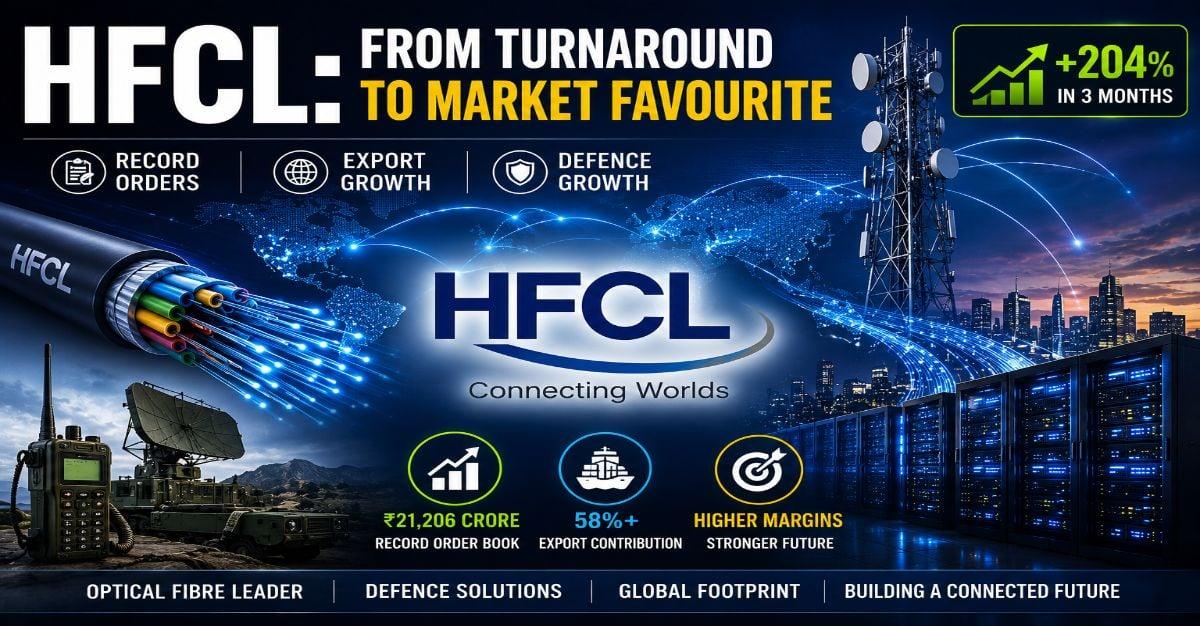
HFCL Ltd hit a 52-week low of Rs 59.83 on January 23, 2026. By June 22, 2026, it had touched Rs 220.10 a gain of 268 per cent in five months. The stock continues to trade near that peak at around Rs 215, delivering 204 per cent over the last three months and 146 per cent over one year. A move of this magnitude raises one question that deserves a direct answer: what exactly changed?
The rally appears to reflect a combination of sharply improved profitability, a shift in business mix toward higher-margin products, record order visibility, growing exports and expectations of stronger execution. At the same time, the rally has pushed valuations to levels that leave little room for execution missteps.
From EPC Contractor to Product-Led Technology Company
For several years, HFCL was read by the market as a telecom infrastructure company one that derived meaningful revenue from engineering, procurement and Construction projects. EPC work supported revenue growth but came with lower margins, higher working capital requirements and dependence on government contracts. None of those characteristics attract premium valuations.
Management has spent the last few years changing that description. HFCL today operates across optical fibre, optical fibre cables, telecom networking equipment, broadband access solutions, Defence communication systems and Railway communication products. The numbers reflect the shift: product revenue has grown from 27 per cent of total revenue in FY21 to 62 per cent in FY26. Exports have moved from less than 5 per cent to over 41 per cent in the same period. Government exposure has reduced and private customers now contribute the majority of revenues.
Product businesses generally carry higher margins than EPC execution. Export orders diversify the customer base, while private sector projects typically require lower working capital than government EPC contracts. Together, these factors have supported overall profitability. The business has evolved meaningfully over the past few years, with a much greater contribution from products and exports than when investors were evaluating it two years ago.
FY26: The Quarter That Changed Investor Perception
The strongest evidence for the re-rating came from the numbers. Revenue grew from Rs 4,065 crore in FY25 to Rs 4,949 crore in FY26 — approximately 22 per cent growth. The bigger story was profitability.
EBITDA rose from Rs 507 crore to Rs 827 crore, nearly 63 per cent growth, with margins expanding from 12.5 per cent to 16.7 per cent. PAT grew from Rs 173 crore to Rs 329 crore — 90 per cent profit growth on 22 per cent revenue growth. That gap between revenue growth and profit growth is the signature of a business whose cost structure is improving faster than its topline.
The quarterly comparison makes it even starker. In Q4 FY25, HFCL reported an EBITDA loss of Rs 22 crore and a net loss of Rs 83 crore. In Q4 FY26, the same quarter delivered Rs 337 crore EBITDA, 18.5 per cent EBITDA margins and Rs 184 crore PAT. A company that was losing money at the operating level twelve months ago is now printing its best margins. Markets tend to reprice that kind of inflection sharply — and they did.
Why the Turnaround Happened
The earlier weakness had a specific cause. HFCL had completed an Army communication network project that entered its warranty period during FY25. In the warranty phase, the company continued incurring maintenance and support expenses without corresponding revenue recognition — a drag that suppressed profitability without appearing in revenue numbers. The Army Annual Maintenance Contract, which management expects to commence in FY27, could convert that cost burden into recurring revenue.
The turnaround was therefore not purely about winning new business. It was about removing a specific drag, improving the business mix toward higher-margin products and growing exports. When multiple tailwinds align simultaneously, the profitability improvement looks dramatic. Here it genuinely was.
The Order Book: Rs 21,206 Crore and Three Times What It Was
HFCL closed FY26 with an order book of Rs 21,206 crore — the highest in its history and nearly three times the Rs 7,010 crore it reported in FY23. More important than the size is the composition. Rs 14,586 crore relates to products rather than EPC execution. Exports account for approximately 58 per cent of the total.
The centrepiece is a recently secured USD 1.1 billion long-term global optical fibre cable supply contract approximately Rs 10,159 crore with execution expected to begin in FY27. A record order book alone does not guarantee earnings growth. But when combined with improving margins and an expanding export base, it gives investors a credible view of where revenues are headed.
Optical Fibre: Where the Margin Story Gets Interesting
HFCL is one of India's leading optical fibre and cable manufacturers, and the product mix within that business is shifting in a meaningful way. More than 70 per cent of cable production is now exported. Management indicated that intermittently bonded ribbon (IBR) cables now account for more than half of the company's optical fibre cable portfolio, reflecting growing demand for high-fibre-count connectivity solutions, including AI-enabled data centre networks. These carry better average selling prices than traditional cable products and support the margin expansion the FY26 numbers reflect.
Capacity is being expanded alongside this mix improvement. Optical fibre capacity moves from 28 million fibre kilometres to 34 million, and cable capacity from 34 million to over 42 million fibre kilometres.
The most strategically significant investment is the optical fibre preform manufacturing facility — a Rs 580 crore commitment to produce the primary raw material that Indian manufacturers currently import. Management expects in-house preform manufacturing could reduce preform costs by around 15–20 per cent compared with imported preforms, while also strengthening supply-chain security. The facility takes approximately two years to commission, so the financial benefit is a FY28-FY29 story, not an immediate one.
Defence: Small Today, Strategic Tomorrow
Beyond telecom, defence is becoming a second growth engine. The existing order book covers thermal weapon sights, radar systems, tactical communication systems and specialised defence cables. The proposed Aerospace acquisition through HFCL Advance Systems adds manufacturing capability and export-oriented business. The company has also received technology transfer from DRDO for the Multi Mode Hand Grenade programme, opening another avenue within the defence ecosystem.
Management expects defence to contribute around 10–12 per cent of FY27 revenues, with margins expected to remain higher than several traditional telecom segments. Defence currently represents a small share of overall revenue — but it offers diversification into higher-value businesses with longer product life cycles. At this stage of HFCL's evolution, that diversification has strategic value beyond what the current revenue contribution suggests.
The Valuation: Where the Story Gets Complicated
The business has genuinely improved. The valuation reflects that improvement aggressively. HFCL trades at approximately 106 times trailing earnings — more than double its three-year median P/E of 49 times and well above the telecom equipment industry average of approximately 15 times. Price to book stands at 6.7 times against an industry average of 2.6 times. EV/EBITDA has expanded to over 41 times.
These are not multiples that price a recovery. They are multiples that price successful execution of the record order book, sustained margin expansion, defence scale-up and timely commissioning of the preform facility — simultaneously and without meaningful setbacks.
ROCE has improved to 10.9 per cent but remains below leading capital goods and technology manufacturers. ROE at approximately 7 per cent indicates that further profitability improvement is needed to justify the premium the market has already assigned. The debt-to-equity ratio of 0.36 is manageable and provides flexibility for ongoing investments.
The area that deserves closest attention is cash flow. Despite the profitability turnaround, operating cash flow and free cash flow remained negative in FY26, reflecting working capital requirements and ongoing capex. Sustained earnings growth will need to translate into cash generation for the re-rating to remain durable. A business that is profitable on paper but consistently cash-flow negative is a business whose earnings quality still needs proving.
What the Next Phase Requires
Management expects FY27 revenue growth of 20–25 per cent with further margin improvement if product mix remains favourable and the Army AMC contract begins as anticipated. The medium-term aspiration is Rs 10,000 crore revenue by FY29 with EBITDA margins approaching 20–21 per cent. These are management expectations, not formal guidance, and the gap between aspiration and delivery will be filled — or not — by execution.
The risks are straightforward. Delays in the USD 1.1 billion export contract defer revenue. The Army AMC has not commenced and any further delay extends the profitability drag. The preform facility is two years from operational. Cash flow needs to improve. And at 106 times earnings, valuation itself is a risk — even a strong result that falls short of elevated expectations will be punished.
The Honest AssesSMEnt
HFCL's rally is not speculation dressed as fundamentals. The operational turnaround is real, the margin expansion is genuine, the order book is the largest in company history and the business mix transformation has been executing for five years. The recent re-rating suggests investors have increasingly recognised these improvements.
What has changed from six months ago is the entry point. A 268 per cent move from the low means the easy repricing has already happened. HFCL has gone from being a recovery story to being an execution story and execution stories are judged differently. The question is no longer whether the business has improved. It is whether the business can grow into the expectations now embedded in the price.
The data makes both sides of that question visible. The interpretation is yours to make.
Disclaimer: This article is for informational purposes only and not investment advice.