Kirloskar Oil Engines: A 123% Multibagger in One Year and the Growth Story Is Still Evolving
 आमच्यासोबत जोडा
 आम्हाला फॉलो करा
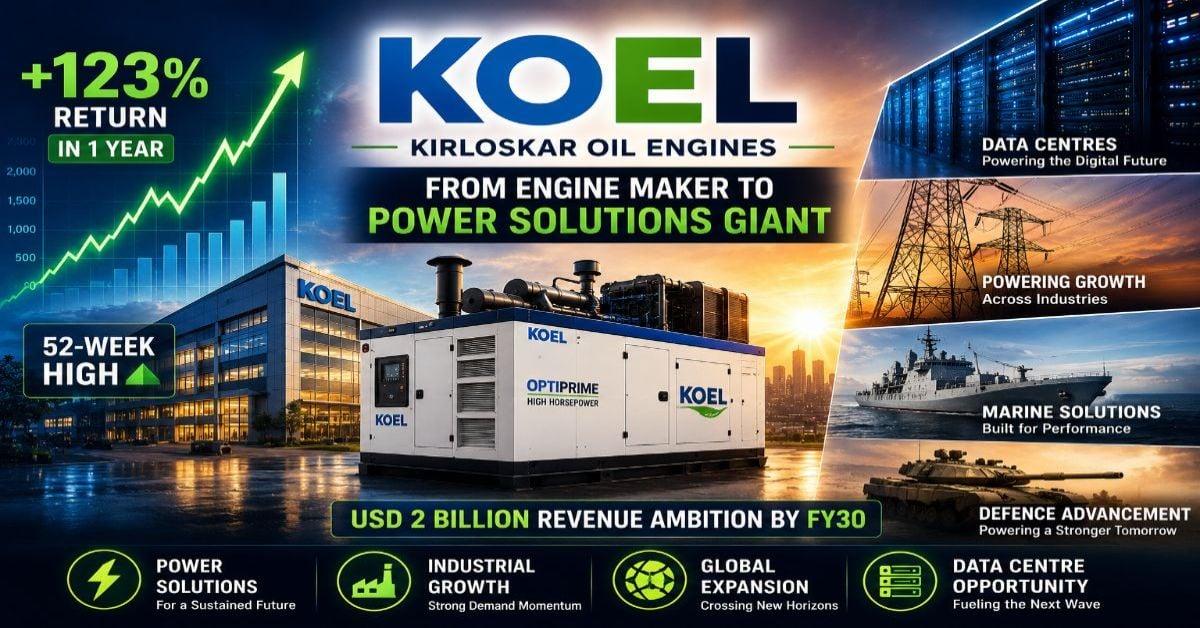
KOEL is no longer being valued purely as a diesel genset company. The market is increasingly pricing it as a multi-segment power solutions platform with a USD 2 billion revenue ambition by FY30 and the FY26 numbers show that ambition is being backed by execution rather than just aspiration.
✨ महत्त्वाचे मुद्दे
On June 1, 2026, shares of Kirloskar Oil Engines Ltd (KOEL) touched Rs 1,989.50 a 52-week high. Today the stock closed at Rs 1,958.20, up by 3.59 per cent. Over the past one year, KOEL has delivered multibagger returns of 123.59 per cent. That kind of move in an industrial manufacturing company does not happen on momentum alone. It happens when a business is genuinely re-rated when the market changes its mind about what the company is.
For most of the past decade, KOEL was priced as a conventional diesel engine manufacturer — cyclical, commodity like, dependent on infrastructure spending and valued accordingly. What FY26 confirmed is that this framing is no longer accurate. The business that reported results this year is categorically different from the one that existed five years ago. The re-rating is the market catching up to a transformation that management has been executing quietly and consistently. Importantly, a meaningful portion of the stock's recent gains has come from valuation rerating rather than earnings growth alone, with the stock now trading at 47.8x earnings versus a three-year median P/E of approximately 30x.
The Numbers That Triggered the Move
|
Metric |
FY25 |
FY26 |
Growth |
|
Revenue (Rs crore) |
6,349 |
7,701 |
21% |
|
Operating Profit (Rs crore) |
1,185 |
1,415 |
19% |
|
Operating Profit Margin (OPM) |
19% |
18% |
Stable |
|
PAT (Rs crore) |
476 |
562 |
18% |
The full-year numbers are solid but the quarterly trajectory is the more important signal.
|
Metric |
Mar-25 |
Dec-25 |
Mar-26 |
YoY Growth |
QoQ Growth |
|
Revenue (Rs crore) |
1,749 |
1,873 |
2,116 |
21.00% |
13.00% |
|
Operating Profit (Rs crore) |
312 |
331 |
376 |
20.50% |
13.60% |
|
OPM |
18% |
18% |
18% |
Stable |
Stable |
|
PAT (Rs crore) |
127 |
109 |
155 |
22.00% |
42.20% |
Q4 FY26 revenue of Rs 2,116 crore represents 21 per cent year-on-year growth with PAT growing 22 per cent the sequential improvement from December to March is significant. OPM has held at 18 per cent despite scale-up costs, which is the signature of operating leverage beginning to emerge.
Trigger One: KOEL Is Beating Its Industry by a Wide Margin
This is the most important number in the entire KOEL story and the least discussed one in mainstream coverage. The diesel genset industry in India grew 18 per cent in FY26. KOEL grew 41 per cent and sold over 50,000 gensets. That differential — growing more than twice as fast as the industry is not explained by market expansion alone. It is explained by KOEL taking market share from competitors.
For industrial companies, sustained market-share gains are structurally more significant than cyclical demand tailwinds because they persist across cycles. A company that grows 18 per cent with the market reverts to slower growth when the cycle turns. A company that grows 41 per cent in an 18 per cent market is gaining structural position. The remaining question is whether the gains are durable and the HHP story suggests they are.
Trigger Two: The High Horsepower Business Is a Structural Step-Change
For most of its history KOEL was associated with small and medium horsepower generators — reliable, well-engineered, but a commodity-adjacent product in a crowded market. High Horsepower generators used in large data centres, industrial facilities, hospitals, Defence installations and infrastructure projects are a fundamentally different business. Higher ticket sizes, stronger margins, longer customer relationships and significantly higher barriers to entry.
A few years ago KOEL's HHP market share was negligible. Management stated in the FY26 earnings call that they are now approaching double-digit market share in HHP. Their Optiprime platform is gaining traction, they are selling gensets up to 3,000 kVA, they have demonstrated capability beyond 3,000 kVA, and they executed a 6.3 MW genset project for Nuclear Power Corporation the kind of reference that opens doors to large institutional buyers who would not have considered KOEL previously.
The data centre angle fits here but should be understood in proportion. The ongoing expansion of data centres and digital infrastructure in India is creating additional demand for large, reliable, high-capacity backup power systems, and KOEL's HHP portfolio is well-positioned to participate in that opportunity. But HHP demand comes from data centres, hospitals, manufacturing facilities, defence installations and infrastructure projects simultaneously. The data centre tailwind is real and growing; it is one part of a broader HHP demand story rather than the whole story.
Trigger Three: Powergen Revenue Has Become the Engine of the Business
Powergen the power generation segment is where the most dramatic numbers sit. Powergen revenue grew from Rs 1,969 crore in FY25 to Rs 2,598 crore in FY26 a 32 per cent increase in a single year. This segment is now the primary earnings driver for KOEL and the concentration of management attention and capital allocation reflects that. The Rs 2,100 crore capex programme being executed at Kagal comprising Rs 700 crore already announced and an additional Rs 1,400 crore is being built specifically to serve Powergen demand at scale. Management would not commit Rs 2,100 crore of capital unless it had substantial confidence in the medium-term demand outlook and the long-term opportunity ahead.
The Kagal expansion adds 50,000 engine capacity in the first phase and an additional 20,000 in the second. Together with the existing base, this positions KOEL to serve demand well beyond FY27 and FY28 and frames the USD 2 billion by FY30 ambition as a capacity plan, not just an aspiration. Managing Director Gauri Kirloskar stated directly on the earnings call: "We are progressing well against our goal to be a USD 2 billion company by Fiscal Year 2030."
Trigger Four: International Business Crossed Rs 1,000 Crore
Many investors still frame KOEL as a domestic India story. That framing is increasingly inaccurate. International business crossed Rs 1,000 crore in gross sales in FY26, growing approximately 37 per cent year-on-year. The Wildcat Power Gen acquisition in the United States gives KOEL access to established dealer networks, LPG genset product lines and a direct presence in one of the world's most developed power backup markets.
Importantly, management explicitly stated they do not want to be exporters they want to build local presence, distribution channels and service networks in target markets. This is a longer-term but more durable approach to international expansion than opportunistic volume selling. If executed, it creates sticky international revenue that does not evaporate when domestic competitors offer slightly lower prices.
Trigger Five: The Construction, Marine and Defence Optionality
Three segments deserve specific mention because they are underappreciated in most KOEL coverage.
The construction segment grew 44 per cent in FY26 and this came in the year that India transitioned from CEV BS-IV to CEV BS-V emission norms. Emission standard changes normally create disruption and customer attrition. KOEL gained customers through the transition, which is a strong signal of product capability and customer confidence.
The marine segment recorded its highest-ever Order Booking in Q4 FY26. India's expanding naval programme, coastal infrastructure buildout and growing shipbuilding activity create a multi-year demand tailwind for marine engines that KOEL is only beginning to scale into.
Defence is the most underappreciated option in the portfolio. KOEL has created a dedicated subsidiary Kirloskar Advanced Systems Pvt Ltd specifically to pursue defence and advanced technology opportunities. The creation of a dedicated subsidiary suggests management sees defence as a meaningful long-term opportunity and is willing to build dedicated capabilities around it. The defence order pipeline is early-stage but the organisational commitment is clear.
Investors should also recognise that a meaningful portion of KOEL's recent growth has been supported by India's broader capex cycle, infrastructure spending and industrial activity. Any slowdown in these drivers could affect demand across Powergen, construction and industrial segments, making execution through the cycle an important factor to monitor.
The Balance Sheet That Makes the Ambition Credible
A company with a Rs 2,100 crore capex programme and a USD 2 billion revenue target needs to fund that ambition from a position of financial strength rather than necessity. KOEL's balance sheet provides exactly that. Net cash position of Rs 552 crore, free cash flow of Rs 595 crore, Piotroski score of 7/9 and low leverage mean the expansion is being funded from operating cash generation rather than aggressive debt. ROIC of 32.9 per cent confirms the capital being deployed is generating exceptional returns on the existing asset base.
The Valuation Context
At 47.8x P/E against an industry P/E of 40.7x and a 3-year median P/E of 30x, the stock is trading at a meaningful premium to its own history. The re-rating from 30x to 47x is what produced the 123 per cent return not earnings growth alone. The market has repriced what KOEL is worth as a business, not just what it earns today.
Whether that premium is justified depends on execution against the FY30 ambition. With 3-year EPS growth of 22.4 per cent, a ROIC of 32.9 per cent, sustained market share gains and a Rs 2,100 crore capacity expansion underway, the business is building toward the target rather than coasting. A PEG of 2.12 is not cheap but it is not unreasonable for a company with this combination of market share momentum, margin stability and multiple growth vectors.
The market is no longer valuing KOEL as a diesel engine manufacturer. It is valuing it as a power solutions platform at the intersection of India's capex cycle, data centre buildout, defence expansion and international growth. The June 1 high is not the end of that re-rating story. It is a checkpoint.
Disclaimer: This article is for informational purposes only and not investment advice.