Index Inclusion and Exclusion: Why Getting Added to Nifty Moves a Stock More Than Its Quarterly Numbers
 எங்களுடன் சேருங்கள்
 எங்களைப் பின்தொடரவும்
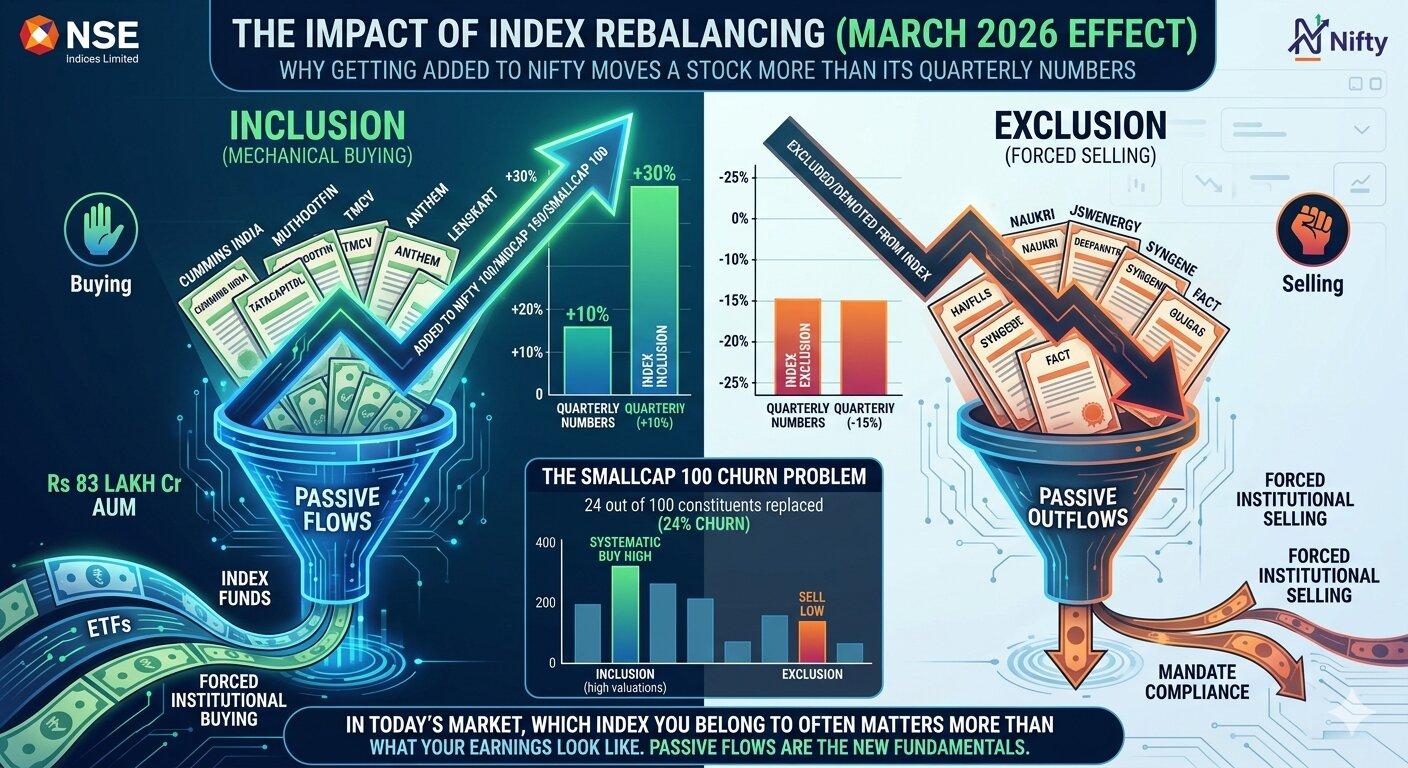
In a market dominated by passive flows and institutional mandates which index you belong to often matters more than what your earnings look like
✨ AI இயங்கும் சுருக்கம்
Every six months, NSE Indices Limited runs a quiet but enormously consequential exercise. It reviews the composition of every major index under the Nifty umbrella and decides which companies move up, which move down and which get dropped out of the listed universe entirely. Most retail investors barely notice when the announcement comes. Institutional desks, however, are watching very carefully. Because in today's market, index inclusion and exclusion can move a stock more decisively than a strong earnings quarter ever will.
The March 2026 rebalancing, effective March 30, makes this point sharply. Across the Nifty 500 universe, 31 constituents changed. The Midcap 150 saw 16 changes, a 10.7 per cent churn. The Smallcap 250 saw 33 changes, a 13.2 per cent churn. And the Smallcap 100, which serves as the benchmark for most Small-Cap Mutual Funds in India, saw 24 of its 100 constituents replaced a 24 per cent churn in a single review. When a quarter of an index is replaced in one sitting, it is worth stepping back and understanding exactly what that means for the stocks involved and for the investors holding them.
Why Index Membership Is a Financial Event in Itself
To understand why inclusion matters so much, you need to understand who is forced to buy when a stock gets added to an index. India's mutual fund industry manages over Rs 83 lakh crore in assets. A significant and growing portion of that sits in Index Funds and ETFs that passively track Nifty indices. When a stock gets added to the Nifty Midcap 150 or the Nifty Smallcap 100, every fund benchmarked to that index must buy it. They have no choice. The mandate requires them to hold the constituents of the index they track. Similarly, when a stock gets excluded, those same funds must sell it regardless of whether the underlying business has deteriorated or not.
This creates mechanical, non-discretionary buying and selling that has nothing to do with valuations, earnings or business quality. A company can report excellent quarterly numbers and still fall sharply if it gets dropped from a key index. Another company can have mediocre fundamentals and rally 20 to 30 per cent purely on the announcement of index inclusion. The flows are real, they are immediate, and they often overwhelm any fundamental signal in the short to medium term.
What the March 2026 Rebalancing Is Actually Telling Us
Index rebalancings are not just mechanical reshuffles. When you look at the pattern of who is coming in and who is going out, they are a mirror of where economic momentum is actually moving. The March 2026 changes tell a clear story across sectors.
In the Nifty 100, six names were replaced. Companies like Bajaj Housing Finance, Havells, ICICI Lombard, Naukri, JSW Energy and LIC exited the largecap index and were demoted to midcap. Coming in were Cummins India, HDFC AMC, Muthoot Finance, Tata Capital, TMCV and Union Bank. The direction of movement here is notable fee based financial businesses, capital market intermediaries and NBFCs are gaining weight in the largecap universe.
In the Nifty Midcap 150, ten names were promoted from the Smallcap 250 to join the midcap index. These include Anthem Biosciences, Groww, HDB Financial, ICICI Prudential AMC, Lenskart, LG India, MCX and Radico. Each of these is either a new-age platform business, a capital market infrastructure play or a specialty manufacturer. On the other side, names like Deepak Nitrite, FACT, IDBI, IOB, IRB, PGHH, Sonacoms, Syngene, Tata Tech and UCO Bank were demoted from midcap to smallcap — a mix of legacy industrials, PSU banks and companies whose market cap has not kept pace with their index peers.
In the Smallcap 250, the new entrants include Meesho, Pine Labs, Piramal Finance, PWL, Tennind, Travelfood and Urbanco several of which are recently listed new-age businesses entering the benchmark universe for the first time. Meanwhile, companies like AstraZeneca, BASF, Reliance Infrastructure, Sundrmfast and Ventive were dropped completely from the Nifty 500 universe.
The sectoral rotation visible in these changes is not accidental. Legacy consumption names — V-Guard, Century Ply, Cera Sanitaryware, Vedant Fashions, Gujarat Gas are being pushed down or out entirely. New-age platforms, specialty chemicals, CDMO-focused pharma, renewable energy and capital market businesses are moving up. NTPC Green Energy replaces Gujarat Gas in thematic indices, signalling the shift from gas to renewables at the index level itself. In healthcare, Acutaas, Anthem Biosciences and Blue Jet Healthcare are coming in while Alembic Pharma and Metropolis exit, reflecting the market's preference for specialty and contract development manufacturing over traditional generics.
The Smallcap 100 Problem
There is a specific concern worth calling out here. The Nifty Smallcap 100 saw 24 of its 100 constituents replaced in this single review. That is a 24 per cent churn. This index is the benchmark against which most small-cap mutual funds in India measure their performance. It is also the index that guides passive small-cap fund allocations.
When a benchmark changes 24 per cent of its composition in six months, it raises a legitimate question about what that benchmark is actually measuring. The small-cap universe in India has seen significant valuation and business quality divergence over the past two years. Some companies that entered the index on momentum have since seen earnings disappoint, market caps erode and eventually get pushed out. New entrants come in typically after a period of strong price performance, which means they are entering at higher valuations. This mechanical dynamic means that the Smallcap 100 tends to systematically buy high and sell low at the index rebalancing level a feature rather than a bug of how market-cap weighted indices work, but one that investors in passive small-cap funds need to understand clearly.
What Happens to Stocks at the Moment of Inclusion and Exclusion
The price impact of index events is well documented and increasingly front-run. Once NSE announces the rebalancing, the market typically reacts within hours. Stocks being added to higher indices say from Smallcap 250 to Midcap 150, or from Midcap to Nifty 100 tend to see sharp buying as funds position ahead of the effective date. Stocks being excluded see the opposite. Forced selling begins almost immediately.
The cut-off date for the March 2026 rebalancing is after market close on March 27, with the effective date being March 30. In the days between the announcement and the cut-off, the movement in affected stocks can be dramatic and entirely disconnected from any news about the business itself.
For active investors, this creates both a risk and an opportunity. If you are holding a stock that has been excluded from a key index, the selling pressure in the short term can take the price well below what fundamentals would suggest is fair. That can be an opportunity for patient investors who understand the business. Conversely, chasing a stock purely because it has been included in an index after the price has already moved 15 to 20 per cent on the announcement means paying a premium for a technical event that has already been priced in.
Index Flows Are the New Fundamentals
This is the broader shift that investors in Indian markets need to internalise. Passive AUM in India is growing faster than active AUM. SIP flows are now north of Rs 25,000 crore per month and a large share of that goes into index funds and Large-Cap funds benchmarked to Nifty indices. FII flows, which also increasingly come through ETF structures, follow index weights. Even active fund managers use the index composition as a reference point for their overweight and underweight decisions.
What this means in practice is that the index itself has become a driver of price. Inclusion creates buying pressure that is independent of earnings. Exclusion creates selling pressure that is independent of business quality. Over a six month horizon, which index a stock belongs to can be more important for its price performance than whether it beats or misses its quarterly estimates.
This does not mean earnings have become irrelevant. Over longer periods, earnings still determine where a stock ultimately goes. A company that grows its profits consistently over five years will compound wealth regardless of index movements. But over the shorter cycles of six to eighteen months, index events are powerful enough to override fundamental signals and investors who ignore them are leaving an important variable out of their analysis.
The March 2026 rebalancing is a reminder that Indian equity markets have matured into a structure where passive flows, benchmark mandates and index mechanics are now as important as balance sheets and management commentary. Understanding both is no longer optional. It is the minimum required to navigate this market intelligently.
Disclaimer: This article is for informational purposes only and not investment advice.