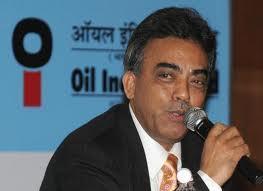
N M Borah - CMD, Oil India
 Join Us
 Follow Us
What are the factors behind the consistently impressive performance of OIL?
Although incorporated as a joint venture between Burmah Oil and the Government of India in 1959, Oil India’s legacy dates back to 1889 when oil was first discovered on the shores of India, starting the petroleum era in the country. The company is also credited with the distinction of making the first discovery of oil post-independence at Nahorkatiya in Assam. The rich heritage of being one of the best in the industry coupled with the need to work under the most challenging work environment have instilled a culture of team work, commitment and a zeal to produce the best.
All these and a very informal work culture to enhance cohesiveness and the explicit belief in the need to contribute towards the nation’s economic growth has helped the organisation to deliver on a continuous basis. Our structured contribution towards sustainable growth of the society at large, particularly in our areas of operation, has further enhanced our ability to perform. This awareness and belief prompts us to take continual action on taking the society along with us, not to mention our deep conviction and actions on the nurturance of the environment.
What management mantras are being followed by OIL for this impressive performance?
The liberalisation of the economy and the subsequent economic reforms has changed the rules of business in India. In the petroleum sector, the Administered Pricing Mechanism (APM) was dismantled and the New Exploration Licensing Policy (NELP) was introduced. This has encouraged a large number of national and international companies to become a part of the national E&P industry, leading to increased competition. The changed business dynamics have also brought forth a need to re-orient the company’s business and development strategies.
As a fall-out of this, in the year 2003 the idea of transforming the company into a ‘learning organisation’ took roots. With the desire to chart a growth path into the future, a participative approach was adopted to create a shared picture of the desired future of the company and a vision for the company was co-created with large-scale participation of the employees across the organisation to bring in alignment ownership and a commitment towards quantum growth. This led to the birth of a strategic change initiative christened ‘Breakthrough Performance’, aiming at quantum improvement in performance and continuously striving for newer heights that may even seem unthinkable at the moment. One could say that our mantra is to continuously improve and keep innovating to overcome various challenges to emerge as a significant player in the energy sector.
Could you tell us about the various initiatives taken by OIL to enhance the employees’ performance?
Enhancing employees’ performance is a topic that has the highest priority for all organisations, and rightfully so, especially in the current competitive era. At OIL, ours’ is a continuous journey of discovering how to enhance employee commitment and capacity to learn and learn together. We are aware that the organisation cannot learn unless the individual employees learn and that the ability to learn faster as an organisation may be the only sustainable competitive advantage. Therefore, apart from the statutory, technical and managerial trainings which we provide for our employees and which are indeed very important, we have also been focusing on the process of thinking differently.
To this effect, the company has undertaken a number of customised initiatives and programmes as part of a transformation process. The more important ones are programmes on foundation for organisational learning, breakthrough performance workshops, leadership and self-development programmes, emotional intelligence workshops to enhance business performance, ethical leadership programmes, retrospection sessions, brainstorming sessions of young executives, dialogue sessions on complex issues and work site fitness programmes.
The company has a structural mentoring cum knowledge sharing programme where the seniors act as mentors, guides and philosophers for the juniors on a continuous basis. We have understood that to unleash the potential of our employees the emphasis will have to be on physical, mental, emotional and spiritual health creation, and accordingly our efforts are on to increase capacity in these areas.
What initiatives are you taking to make OIL a dream company for people to work for?
As already mentioned, a performance orientation, an open culture and our respect and care for our employees have made OIL what it is today. With the change of times, we are now in the process of building an organisation which is more consistent with our employees’ higher aspirations. We have moved from viewing work as a means to an end to work which is meaningful where people are intrinsically motivated to work. As we have mentioned, our vision was co-created and therefore we are truly vision-led and capable of learning to achieve our vision. The process of transformation has brought in an awareness that we have to change according to the needs of the time and this may be at the cost of traditions and old practices.
Therefore, at OIL, our managers are less of administrators and more of facilitators, team builders, and dynamic inspirers and mentors. This gets manifested in the involvement of people at all levels to dream, design and deliver together. This has taken root because of shared vision, team work, empowerment and nurturance of our employees. Our submissions above speak a lot on the time and money we invest in developing our people, and on having their voices and ideas heard. To encourage performance, the company has an excellent and a very transparent reward and recognition scheme in place which acts as an extrinsic motivation to enhance performance and make our employees feel rewarded and recognised for commendable work done.
Why is it important to have Indian courses according to the Indian business environment rather than opting for global exposure?
Societies survive on the foundation of universal truths. The Vedanta philosophy of India had discovered two basic universal truths of life: one, the essential infinitude and divinity of all souls and two, the essential oneness and solidarity of universe and all life. This is the source of strength and power which saw our civilisation and culture survive through the vicissitudes of history. Similarly, in the corporate world, without a higher spiritual culture, the corporate culture degenerates into a corporate ghetto. Like an individual, the corporate body of all the people needs to harmonise all the four kinds of human energy - physical, mental, emotional and spiritual - in order to strike a balance between profits, ethics, care for society and the environment as also between personal aspiration and collective aspiration.
The Indian ethos teaches us to awaken the infinite power in the individual by showing respect to even the lowest of workers instead of exploiting their ignorance. Therefore, falling back on Indian concepts can always take an organisation towards holistic management which is the only source of sustainability. In fact, today, the world is looking towards India and the eastern countries to provide the spiritual and emotional fuel which can enhance performance.
The western culture is goal-oriented. Their concept of a successful manager means being decisive, being ‘in control’, knowing what is going on, having answers and to get others to ‘buy in’. This approach may not be sustainable any more as the world and business have become complex and require the collective wisdom and collaborative effort of people to take an organisation forward. Having said this, I would also like to state that the world is becoming smaller with the advent of the communication revolution. Most corporates operate worldwide. The mantra is to be a global manager and pick the best learnings from across the world.
If you want to stay updated with the Share Market News Today, keep a close watch on the Indian Stock Market Today with real time movements like Sensex Today Live and overall trends. Investors tracking IPO Allotment Status, IPO News Today, or the Latest IPO India can also follow daily updates along with BSE Share Price Live data. Whether you are learning How To Invest in Stock Market in India, preparing for a Market Crash Today, or searching for the Best Stocks to Buy in India, insights on Top Gainers Today India, Top Losers Today India, Trending Stocks India and Long Term Stocks India help in making informed investment decisions.
Stay informed, stay disciplined, and make smarter investment choices with timely and reliable market insights.