The 'Hormuz Strait' Crisis & India’s Energy Security
 Join Us
 Follow Us
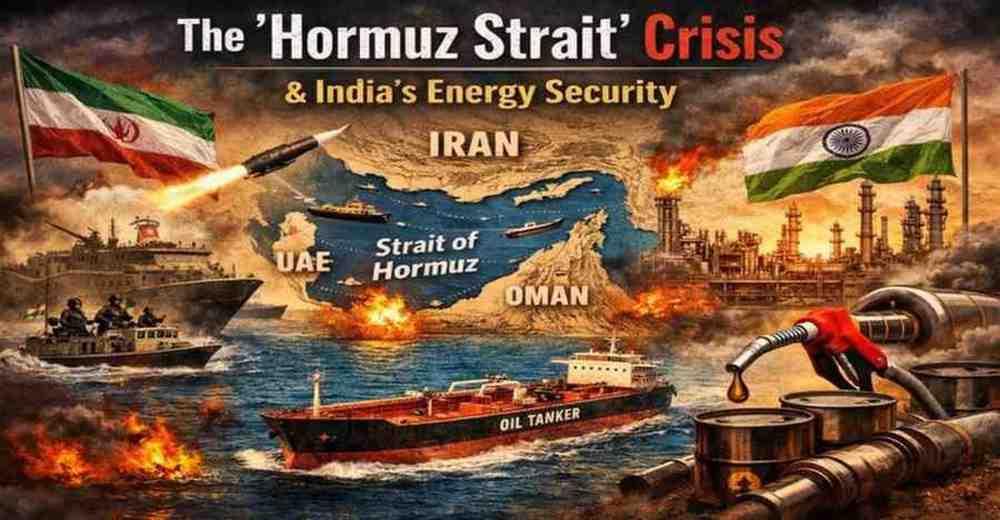
Navigating India's Oil Vulnerability and the Hormuz Chokepoint
✨ Key Takeaways
The global energy landscape shifted dramatically in the first week of March 2026. Following a series of military escalations between the US, Israel, and Iran, the Strait of Hormuz, the world’s most important oil chokepoint, has become a zone of extreme uncertainty. For India, a nation that relies on overseas markets for nearly 88 per cent of its crude oil, this is not just a distant geopolitical headline. It is a threat to the economy, the value of the Rupee, and the cost of living for every citizen.
This article breaks down why the Hormuz crisis is critical, how India is positioned to fight back, and what it means for our energy future.
1. The Geopolitical Trigger: March 2026 Context
The current crisis was sparked by a 'Black Swan' event over the weekend of February 28, 2026. Military strikes in the region led to a near-halt in shipping traffic through the Strait of Hormuz. By March 4, traffic through the waterway plummeted by an estimated 94 per cent compared to just days earlier.
Why Hormuz is the 'Jugular Vein'
The Strait of Hormuz is a narrow waterway, only 33 km wide at its tightest point, connecting the Persian Gulf to the Arabian Sea. It is the only way out for oil and gas from giants like Saudi Arabia, Iraq, the UAE, Kuwait, and Qatar.
Global Impact: It carries 20 per cent of global oil and 20 per cent of global Liquefied Natural Gas (LNG).
Price Surge: As a knee-jerk reaction, Brent crude jumped toward $85 per barrel this week.
2. India’s Critical Exposure: The 'Why We Care'
India is the world’s third-largest oil consumer, and our vulnerability is 'acute'.
The Volume: Approximately 2.5 to 2.7 million barrels per day (bpd) of India’s crude imports, nearly 52 per cent of our total oil intake, transit through the Strait of Hormuz.
The Recent Shift: Interestingly, India’s exposure to Hormuz increased in early 2026. After a year of heavy Reliance on Russian oil, Indian refiners had recently pivoted back toward Gulf suppliers (like Saudi Arabia and Iraq) to secure term contracts. This pivot has now left nearly half of our oil supply exposed to the current conflict.
3. The Economic 'Twin Deficit' Math
For a finance-heavy economy like India’s, high oil prices act as a massive 'Tax' on growth.
The Import Bill: Every $1 increase in the price of a barrel of oil adds roughly $2 billion to India’s annual import bill. If oil stays at $85 instead of the projected $70, India faces a sudden $30 billion hole in its budget.
Corporate Margins: Oil Marketing Companies (OMCs) like IOCL, BPCL, and HPCL are in a tough spot. If they do not raise petrol and diesel prices, their profit margins get crushed. If they do, inflation rises, and the RBI might be forced to keep interest rates high.
4. India’s Firewalls: The Buffer Zone
While the situation looks grim, India is not Defenceless. We have built 'firewalls' to survive a short-term shock.
Strategic Petroleum Reserves (SPR): India has underground salt caverns in Visakhapatnam, Mangaluru, and Padur that hold 5.33 million metric tonnes of crude. This is an 'emergency fund' that can cover about 9.5 days of national demand.
The 74-Day Cushion: When you add the oil kept at refineries and the 'oil on water' (cargo already in ships heading to India), the government estimates we have a total buffer of 74 days.
The Russian Pivot 2.0: This is India's 'Ace' in the hole. About 9.5 million barrels of Russian oil are currently idling in Asian waters. Since Russian oil comes via the Eastern route (bypassing the Middle East), India can quickly ramp up these purchases to replace lost Gulf volumes.
5. The 'Weakest Links': LPG and LNG
While we have a plan for crude oil, the situation for cooking gas (LPG) and natural gas (LNG) is much tighter.
LPG Vulnerability: India imports 80 to 85 per cent of its LPG, mostly from the Gulf. Unlike crude oil, we do not have large 'strategic reserves' for LPG. Most households have less than two weeks of buffer.
The Gas Shock: Around 55 to 60 per cent of our LNG (used for factories and city gas) comes through Hormuz, with Qatar being a major supplier. As of March 4, some industrial gas supplies have already been curtailed to prioritise households.
6. Sector-Specific Impact Analysis
Aviation: Jet fuel (ATF) is the biggest cost for airlines. A spike in oil will likely lead to higher airfares.
Fertilisers: Natural gas is the main 'food' for making Urea. Higher LNG prices mean a higher government subsidy bill to keep fertiliser cheap for farmers.
Paints & Chemicals: These industries use oil derivatives as raw materials. Expect their stock prices to remain volatile in the short term.
Conclusion: The Road to 2030
The Hormuz Crisis of 2026 is a loud 'wake-up call'. It proves that as long as we are tethered to the Middle East for fossil fuels, our economic sovereignty is at risk.
This crisis is accelerating India's transition. The government is already channelling billions into Green Hydrogen and Ethanol blending (E20). By the time the next geopolitical storm hits, the goal is for India to be running on its own sunshine and wind, rather than being squeezed by a 33 km stretch of water thousands of miles away.