Banks vs. NBFCs Returns Performance: A Comparative Analysis
 Join Us
 Follow Us
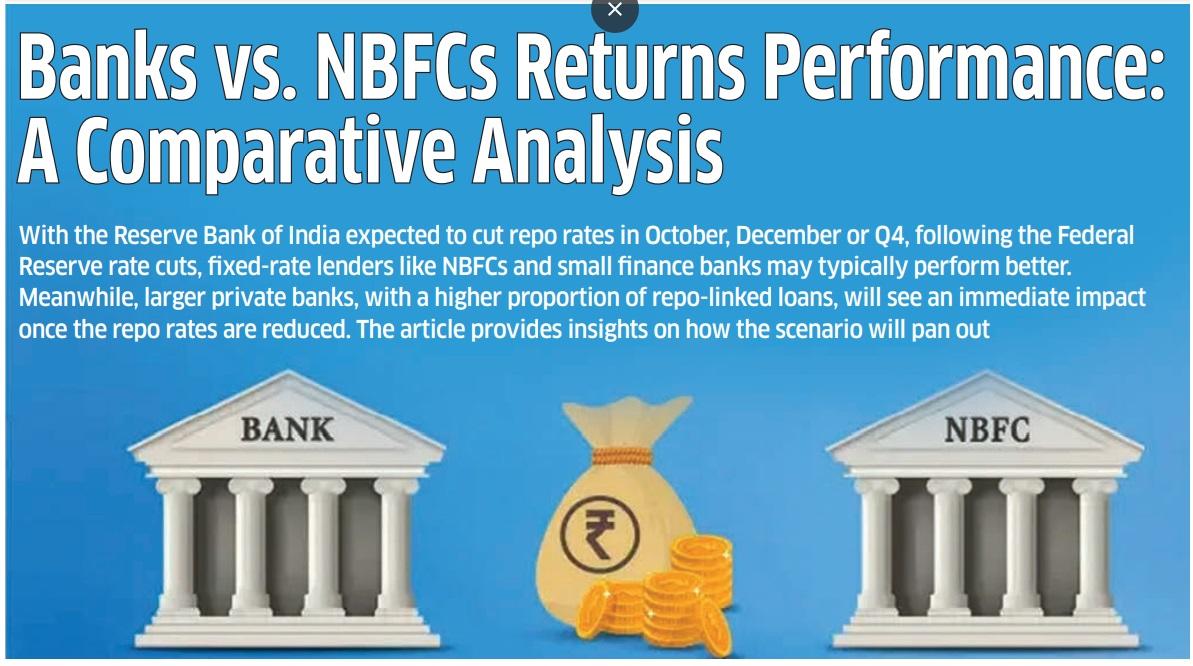
With the Reserve Bank of India expected to cut repo rates in October, December or Q4
✨ Key Takeaways
With the Reserve Bank of India expected to cut repo rates in October, December or Q4, following the Federal Reserve rate cuts, fixed-rate lenders like NBFCs and small finance banks may typically perform better. Meanwhile, larger private banks, with a higher proportion of repo-linked loans, will see an immediate impact once the repo rates are reduced. The article provides insights on how the scenario will pan out
The financial landscape in India is dominated by both traditional banks and non-banking financial companies (NBFCs). Their performance, as illustrated below, varies due to their operational structures, business models, and segment exposure. Understanding these differences is crucial for investors aiming to fine-tune their portfolios. Let’s understand the returns performance and the underlying factors that shape these entities’ financial dynamics.

Returns Performance: Banks versus NBFCs
The data for YTD (year-to-date) returns and one-year returns shows a clear divergence between the performance of banks and NBFCs. Nifty 50 has yielded a solid 15.20 per cent YTD return and 25.28 per cent over one year, indicating a strong broad market performance. Bank Nifty lags behind with 6.34 per cent YTD and 12.60 per cent one-year returns. This is largely due to the underperformance of HDFC Bank and Kotak Bank which have significant weightage in the index.
Banks
Among the major banks, ICICI Bank stands out with a stellar 23.80 per cent YTD and 26.48 per cent one-year returns, well above the industry average. Axis Bank has also delivered moderate gains, posting 8.16 per cent YTD and 18.95 per cent over the year. On the other hand, HDFC Bank and Kotak Mahindra Bank have struggled. HDFC Bank’s deposit costs increased due to tight liquidity conditions and Kotak Bank faced regulatory action from the Reserve Bank of India (RBI).
NBFCs
Shriram Finance leads the NBFCs pack with a whopping 59.18 per cent YTD and 66.64 per cent one-year returns, far outpacing the top-performing banks. Muthoot Finance and Manappuram Finance have also demonstrated strong performances primarily due to the rally in gold prices which drive the demand for gold loans. An interim ban posed by the RBI on IIFL Finance for gold loans has also helped these companies. Cholamandalam Investment has similarly outperformed the banks with 23.01 per cent YTD and 27.27 per cent over one year. However, Bajaj Finance showed a muted performance with -0.70 per cent YTD and -1.94 per cent over the year.
Understanding the Key Differentiators: Banks versus NBFCs
1. Raw Material for Banks and NBFCs
The primary raw material for both banks and NBFCs is capital, which they deploy in the form of loans and credit. However, the source of capital for these institutions differs significantly. Banks primarily source their capital through CASA (current account and savings account) deposits, which are relatively cheaper sources of funds. They also rely on term deposits and borrow from the market when necessary. NBFCs, on the other hand, do not have access to CASA deposits. They rely on wholesale borrowings from banks and financial markets, as well as issuing debt instruments like debentures and commercial papers.
2. Raw Material Prices: The Deciding Factors
The price of capital for both banks and NBFCs is largely influenced by the existing monetary policy and market conditions. For banks, the cost of funds is primarily determined by the repo rate set by the RBI, as it impacts the interest rates on deposits and borrowing. For NBFCs, since they depend on the wholesale market, the cost of capital is tied to bond yields and the prevailing interest rate environment. Credit ratings also play a crucial role. NBFCs with better ratings can secure funds at lower costs.
3. Banks’ CASA Advantage and NBFCs’ Dependence on Wholesale Deposits
One of the key advantages banks hold over NBFCs is their CASA base. CASA deposits are a low-cost source of funds, which allows banks to maintain lower interest rates on loans while preserving profitability. The larger the share of CASA in a bank’s deposit base, the lower its overall cost of funds. Conversely, NBFCs rely heavily on wholesale deposits and market borrowings, which are typically more expensive. This dependence on external funding sources exposes NBFCs to fluctuations in market interest rates, often resulting in higher borrowing costs, which can impact their lending rates and profitability.
4. Impact of Interest Rates on Credit Growth
Interest rates have a profound impact on the demand for credit. When the interest rates are low, borrowing becomes more affordable, encouraging businesses and consumers to take out loans for investment or consumption, thereby stimulating credit growth. On the flip side, when the interest rates are high, the cost of borrowing rises, reducing the demand for loans. This can lead to slower credit growth as individuals and companies defer or reduce borrowing.
5. High Interest Rates: Effect on Credit Growth
In an environment of high interest rates, both banks and NBFCs face challenges. Borrowers may find it expensive to service debt, resulting in a reduced demand for loans, especially for discretionary purposes like personal loans or vehicle financing. Lenders may witness a slowdown in loan disbursements, particularly in sectors that are interest-sensitive, such as real estate and consumer durables. NBFCs, given their higher cost of capital, might find it even more challenging to maintain margins, as they cannot pass on the entire cost increase to customers without impacting the demand.
6. Falling Interest Rates: NIM Compression and Credit Growth Offset
When interest rates begin to fall, banks and NBFCs face net interest margin (NIM) compression. This happens because loan rates typically adjust downwards faster than the cost of deposits or borrowing. As a result, the spread between lending rates and the cost of funds narrows, reducing profitability. However, falling rates can also lead to a boost in credit growth.
The increased demand for loans, driven by lower borrowing costs, can offset the margin compression by expanding the loan book, thereby maintaining profitability. Banks with a strong CASA base are better positioned to handle NIM compression because their cost of funds is relatively low. NBFCs, reliant on market borrowings, may feel the pinch more acutely, but rapid loan growth can still offset the margin pressure.
7. Floating Interest Rates: Impact on Loans
In a floating interest rate regime, the interest rate on loans adjusts in line with changes in the benchmark rate, such as the repo rate or the MCLR (marginal cost of lending rate) for banks.
For borrowers, floating rates mean that their loan repayments will fluctuate with changes in interest rates. During periods of rising rates, borrowers could face higher monthly payments, increasing the risk of defaults in some cases. Banks benefit from the ability to quickly reprice loans, maintaining profitability. NBFCs, however, may face higher costs to refinance their borrowings, especially if they are locked into fixed-rate loans while borrowing costs increase.
Conclusion
Interest rates have reached their peak, and rate cuts are somewhere near the horizon. The RBI is expected to cut repo rates in October, December or Q4, following the Federal Reserve rate cuts. In this environment, fixed-rate lenders like NBFCs and small finance banks typically perform better.
Since their lending rates are fixed, a reduction in borrowing rates leads to an expansion in their net interest margins. For this reason, NBFCs should do better. Meanwhile, larger private banks, with a higher proportion of repo-linked loans, will see an immediate impact once the repo rates are reduced.