Cuba Is Next: What Trump's Caribbean Gambit Means for Oil, Sanctions and India
 Join Us
 Follow Us
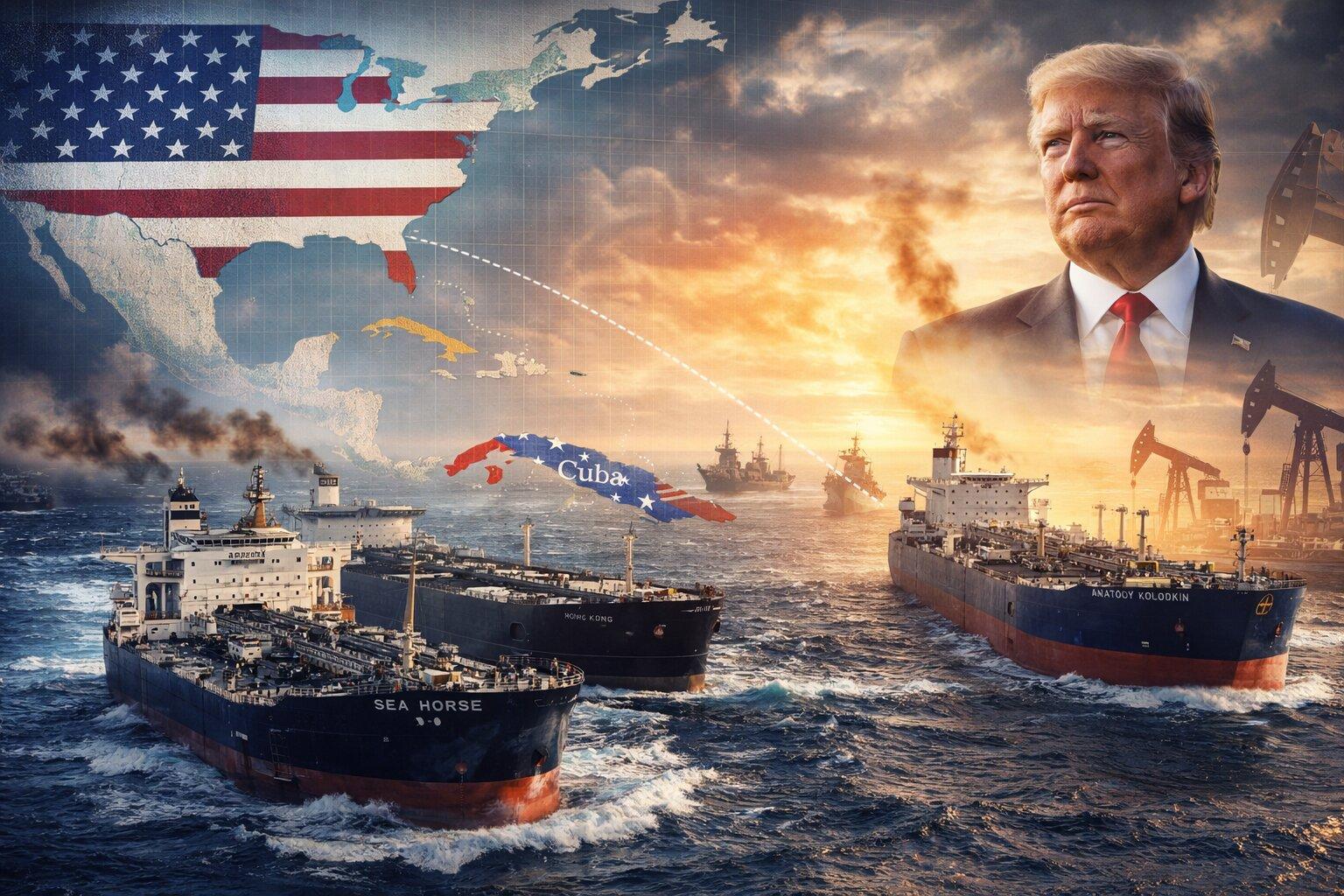
Two Russian tankers, a US blockade and a president who says "Cuba is next" the Caribbean is becoming the next theatre of economic warfare and India is watching more carefully than it is letting on
✨ AI Powered Summary
On March 27, 2026, at an investment forum in Miami, Donald Trump said three words that reverberated far beyond the Caribbean. "Cuba is next." He added, almost theatrically, "But pretend I didn't say that." Nobody pretended.
The remark came as two Russian tankers were crossing the Atlantic toward Cuba in defiance of a US blockade. One, the Hong Kong flagged Sea Horse, was carrying roughly 190,000 to 200,000 barrels of Russian gasoil. The other, the Anatoly Kolodkin, had 730,000 barrels of crude on board. The US Treasury had already made its position clear: Cuba would not be allowed to take delivery. Russia was sending the ships anyway. And Trump was telling a Miami audience that military action was next on his agenda after Venezuela and Iran.
This is not just a Cuba story. It is a story about how the US uses energy as a weapon, how far it is willing to go to force political outcomes, and what that means for every country including India that has chosen to keep buying Russian oil.
Why Cuba and Why Now
To understand the current crisis, you need to understand how dependent Cuba is on imported energy. The country produces barely 40 per cent of its own petroleum. The rest comes from imports, historically from Venezuela and Mexico. That supply chain collapsed rapidly in early 2026. The US military's abduction of Venezuelan President Nicolás Maduro in January severed Venezuela's oil lifeline to Cuba. Mexico halted shipments shortly after when Trump threatened tariffs on any country supplying oil to the island.
On January 29, 2026, Trump signed Executive Order 14380, declaring a national emergency over Cuba and authorising tariffs on any country that provides it with oil. The Treasury's Office of Foreign Assets Control added Cuba to a list of countries blocked from Russian oil transactions. The result has been a humanitarian slow motion collapse. Blackouts run 8 to 10 hours daily. A complete grid failure on March 16 left 10 million people without electricity. Hospitals are struggling with fuel for generators and ambulances. Cuban airports have suspended refuelling operations. Only 44 of Havana's 106 garbage trucks are operational.
Trump's stated goal is regime change. He has described Cuba's government as an "unusual and extraordinary threat" and said he thinks he will have the honour of taking Cuba. UN experts have condemned the blockade as a serious violation of international law.
Why the US Has Always Wanted Cuba
America's obsession with Cuba predates the Castro revolution. It goes back to the 19th century when US strategists viewed Cuba as the gateway to the Gulf of Mexico and the Caribbean trade routes. The island sits 145 kilometres from Florida, directly in the path of shipping lanes connecting the Atlantic to the Panama Canal. Whoever controls Cuba has significant leverage over Caribbean maritime traffic.
After the 1959 revolution, Cuba became a Cold War flashpoint the Bay of Pigs invasion, the Cuban Missile Crisis of 1962, decades of economic embargo. The US has never accepted a hostile government 90 miles from its coast. With Venezuela neutralised and Mexico brought to heel through tariff pressure, Cuba stands as the last remaining independently governed nation in America's near abroad that has historically aligned with US adversaries. From Washington's perspective, completing that picture is unfinished business from six decades ago.
There is also a domestic political dimension. Miami's large Cuban-American population has been one of the most influential voting blocs in Florida for decades. Trump's "Cuba is next" comment was made at a Miami investment forum. The audience understood exactly what he meant and why he was saying it there.
Russia's Calculation
Russia's decision to send the tankers is not primarily about oil supply. Cuba consumes roughly 20,000 barrels of diesel daily. The Sea Horse's cargo would cover nine to ten days of demand. That is not a meaningful strategic intervention. It is a signal.
Putin did not act to defend Venezuela after Maduro's abduction. Failing to show any solidarity with Cuba a relationship that predates the Soviet collapse and runs far deeper historically would send a damaging message to every country that considers Moscow a reliable partner. By sending the tankers, Russia demonstrates it is willing to defy Washington's energy blockade even if the practical impact is limited. The Anatoly Kolodkin reportedly updated its stated destination to Venezuela after the Treasury clarified its position, suggesting Russia is probing the limits of US enforcement rather than seeking direct confrontation.
The deceptive practices are telling. The Sea Horse switched off its location transponders during oil transfers and operates without Western insurance. The playbook is identical to what Indian refiners have navigated when buying Russian crude since 2022 shadow fleet shipping, non-Western insurance, alternative payment channels. Russia has built this infrastructure precisely for situations like this.
Three Ways This Plays Out
The most likely near term outcome is that Russia backs down from direct delivery to Cuba without a face saving arrangement the Kolodkin's destination update suggests this is already happening. A direct confrontation with the US Navy over a cargo that covers ten days of Cuban diesel demand is not worth it for Moscow strategically.
The second scenario is Cuban government collapse. Approximately 40 per cent of Cuba's population is estimated to be living in extreme poverty. Since 2021, around 2.5 million Cubans — 24 per cent of the population have fled the country. If fuel does not arrive in meaningful quantities soon, the government's ability to function deteriorates rapidly. This is arguably the scenario Washington is deliberately engineering.
The third scenario is escalation. Russia tests US resolve by sending more tankers, the US intercepts one, and the Caribbean becomes a live theatre of great power confrontation. This remains unlikely given the asymmetry involved, but the risk is not zero.
Why India Is Watching This Very Carefully
India is not a party to this dispute. But it is paying close attention because the playbook being used against Cuba is one India has been navigating in a different context since February 2022.
India imports roughly 88 per cent of its oil and is the world's third largest consumer. Since Russia's invasion of Ukraine, India has been buying Russian crude at significant discounts, despite Western pressure. Russian oil now accounts for a meaningful share of India's import basket and has materially reduced India's energy bill during a period of global price volatility.
The Cuba episode demonstrates precisely how the US operationalises energy as a coercive tool. Executive Order 14380 authorises tariffs on any country supplying oil to Cuba a direct threat to third party sovereign trade decisions. The Sanctioning Russia Act, still moving through the US Senate, contains provisions for tariffs of up to 500 per cent on countries that continue buying Russian petroleum. India has been explicitly named in that context.
Cuba's crisis stems directly from its dependence on Venezuelan oil, which disappeared after a US military operation, and from Mexico folding under tariff pressure. The sequence neutralise the primary supplier, threaten secondary suppliers, block alternative sources is a template. India's Russian oil imports make it a potential target of exactly this template, and Indian policymakers understand that.
The space for neutrality in a world fracturing into competing blocs is shrinking. Middle powers like India are left calculating how to secure energy needs without becoming collateral damage in someone else's geopolitical game. Cuba, with fewer options and less leverage, offers a clear view of what that calculation looks like when it fails.
Disclaimer: This article is for informational purposes only and not investment advice.