Dividend Record Date Versus Ex Dividend Date: What Investors Should Know
 Join Us
 Follow Us
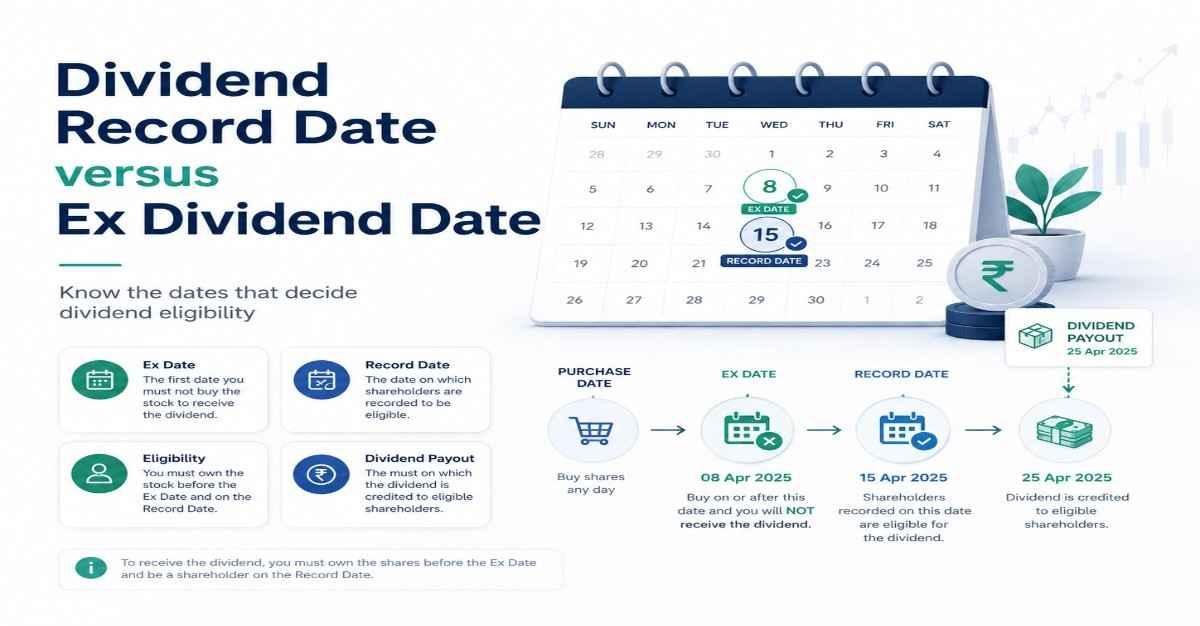
Learn which date determines dividend eligibility and when investors must purchase shares to qualify.
✨ Key Takeaways
Dividend announcements include several dates, but the record date and ex dividend date cause the most confusion. One determines who is eligible to receive the dividend, while the other marks when the share begins trading without that entitlement.
Understanding dividend record date versus ex dividend date is essential for investors who want to know whether a purchase qualifies for an announced payout. It also explains why the share price may adjust when the stock turns ex dividend.
What Is the Dividend Record Date?
The record date is fixed by the company to identify shareholders eligible for the dividend. The company or its Registrar and Transfer Agent checks the official shareholder records at the end of that date.
SEBI’s investor material defines the record date as the date used to determine eligible shareholders. Investors whose names appear in the records on that date are entitled to receive the declared dividend, subject to the terms and approvals mentioned in the announcement.
The same concept is used for other corporate actions, including Bonus issues, Stock Splits, rights issues and buybacks.
What Is the Ex Dividend Date?
The ex dividend date is the date from which the share trades without the right to receive the upcoming dividend. An investor purchasing on or after this date generally does not receive that payout. The entitlement remains with the seller whose ownership is captured for the record date.
Stock exchanges publish the ex date based on the company’s record date and the applicable settlement process. NSE’s corporate action data separately displays the purpose, ex date and record date.
Under the current T+1 settlement framework, the ex dividend date and record date are often the same for Indian shares, although investors should check the exchange announcement for the specific company. A buyer generally needs to purchase at least one trading day before the ex date.
A Simple Example
Assume a company declares a dividend of ₹8 per share and announces Friday, 21 August, as both the ex dividend date and record date.
An investor who buys on Thursday, 20 August, would normally have the trade settled in time for the holding to appear on the record date and would be eligible for the dividend.
An investor buying on Friday, 21 August, purchases after the stock has turned ex dividend and would generally not receive the ₹8 payout. An existing shareholder who sells on the ex date would generally remain eligible because the shares were held through the last cum dividend trading day.
Holidays can affect the practical deadline, so investors should rely on the published ex date rather than calculate eligibility only from calendar dates.
What Is the Cum Dividend Date?
Cum dividend means “with dividend”. The last cum dividend date is the final trading day on which a buyer can purchase the share with entitlement to the announced payout.
It is usually the trading day immediately before the ex dividend date. Once the market opens on the ex date, new buyers no longer receive the upcoming dividend.
The company may announce a dividend weeks before the record date. Buying after the announcement alone does not ensure eligibility. The purchase must take place before the share turns ex dividend.
Why Does the Share Price Adjust?
When a share turns ex dividend, its price may theoretically adjust lower by approximately the dividend amount because new buyers no longer receive that cash.
If a share closes at ₹200 before going ex dividend for ₹8, its theoretical adjusted reference may be near ₹192. SEBI’s corporate action material explains that the share price is adjusted for the dividend payout on the ex date.
The actual market price can differ because demand, sentiment, earnings expectations and broader market movement continue to influence trading. A dividend is therefore not free additional wealth. The company distributes cash, and the market value may adjust to reflect it.
Declaration Date and Payment Date
The declaration date is when the board approves an interim dividend or recommends a final dividend. A final dividend may require shareholder approval, while an interim dividend is generally approved by the board.
The payment date is when eligible shareholders receive the money in their registered Bank accounts. It occurs after the record date because the company needs time to verify records and process payments.
Investors should keep their bank, PAN and demat details updated to avoid payment delays.
Common Mistakes
A frequent mistake is buying on the record date and assuming the purchase qualifies. Eligibility depends on settlement and the published ex date, not simply on placing an order before the record date ends.
Another mistake is buying only for the dividend without considering the likely price adjustment, Taxes, transaction costs and the company’s financial strength.
Investors should also avoid confusing dividend percentage with dividend yield. A 100% dividend on a face value of ₹2 means ₹2 per share, not 100% of the market price.
Key Takeaway
In dividend record date versus ex dividend date, the record date identifies eligible shareholders, while the ex date marks when the share begins trading without the entitlement.
For most Indian equities under T+1 settlement, investors generally need to buy at least one trading day before the published ex date. Since holidays and exchange schedules can affect eligibility, the official corporate action notice should always be checked.