Moats in Business: How to Identify Companies With Sustainable Competitive Advantages
 Join Us
 Follow Us
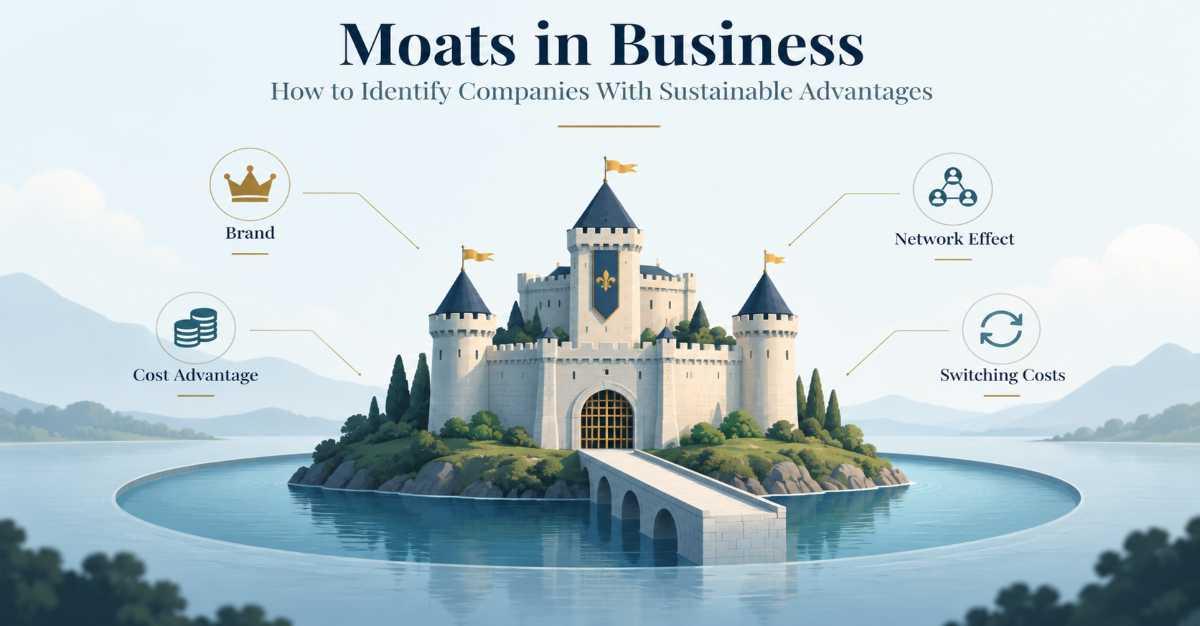
Learn how business moats help companies maintain competitive advantages. Understand brand moats, network effects, cost advantages and switching costs to identify quality businesses for long-term investing.
✨ Key Takeaways
Introduction: Why Business Moats Matter for Investors
In investing, identifying companies that can consistently grow and protect their profitability is one of the most important aspects of long-term wealth creation. While financial performance, valuations and growth prospects are critical, another factor often separates exceptional businesses from average ones — a strong competitive advantage or business moat.
The term “economic moat” was popularised by legendary investor Warren Buffett, who compared a company’s competitive advantage to the protective moat surrounding a medieval castle. Just as a moat protected a castle from competitors, a strong business moat helps companies defend their market position, maintain pricing power and generate sustainable returns over long periods.
However, not every successful company has a durable moat. A business may report strong growth for a few years due to favourable market conditions, but without a sustainable advantage, competitors can eventually enter the market and reduce profitability. Therefore, understanding different types of moats can help investors identify businesses with long-term potential.
What Is a Business Moat?
A business moat refers to a structural advantage that allows a company to stay ahead of competitors. It enables a company to maintain customer loyalty, protect margins and create barriers for new entrants.
A strong moat usually reflects itself through:
- Consistent profitability over several years
- Strong return on capital employed (ROCE)
- Stable or expanding margins
- Pricing power
- Customer retention
- Market leadership
Companies with strong moats are not necessarily those operating in the fastest-growing industries. Instead, they are businesses that have built advantages competitors find difficult to replicate.
1. Brand Moat: The Power of Customer Trust
A strong brand is one of the most visible forms of a business moat. Companies with powerful brands often enjoy customer loyalty, allowing them to charge premium prices compared with competitors.
A brand moat develops over years through consistent product quality, customer experience and trust. Customers often associate certain brands with reliability, making them less sensitive to price changes.
For example, premium consumer companies benefit from strong brand recognition because customers are willing to pay more for their products despite alternatives being available. Similarly, established financial institutions, automobile manufacturers and healthcare companies often leverage their reputation to attract and retain customers.
Key indicators of a brand moat include:
- High customer loyalty
- Strong market share
- Premium pricing ability
- Low customer acquisition costs
- Repeat purchases
However, investors should evaluate whether the brand advantage is translating into financial strength. A popular brand without improving profitability may not represent a strong economic moat.
2. Network Effect: When More Users Create More Value
A network effect occurs when the value of a product or service increases as more people use it. This creates a self-reinforcing advantage, making it difficult for competitors to attract customers.
Technology platforms, digital marketplaces and financial networks often benefit from network effects.
For instance, a platform with millions of users becomes more attractive because users find greater value from interacting within a larger ecosystem. At the same time, new competitors face challenges because they must convince users to shift away from an already established network.
Examples of network-driven businesses include:
- Digital payment platforms
- Online marketplaces
- Social platforms
- Software ecosystems
The strength of a network moat depends on user engagement, transaction volume and the difficulty customers face while moving to alternatives.
3. Cost Advantage: Competing Through Efficiency
Some companies build moats by developing a cost advantage that competitors cannot easily match. Lower operating costs allow these businesses to offer competitive prices while maintaining healthy margins.
Cost advantages can come from:
- Economies of scale
- Efficient supply chains
- Superior technology
- Access to cheaper resources
- Operational excellence
Large companies often benefit from scale because higher production volumes reduce per-unit costs. This creates an advantage over smaller competitors.
For example, a company with a strong distribution network and efficient manufacturing process may maintain profitability even during challenging economic conditions, while competitors struggle with rising costs.
Investors can identify cost advantages by analysing:
- Operating margins compared with peers
- Cost structure
- Asset utilisation
- Supply chain efficiency
4. Switching Costs: Making Customers Stay
Switching costs arise when customers face difficulties, expenses or inconvenience while moving from one company to another.
These costs do not always have to be financial. They can also involve time, learning effort, operational disruption or loss of accumulated data.
Examples include:
- Enterprise software platforms where companies invest heavily in integration and employee training
- Banking relationships involving multiple linked services
- Industrial equipment requiring specialised maintenance systems
Businesses with high switching costs often enjoy strong customer retention and predictable revenue streams.
Important indicators include:
- High customer retention rates
- Recurring revenue models
- Long-term contracts
- Increasing customer lifetime value
How Investors Can Identify Strong Business Moats
Identifying a moat requires looking beyond short-term financial performance. Investors should analyse both qualitative and quantitative factors.
Some important questions include:
Does the company have pricing power?
A company that can increase prices without losing customers often has a strong competitive advantage.
Is profitability consistent?
Businesses with durable moats generally maintain healthy margins and returns across economic cycles.
How difficult is it for competitors to replicate the business?
A strong moat exists when competitors cannot easily copy the company’s technology, brand, distribution network or customer relationships.
Does the company continue strengthening its advantage?
A moat should ideally become stronger over time rather than weaken due to competition.
Conclusion: Finding Businesses Built to Last
A business moat is not just about being a market leader today; it is about having the ability to remain competitive in the future. Brand strength, network effects, cost advantages and switching costs are some of the most important sources of sustainable competitive advantages.
For investors, understanding moats can provide valuable insights into why certain companies consistently generate superior returns while others struggle despite operating in attractive industries.
However, a strong moat should always be evaluated along with valuation, management quality, financial performance and industry trends. A great business can still be a poor investment if purchased at an excessive valuation.
The objective is not simply to find companies that are successful today, but to identify businesses with advantages that can protect and compound value over the long term.