Domestic Markets Still Under A Grey Cloud
 Join Us
 Follow Us
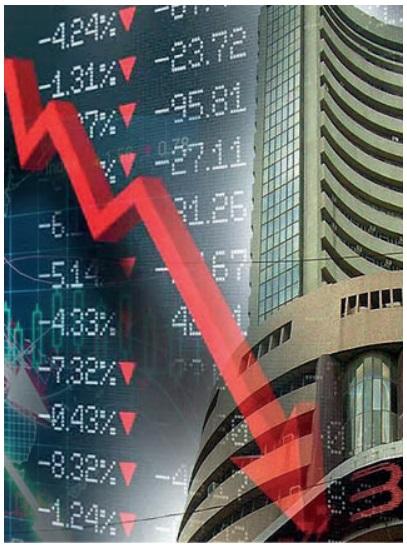
The benchmark indices’ bearish streak is now on the verge of breaking a 23-year record
✨ Key Takeaways
The announcement of no Income Tax payable on annual income up to `12 lakhs served as a beacon of hope for taxpayers, providing a boost to consumptiondriven sectors
The benchmark indices’ bearish streak is now on the verge of breaking a 23-year record, marking the fourth consecutive month of decline. The BSE Sensex and Nifty 50, which had plunged over 10-11 per cent from their record highs in September 2024, extended their decline during the first week of the last fortnight. A persistent FII selling streak drove the downturn, concerns over overvalued stocks amid lacklustre Quarterly Results, and mounting global uncertainties stemming from the tariff war. Another major reason is India’s sluggish economic growth.
The annual economic survey, presented in the parliament by Finance Minister Nirmala Sitharaman, projects GDP growth to range between 6.3 per cent and 6.8 per cent for the upcoming fiscal year, beginning April 1. This comes as economic growth is anticipated to slow down to a four-year low this year, down from 8.2 per cent in the previous year. Foreign institutional investors (FIIs) continued to be net sellers during the fortnight, divesting equities worth over `42,000 crore. The Nifty 50 index even slipped below the critical 23,000 psychological level, triggering panic among investors.
However, sentiment shifted during last week as the domestic markets staged a strong rebound. Benchmark indices logged a four-session rally, surging nearly 3 per cent, fuelled by optimism surrounding potentially favourable announcements in the Union Budget 2025 and expectations of a broader market recovery. The Nifty VIX, often regarded as the market’s fear gauge, plummeted over 13 per cent on the day of the Union Budget, signalling reduced expected volatility. Although the budget was hailed as a ‘dream budget’ for the middle-class thanks to the announcement of no Income Tax payable on annual income up to `12 lakhs, the market’s reaction remained subdued.
While the main indices ended the budget trading session on a flat note, sectoral performance was highly mixed. FMCG, consumer durables, real estate, automotive, and discretionary sector stocks climbed on optimism that the government’s tax relief measures would lead to higher disposable income, ultimately boosting consumer spending and demand. On the other hand, stocks in PSU, power, energy, railway, defence and capital goods sectors saw a sharp decline after the government’s decision in the Union Budget 2025-26 to reduce the revised capital expenditure (capex) estimate for FY25 to `10.18 lakh crore.
This dampened investor sentiment in these sectors. However, Finance Minister Nirmala Sitharaman clarified that there is no reduction in public spending on capital expenditure, emphasising that the government’s commitment to infrastructure development and economic growth remains intact. Meanwhile, the new U.S. government’s imposition of tariffs on certain countries has turned into a hanging sword and markets worldwide are in a wait-andwatch mood. The question is: Has the market reached its bottom and is poised for a recovery, or is there still potential for further downside? Stay tuned for further updates!
