Asset Allocation for Beginners: Finding Your 'Sleep Well at Night' (SWAN) Ratio
 Join Us
 Follow Us
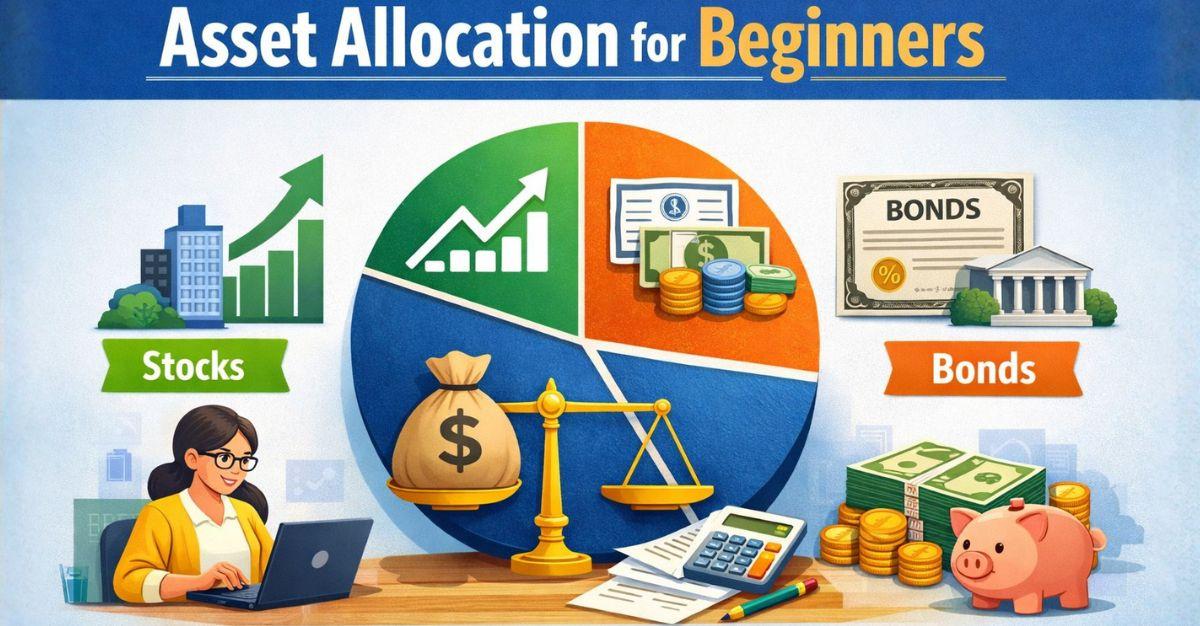
A Simple Recipe for Financial Security in an Unpredictable Market.
✨ Key Takeaways
Imagine you are building a meal. If you eat nothing but chilli peppers, you will be on fire. If you eat nothing but white bread, you will be bored and malnourished. A great meal, like a great investment portfolio, is all about the mix.
In the financial world, this mix is called Asset Allocation. It sounds like a dry, textbook term, but it is actually the secret sauce to staying wealthy without losing your hair. At its heart, asset allocation is about finding your SWAN Ratio: the specific balance of investments that lets you Sleep Well At Night.
If you have ever stayed awake at 2:00 a.m. wondering if a stock market dip just 'erased' your summer vacation, your allocation is wrong. Let us fix that.
1. What Exactly is an 'Asset Class'?
Before we mix the ingredients, we need to know what is in the pantry. In personal finance, there are three 'Big Players':
- Stocks (Equities): These are the race cars. They have the potential to go very fast and win big trophies (high returns), but they can also crash spectacularly. When you buy a stock, you own a piece of a business.
- Bonds (Fixed Income): These are the minivans. They are not flashy, and they will not win any races, but they are reliable. They pay you a steady 'rent' (interest) for lending them money.
- Cash (and Equivalents): This is the spare tyre. It does not move you forward, but you are sure glad it is there when things go wrong.
There are others like Real Estate or Gold, but for a beginner, the dance between Stocks and Bonds is where the magic happens.
2. The Great Tug-of-War: Risk vs. Reward
The reason we do not put all our money into stocks (the race cars) is that the road is bumpy. The reason we do not put all our money into bonds (the minivans) is that we will never reach our destination on time.
Asset Allocation is the art of balancing your 'Need for Speed' with your 'Need for Safety.'
If the stock market drops by 20 per cent tomorrow, how would you react?
A) 'Great! Everything is on sale! I will buy more.'
B) 'I am slightly annoyed, but I will check back in six months.'
C) 'I cannot breathe. Should I sell everything and hide the cash under my mattress?'
If you answered C, you are currently driving a race car when you should probably be in a sturdy SUV.
3. Finding Your SWAN Ratio: The Strategy
The 'SWAN Ratio' is not a fixed maths formula; it is a reflection of your life stage and your personality. Here are three classic 'Recipes' to help you find yours:
The 'Young & Bold' (90 per cent Stocks / 10 per cent Bonds)
If you are in your 20s or early 30s, time is your superpower. If the market crashes, you have decades to wait for it to recover. You can afford to let the race cars do their thing. You only keep 10 per cent in bonds just to have a tiny bit of 'ballast' to keep the ship steady.
The 'Balanced Builder' (60 per cent Stocks / 40 per cent Bonds)
This is the classic 'Goldilocks' portfolio. It is not too hot, not too cold. When stocks go up, you make good money. When stocks go down, your 40 per cent in bonds acts like a giant pillow, softening the fall. This is perfect for people who want growth but do not want to see their account value swing wildly every week.
The 'Preservation Pro' (30 per cent Stocks / 70 per cent Bonds)
This is usually for people nearing retirement. At this stage, you have already won the game. Your goal is not to get rich; it is to stay rich. You keep most of your money in the 'minivans' (bonds) so that your monthly income is predictable and safe.
4. Why Asset Allocation Works (The 'Pizza' Analogy)
Think of your portfolio as a pizza. If you have a 'Meat Lover's' pizza (All Stocks) and the price of meat skyrockets, your whole meal becomes expensive and risky. But if you have a 'Supreme' pizza (Stocks, Bonds, Real Estate, Cash), and one ingredient has a problem, you still have a delicious meal.
This is called Allocation. Different assets react differently to the world. Usually, when stocks are panicking and going down, people run towards the safety of bonds, causing bond prices to go up. They balance each other out. It is like owning an umbrella shop and a sunscreen shop, you are covered no matter the weather.
5. The 'Age' Rule (And Why to Break It)
There used to be an old rule: '100 minus your age = how much you should have in stocks.' So, if you are 30, you should have 70 per cent in stocks. If you are 70, you should have 30 per cent.
While this is a decent starting point, it is a bit outdated. In 2026, people are living longer. If you are 70, you might still have 20 or 30 years of life ahead of you. You might need a bit more 'race car' in your garage than the old rules suggest. The best rule is your gut. If your portfolio is keeping you awake, it is too aggressive. Full stop.
6. Do Not Forget to 'Rebalance'
Imagine you start with a 50/50 mix of stocks and bonds. Suddenly, the stock market has a monster year and doubles in value. Now, your mix is 75 per cent stocks and 25 per cent bonds.
You are now accidentally 'High Risk.' To get back to your SWAN Ratio, you have to do something that feels counter-intuitive: Sell some of your winners (stocks) and buy more of your 'boring' assets (bonds).
This forces you to do the one thing every investor dreams of: Buying low and selling high. It keeps your 'race car' from turning into a 'rocket ship' that might eventually crash.
7. Common Pitfalls for Beginners
Chasing Performance: Do not change your allocation just because you saw a TikToker made 1,000 per cent on a random crypto coin. That is not a strategy; that is a lottery ticket.
Checking Too Often: The more you check your portfolio, the more 'risk' you perceive. If you look every hour, you see every tiny bump. If you look once a year, you see a smooth upward line.
Forgetting Cash: Always keep a 'boring' emergency fund in a simple savings account. Knowing you can pay for a flat tyre or a broken laptop is the ultimate sleep aid.
Disclaimer: The article is for informational purposes only and not investment advice.