India Slips to 6th: What the IMF's Latest GDP Rankings Actually Tell Us
 Join Us
 Follow Us
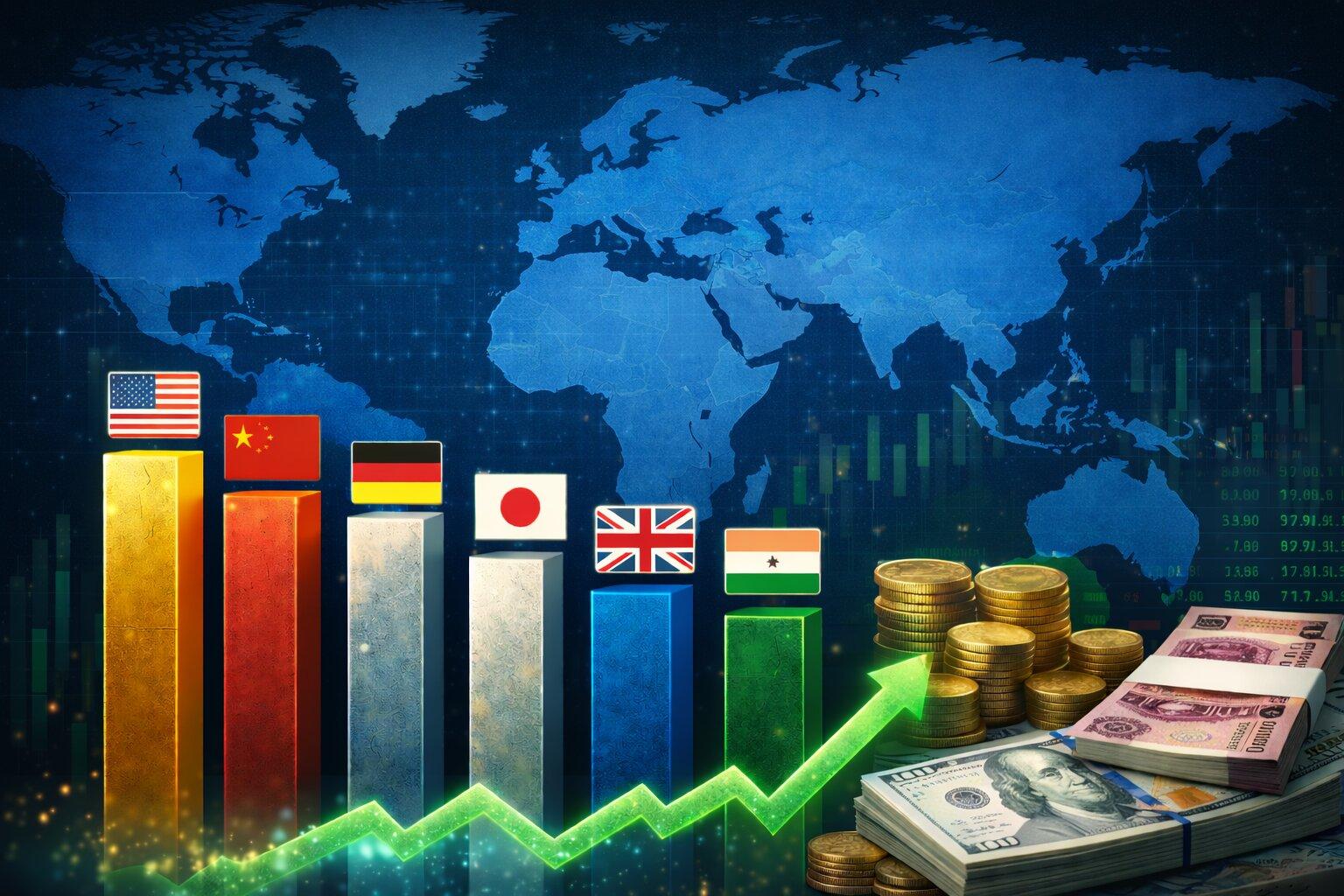
A weakening rupee and a base year revision moved India behind Japan and the UK but the real question is whether GDP rank is even the right metric for a country like India
✨ Key Takeaways
The International Monetary Fund's April 2026 World Economic Outlook delivered an uncomfortable headline for India. After overtaking the UK in 2022 and Japan in 2025 to briefly claim the fourth spot among the world's largest economies, India has slipped back to sixth. Both countries have reclaimed their positions, and India now sits behind them with a nominal GDP estimated at approximately USD 4.15 trillion.
Where the World's Largest Economies Stand
The current IMF ranking by nominal GDP in dollar terms is as follows.
|
Rank |
Country |
Nominal GDP (2026) (Billions USD) |
|
1 |
United States |
32.38 |
|
2 |
China |
20.85 |
|
3 |
Germany |
4.9 |
|
4 |
Japan |
4.38 |
|
5 |
United Kingdom |
4.26 |
|
6 |
India |
4.15 |
The gap between ranks 4, 5 and 6 is striking. Japan at approximately USD 4.4 trillion, the UK at USD 4.3 trillion and India at USD 4.15 trillion are separated by less than USD 300 billion in total — small relative to the scale of these economies, which means movement between them remains highly sensitive to exchange rate fluctuations rather than fundamental differences in economic output.
Why India Slipped: Two Reasons, Neither Is a Crisis
The first and primary reason is rupee depreciation. The rupee has fallen approximately 9 per cent against the US dollar and currently sits at record lows, making it one of the worst-performing currencies in Asia this year. The IMF calculates each country's GDP in local currency and then converts it to US dollars for global comparison. When the rupee weakens, India's economic output in dollar terms shrinks mechanically not because less was produced, but because each rupee buys fewer dollars when the conversion is applied. A country growing at 6.5 per cent in real rupee terms can still fall in the dollar-denominated ranking if its currency depreciates faster than its real growth rate.
The second reason is a GDP base year revision. India updated its GDP base year from 2011-14 to 2022-23 in February 2026. This was a necessary statistical correction base years need periodic updating to reflect current price levels, otherwise inflation in goods and services that occurred since the old base year makes nominal GDP appear larger than it actually is. When the revised calculations were applied, India's projected GDP for 2025-26 came in lower on paper, allowing the UK to reclaim fifth place.
Neither of these is a symptom of an economy in trouble. India's real GDP growth remains in the 6.4 to 6.5 percent range more than double the global average. The country remains the fastest-growing major economy in the world by a significant margin. Japan, which has now moved back above India, has seen its economy stagnate and in some periods shrink over the past four years. The irony is real: an economy growing at near zero percent in volume terms has climbed above one growing at 6.5 percent purely because of dollar conversion math.
What This Means for the USD 5 Trillion and Third Largest Dreams
India's target to become a USD 5 trillion economy has already been revised multiple times initially set for 2025, then pushed to 2027. At current trends, the timeline may need revision again. To reach USD 5 trillion in a single year from USD 4.15 trillion would require approximately 20 percent nominal GDP growth in dollar terms. India's average GDP growth over the past decade has been around 7 per cent. Even the US and China at their respective peaks never consistently achieved 20 per cent growth. The USD 5 trillion milestone is achievable, but the timeline depends heavily on where the rupee stabilises.
The path to third largest by 2031, which would require overtaking Germany at approximately USD 4.9 trillion, is more realistic. At 6 to 7 percent real growth with reasonable currency stability, India can cover that gap over five years. The current slippage to sixth is a speed bump on that trajectory, not a detour from it.
The Number That Matters More Than the Rank
Here is where the conversation needs to go beyond headline rankings, and it is a point worth making directly even if it cuts against the comfortable narrative.
Nominal GDP measures the total size of an economy. It tells you how much is produced in aggregate. What it does not tell you is how that production is distributed across 1.4 billion people. India at USD 4.15 trillion divided by its population gives a per capita GDP of approximately USD 2,900. Japan at USD 4.4 trillion divided by 125 million people gives approximately USD 35,000 per capita. The UK at USD 4.3 trillion divided by 67 million gives approximately USD 64,000.
India's fourth or sixth ranking in total GDP is a fact about economic scale. But scale and prosperity are different things. A country can have a large aggregate economy while a substantial share of its population remains in low-income conditions. The GDP rank tells you how big the pie is. It does not tell you how many people are eating it.
India's Purchasing Power Parity ranking, which adjusts for the fact that a dollar buys significantly more in India than in the US or UK, places India third in the world — already ahead of Germany and Japan. In PPP terms, India's economic weight is far larger than the nominal dollar ranking suggests because the domestic cost of living, wages and services are priced in rupees, not dollars.
This distinction matters enormously for policy. If the primary goal is to move up the nominal GDP ranking to be fourth rather than sixth the most direct lever is currency management, not economic development. But if the goal is to raise the living standards of 1.4 billion people, the more relevant questions are about household income growth, the quality of employment being created, access to healthcare and education, and whether the benefits of 6.5 per cent GDP growth are reaching the households that need them most.
India's per capita income, even adjusted for purchasing power, remains significantly below middle-income country averages. Real wages for a large share of the workforce have not kept pace with GDP growth. This is not a reason to dismiss the growth achievement it is substantial and has lifted hundreds of millions out of poverty over two decades. But it is a reason to be careful about treating a GDP ranking as the primary scorecard for a country with this level of internal income disparity.
The most honest framing is this: India's rise to the fourth or third largest economy by nominal GDP is a milestone worth celebrating as a measure of the country's increasing global economic weight. But the milestone that matters more for the average Indian family is not whether India's aggregate output overtakes Japan's — it is whether household incomes, formal employment and social infrastructure are growing fast enough to convert aggregate expansion into broadly shared prosperity.
A country of India's size and complexity needs both ambitions simultaneously. The GDP ranking is the global scorecard. The per capita trajectory is the domestic one. Right now, one is moving faster than the other.
Disclaimer: This article is for informational purposes only and not investment advice.