India's Data Centre Boom: The Digital Infrastructure Story That Is Just Getting Started
 Join Us
 Follow Us
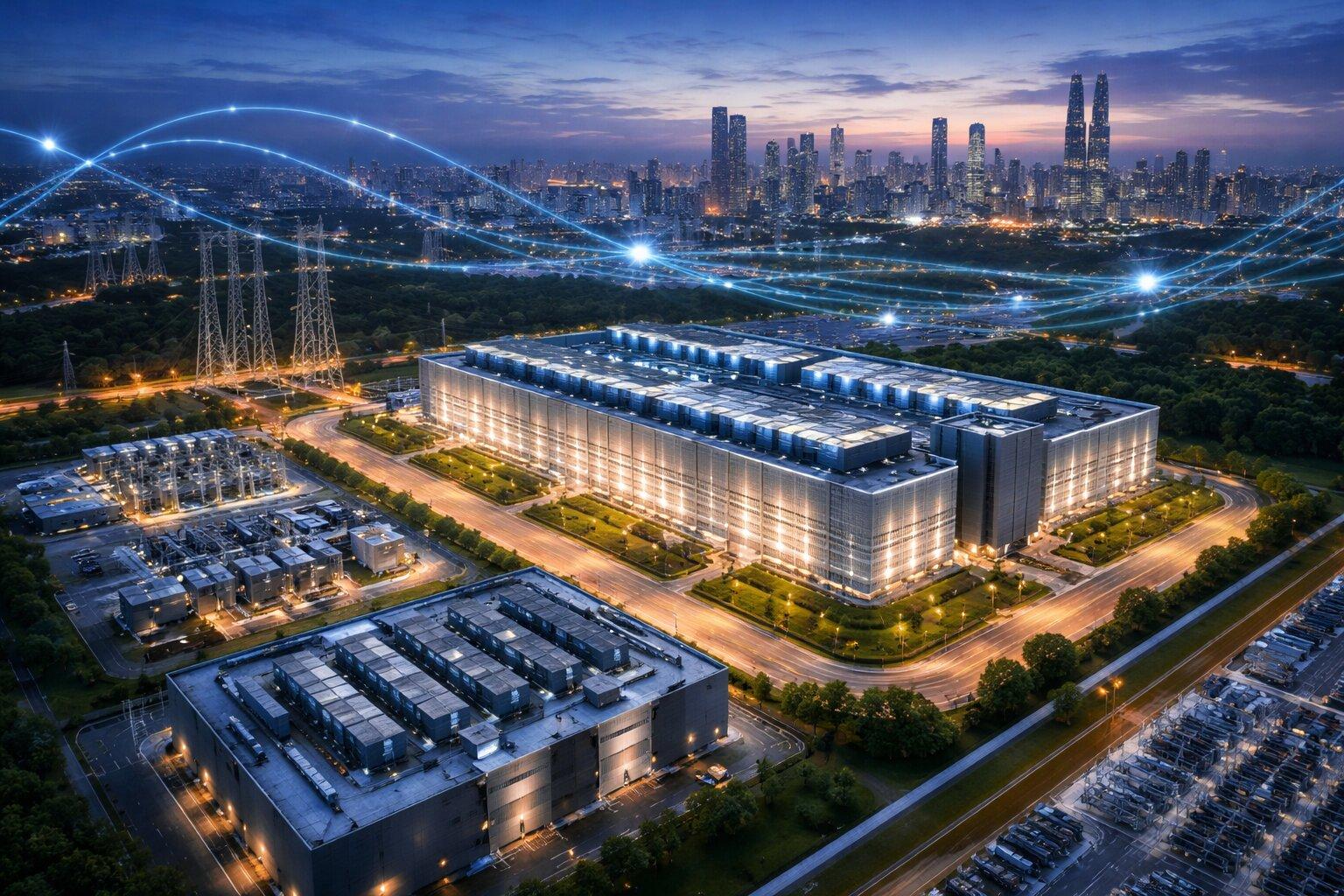
From generating 20% of the world's data but storing only 1% of it, India is now attracting over Rs 3 lakh crore in data centre investments and the opportunity runs far deeper than the headline numbers suggest
✨ Key Takeaways
India generates nearly 20 per cent of the world's total data. It stores only 1 per cent of it. That single gap explains everything about what is happening in the Indian data centre industry right now. Every UPI payment, every IPL stream on Hotstar, every ChatGPT query, every cloud backup all of it runs through data centres. The US average data centre capacity is around 100 megawatts. India's largest, until recently, was 5.8 megawatts. Below the minimum starting capacity in America. That is the starting point from which India is now attempting one of the fastest infrastructure scale-ups in its digital history.
What Triggered the Rush
Two forces have converged simultaneously to make data centres an urgent national priority. The first is the Digital Personal Data Protection Act of 2023, which mandates that data on Indian citizens must be stored within India. Banks, hospitals, fintech firms, OTT platforms all of them were previously hosting data in Singapore or the US. That is no longer permitted. Overnight, every large enterprise in India became a potential data centre customer.
The second force is AI. By 2030, AI workloads are projected to account for nearly 70 per cent of total data centre demand globally. GPU intensive model training and real time inference require compute infrastructure at a scale that simply did not exist in India even three years ago. The combination of data localisation mandates and AI driven compute demand has created a pull that global hyperscalers cannot ignore.
The investment response has been immediate and large. Amazon Web Services has committed Rs 70,000 crore in Maharashtra. Google has announced approximately Rs 50,000 crore investment in Vizag, targeting one gigawatt of capacity that would be Asia's largest data centre. Microsoft is expanding its Hyderabad operations. Reliance Industries has announced Rs 98,000 crore in data centre investments. And Lodha Developers, India's largest luxury Real Estate developer, signed an MoU with the Maharashtra government at Davos in January 2026 for Rs 1 lakh crore in additional data centre park development on top of an earlier Rs 30,000 crore commitment creating a 2.5 gigawatt park that will be the largest in the country. Amazon has already acquired land within that park and secured power arrangements for the next 15 years.
The Indian data centre market was valued at USD 5 to 7 billion in 2024. It is projected to reach USD 12 to 25 billion by 2030. Installed capacity has doubled to 1,400 megawatts and could reach 4,500 to 8,000 megawatts by 2030. Total investments are expected to cross USD 100 billion by 2027.
Where the Real Money Is Being Made
The California Gold Rush analogy is overused in investment circles but it genuinely fits here. During the 1850s gold rush, it was not the miners who got rich consistently it was Levi Strauss selling jeans and Wells Fargo providing banking and transport. The ecosystem players made more reliable money than the core operators. India's data centre boom follows the same pattern.
The most direct beneficiaries are not the data centre operators themselves but the industries that enable them. Energy is the most critical constraint. Data centres are extraordinarily power hungry. By 2030, data centres in India alone may consume as much electricity as the entire country currently uses. The shift toward renewable energy to power these facilities is accelerating demand for Tata Power, Adani Green Energy and the broader clean energy supply chain. Battery energy storage systems are becoming essential for the 24/7 uptime that data centres require, creating a new demand pool for energy storage players.
Cooling systems consume approximately 40 per cent of a data centre's electricity costs. The challenge in India is compounded by water scarcity a 100 word AI query consumes roughly 590 millilitres of water and a single large data centre in Greater Noida is expected to consume 20 lakh litres of water daily already causing groundwater levels to drop from 20 to 30 feet down to 80 feet in surrounding areas. Singapore stopped approving new data centres precisely because of water concerns. Innovation in low water cooling represents both a market need and an opportunity for companies like Voltas and Blue Star.
Transformers are sold out. Order Books at Voltamp Transformers and peers are full for one to two years as the power infrastructure buildout accelerates. Cables and connectivity equipment thousands of kilometres of internal cabling within a single large campus are driving demand for Polycab India, KEI Industries and Sterlite Technologies. Real estate with the right land parcels, power access and connectivity is commanding significant premium. Anant Raj Limited's stock moved from Rs 30 to Rs 300 after pivoting its land bank in the NCR toward data centre development. Lodha is now playing the developer role for multiple hyperscalers simultaneously.
Vizag: The Next Major Hub
While Mumbai, Delhi-NCR and Bengaluru currently account for over 60 per cent of India's data centre capacity, Vizag is emerging as the most strategically positioned new hub. Google's one gigawatt investment there has triggered the anchor tenant effect once one major player commits, others follow. Bharti Airtel's Nxtra, Safi Technologies working with Meta, Reliance Industries and Tillman Global Holdings have all announced Vizag investments. Cable landing stations providing direct undersea connectivity to Singapore, Southeast Asia and Australia are being planned.
The Andhra Pradesh government has deployed the same playbook that Chandrababu Naidu used to build Hyderabad into a global IT hub in the late 1990s land at near-zero cost under the LIFT policy for qualifying companies, power subsidies, single window clearance and targeted CEO outreach. Cognizant is investing Rs 1,583 crore there with 8,000 jobs planned by 2029. TCS is putting in Rs 1,370 crore targeting 12,000 jobs. Google's Rs 1 lakh crore data centre investment is projected to contribute USD 15 billion to GDP by 2030.
The Listed Universe Worth Watching
For investors mapping this theme to the market, five names stand out across different parts of the value chain. Tata Communications operates 44 global and 22 Indian data centres with connectivity to 60 per cent of the world's cloud giants. Bharti Airtel's Nxtra is targeting 400 megawatts of capacity backed by Carlyle Group. Anant Raj is scaling from 28 megawatts to 307 megawatts by FY32 using its NCR land reserves as a cost advantage. RailTel is expanding into edge data centres leveraging its 60,000 kilometre optical fibre network. Netweb Technologies, India's only indigenous high-performance computing manufacturer partnering with Nvidia, recently secured a Rs 1,734 crore sovereign AI infrastructure order.
The Challenges Are Real
The opportunity is not without friction. Power reliability remains a bottleneck outside major metros. Water consumption at scale will face increasing regulatory and community pushback. Land acquisition in high-demand corridors is expensive and contested. Valuations in the listed data centre space are already elevated, reflecting the excitement rather than near-term earnings.
But the structural direction is unambiguous. Data localisation is law. AI infrastructure demand is accelerating. Global hyperscalers are committing capital at a pace that makes the trend irreversible. India is transitioning from a country that generates data it cannot store to one building the infrastructure to store, process and monetise it at global scale.
The picks and shovels of this revolution — power, cooling, cables, transformers, land and connectivity are where patient capital is likely to be rewarded most durably.
Disclaimer: This article is for informational purposes only and not investment advice.