Inflation Indices, IIP, and What They Really Mean for Equity Investors in India
 Join Us
 Follow Us
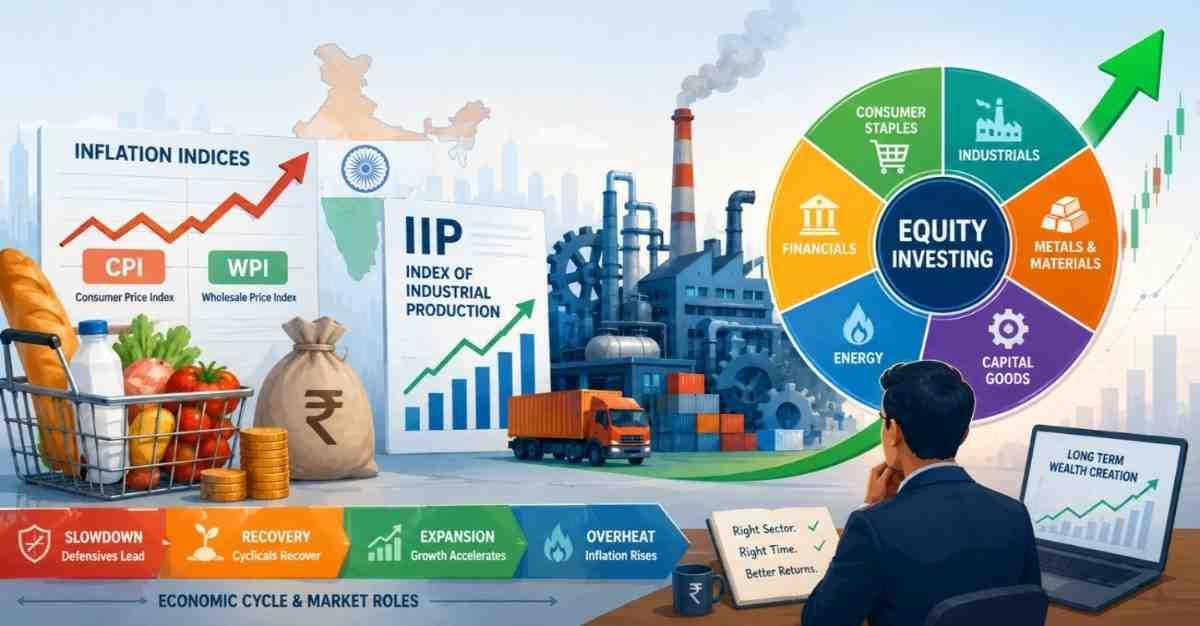
A plain-language breakdown of how India measures inflation, what the Index of Industrial Production tracks, and how both together signal the right sectors to own at every stage of the economic cycle
✨ Key Takeaways
Inflation is the sustained rise in the general price level of goods and services in an economy. It sounds simple, but the way it is measured, and what those measurements signal about industrial activity and corporate earnings, is anything but simple. For an equity investor, understanding inflation indices and the Index of Industrial Production is as practical as reading a balance sheet.
The Three Faces of Inflation
Inflation does not have a single cause. Demand-pull inflation happens when consumer demand outpaces production capacity, too much money chasing too few goods. Cost-push inflation is driven by rising input costs like crude oil, metals, or wages, which producers pass on to consumers. Built-in inflation is self-reinforcing: workers expect prices to rise, demand higher wages, firms raise prices to cover those wages, and the cycle repeats. Knowing which type is driving the current inflation episode tells you a great deal about which sectors will get hurt and which will benefit.
India's Inflation Measurement Framework
India tracks inflation through multiple indices, each serving a different purpose.
The WPI (Wholesale Price Index) covers 676 items across primary articles, fuel, and manufactured products. It captures inflation at the producer level, before goods reach consumers. Fuel carries a 15% weight here, so global crude movements hit WPI disproportionately hard.
The CPI Combined is the one that matters most for markets. It covers roughly 250 items, collecting data from 1,181 rural villages and 1,114 markets across 310 urban towns. Food commands close to 46% of its weight. The RBI formally adopted CPI Combined as its monetary policy anchor, which means every monthly print moves bond yields and rate expectations. When CPI breaches the RBI's 6% upper tolerance band, rate hikes follow, and equity valuations take a hit.
CPI-IW (Industrial Workers) covers 78 industrial centres and is used to compute Dearness Allowance revisions in the organized sector. It is directly relevant when building cost models for PSUs, cement companies, or mining firms where DA escalations are a material expense.
All these indices are computed using the same core logic. A representative basket of goods is defined, each item is assigned a weight based on its share of consumption or production value, prices are collected monthly from markets and factories, and the index is computed by comparing what that fixed basket costs today versus what it cost in the base year. The inflation rate is simply the percentage change in this index year-on-year.
The Index of Industrial Production
The IIP is India's primary high-frequency measure of industrial output, covering mining, manufacturing, and electricity across 839 items. Published monthly by the NSO, it gives you a read on the industrial economy roughly six weeks before quarterly GDP data arrives. The base year is 2011-12.
Manufacturing dominates with a weight of around 77.6%, followed by Mining at 14.4% and Electricity at 7.9%. Beyond the headline, IIP is split into use-based categories that are far more useful for investors: Capital Goods, Consumer Durables, Consumer Non-Durables, Intermediate Goods, Infrastructure and Construction Goods, and Primary Goods.
The calculation uses a weighted average of production ratios. For each item, you divide current month output by the base year output, weight it by its contribution to Gross Value Added in the base year, and aggregate these across all items to arrive at the headline number. One important caveat: IIP captures only organized sector output. Informal manufacturing, which contributes nearly half of India's manufacturing output, is entirely invisible here, making IIP directionally useful but prone to revisions.
What This Means for Your Portfolio
Inflation and IIP are not just numbers released by the government every month. Together, they tell you what phase of the economic cycle you are in, which directly shapes where corporate earnings are headed and how the RBI will respond.
Think of it as a simple grid with four states.
When industrial production is growing and retail inflation is under control, you are in the best possible environment for equities. Companies are producing more, input costs are not running out of hand, and the RBI has no reason to raise rates. This is when cyclical businesses, manufacturers, and capital goods companies tend to do very well. If you are overweight cash during this phase, you are leaving returns on the table.
When industrial production is growing but wholesale prices are rising sharply, the picture gets complicated. Output is strong but raw material costs are climbing faster than companies can raise prices. In this environment, businesses with strong brand loyalty or long-term supply contracts protect their margins better than commodity-linked price-takers. You want to own companies where the customer has no easy alternative, not companies that sell undifferentiated products in competitive markets.
When industrial output is weak but inflation is high, you are in the toughest environment of all. The economy is slowing but prices are not, which gives the RBI very little room to cut rates and support growth. In this phase, sectors like pharma and FMCG tend to hold up because people still buy medicines and daily essentials regardless of the economic climate. Broad index exposure tends to underperform and picking the right individual businesses matters more than ever.
When both industrial production and inflation are low together, a slowdown is underway but rate cuts are likely on the horizon. This is historically when you want to start building positions in housing finance companies, NBFCs, and Real Estate stocks. These businesses are highly sensitive to interest rates, and they tend to rerate sharply the moment the market starts pricing in rate cuts, often well before the actual cuts happen.
Beyond the headline IIP number, the use-based sub-indices are where the real signals sit. When capital goods output starts accelerating, it means companies are ordering new machinery and setting up new capacity. That is a forward signal for engineering and industrial stocks, often arriving two to three quarters before earnings reflect it. When consumer durables pick up, households are buying cars, appliances, and electronics, a direct read on discretionary demand. When consumer non-durables accelerate, rural India is spending, which shows up in FMCG and agri-input company volumes before management commentary catches up.
The monthly CPI and IIP releases deserve the same attention you give a quarterly result. They are the earliest honest signals of where margins, monetary policy, and consumption are headed, and acting on them before the crowd is one of the clearest edges available to a research-driven investor.