India’s privatisation drive remains limited as state footprint expands across strategic sectors
 Join Us
 Follow Us
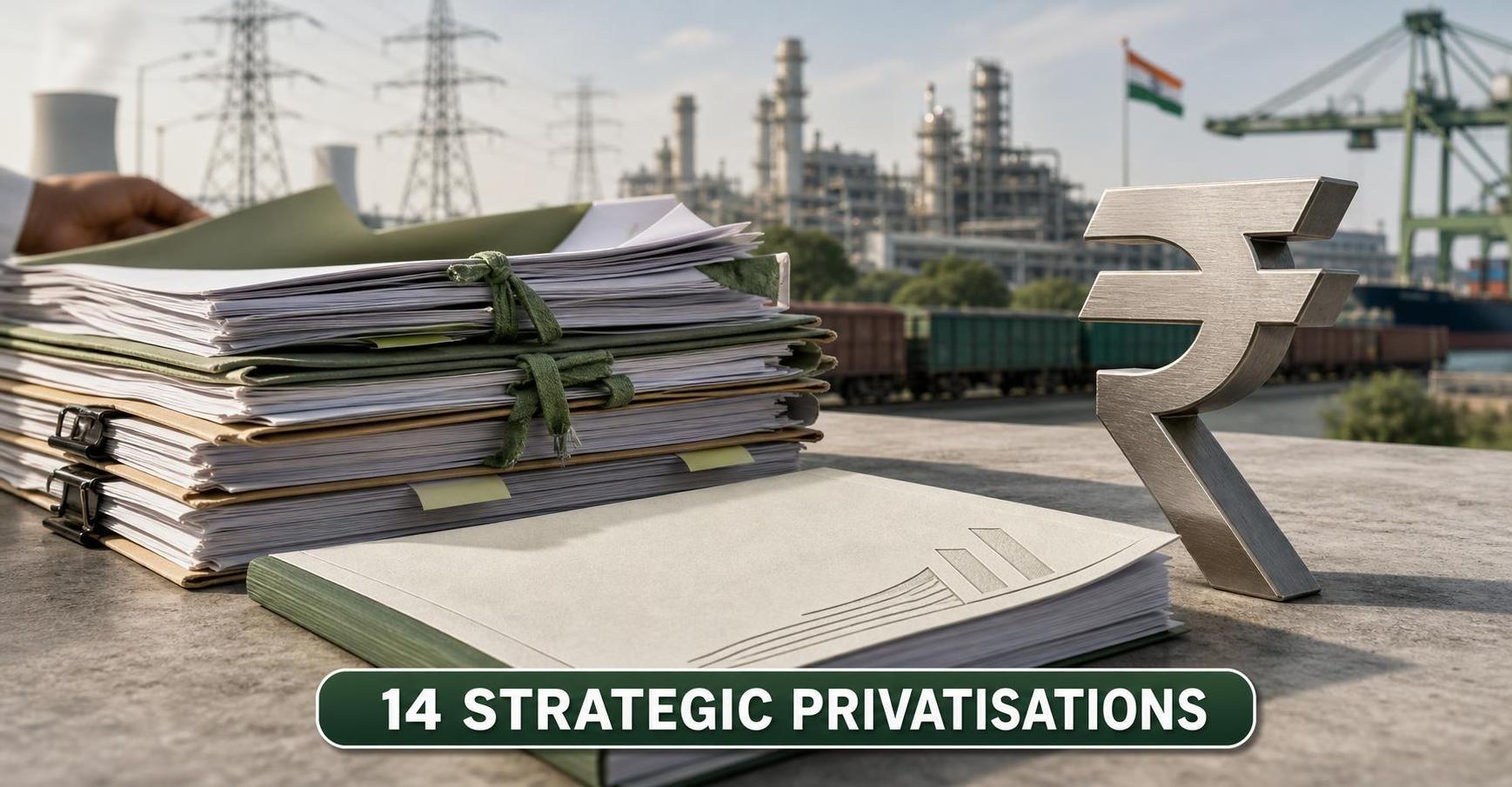
India’s public-sector footprint has expanded despite three decades of economic reform, as minority stake sales have outpaced genuine privatisation involving transfer of management control.
✨ Key Takeaways
Thirty-five years after India began economic liberalisation, the government remains a major commercial owner across Banking, insurance, energy, Railways, Defence production and nuclear power, while outright privatisation has remained sporadic.
The number of operating central public sector enterprises rose to 291 in FY25 from 236 in the early 1990s, according to the latest public-enterprise data. That expansion has occurred even though successive governments have pursued disinvestment programmes, largely because most stake sales did not involve a transfer of management control.
Only 14 strategic privatisation transactions have been completed since 1991. Of these, 10 were undertaken during the 1999-2004 period, when the government sold or transferred control in companies including BALCO, Hindustan Zinc, Videsh Sanchar Nigam, CMC, Jessop and Modern Food Industries.
Rajnish Gupta, EY India’s Tax and Economic Policy Partner, said the distinction between disinvestment and privatisation explains much of the policy outcome. ‘Disinvestment has continued in a relatively consistent manner, but genuine privatisation, which entails the transfer of ownership and management control, has remained sporadic,’ he said.
Between 1991 and 1999, the government raised around Rs 16,809 crore by diluting an average 8.87 per cent stake in 39 central public sector enterprises, according to a National Institute of Public Finance and Policy study. However, those transactions did not hand operational control to private buyers.
Policy momentum weakened after the United Progressive Alliance took office in 2004, when the Ministry of Disinvestment was merged with the finance ministry and the Disinvestment Commission became dormant. The Narendra Modi-led government later restored focus to the programme, renaming the department as the Department of Investment and Public Asset Management in 2016.
The New Public Sector Enterprise Policy announced in 2021 sought to reduce the government’s presence across much of the economy. It envisaged retaining only a minimum public-sector presence in strategic sectors, while considering other enterprises for privatisation, merger or closure. The implementation record, however, remains modest, especially for large and complex businesses.
Energy illustrates the difficulty. The government terminated the strategic-sale process for Bharat Petroleum Corporation after prospective buyers withdrew amid crude-price volatility following the Russia-Ukraine war. Proposed transactions have also faced employee-union opposition, state-level resistance, litigation, valuation differences and the challenge of executing large asset sales.
The state’s continued role is also shaped by policy objectives that go beyond commercial returns. RS Sharma, former chairman of Oil and Natural Gas Corporation, said, ‘Having management control over oil firms helps the government insulate the economy against external shock.’ State-owned oil marketing companies have periodically absorbed part of global crude-price increases instead of immediately passing them on to consumers.
The FY25 Public Enterprises Survey showed that 226 operating central public sector enterprises were profitable, while 63 incurred losses. India Tourism Development Corporation reported a FY25 profit of around Rs 82.94 crore, MSTC earned around Rs 402.98 crore and HLL Lifecare posted a profit of about Rs 231.77 crore.
The persistence of state ownership in defence-related activities is also relevant for private suppliers such as Premier Explosives, which manufactures high-energy materials for defence, Aerospace and industrial applications. The company’s management has said its Order Book stood at about Rs 1,393 crore, with roughly 94 per cent linked to defence, highlighting the scale of institutional demand alongside the government’s retained presence in strategic production.
Premier Explosives reported net sales of Rs 102.56 crore in the June 2026 quarter, down 27.85 per cent year-on-year, as delayed export licences, Logistics disruption and imported-component delays affected dispatches. Management has maintained that the defence order environment remains robust, although revenue conversion depends on approvals, inspections and execution schedules.
As of 3:29 PM on October 1, 2026, Premier Explosives was trading at Rs 679.75. The stock had gained 14.19 per cent over one year, compared with a 3.22 per cent decline in the BSE 500, although it remained below its 52-week high of Rs 808.15.
For India’s privatisation programme, the central question remains whether strategic policy commitments can translate into transactions that transfer ownership and management control, rather than continuing to rely primarily on minority stake dilution.
Disclaimer: The article is for informational purposes only and not investment advice.