MF or PMS in 2023?
 Join Us
 Follow Us
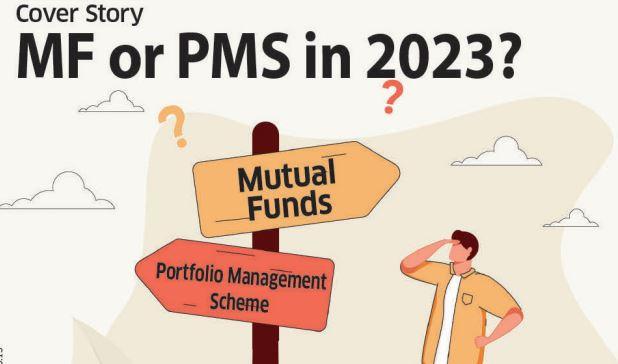
Mutual funds (MFs) and portfolio management services (PMS) are frequently seen through the same prism. The two, however, are very different. MFs cater to a far wider audience and provide much less customisation while PMS caters to a specific investment demographic and offers superior customisation. Vardan Pandhare helps you to decode both options as an investment avenue for 2023.
✨ Key Takeaways
Since the corona virus epidemic began in March 2020, India has seen a tremendous expansion in retail participation in financial investments like shares, mutual funds and PMS. The pandemic, along with digitisation and more lenient restrictions, contributed to an increase in household financial assets from 12 per cent of GDP in 2019–2020 to 15.7 per cent in 2020–21. One asset class that has seen significant growth in investor activity is equities. At the end of November 2022, there were approximately 10.5 crore demat accounts in India.
Since the pandemic began, this has increased by more than twice. Mutual funds collected almost ₹1.25 lakh crore in 2021–2022 from 5.5 crore accounts in just their SIP books. Earlier, investors used to favour mutual funds as their preferred vehicle for stock investing, but recently portfolio management services, or PMS, have generated a lot of attention. Approximately ₹24 lakh crore of assets are managed by PMS compared to about ₹38 lakh crore by mutual funds. This doesn’t give a comprehensive picture though as ₹18 lakh crore of the ₹24 lakh crore invested are by EPFOs.
If we have to look at individual participation in PMS, the equity PMS is about ₹2 lakh crore and the MF side, which is worth about ₹16 lakh crore, makes up the majority. The allure of PMS investing as an additional flavour in one’s portfolio appears to be quite high as more and more mutual fund managers rush to launch their own PMS. But, what is best for you i.e. mutual funds or PMS is a major concern that investors constantly wrestle with. By examining both investment options from several angles, we will address this argument.
Deep Dive into PMS
Portfolio management service is an investing service provided by a portfolio manager that gives investors the chance to customise their portfolios in accordance with their financial objectives and personal preferences. By making an investment in PMS, investors can hold bonds or stock in their names. There are two sorts of portfolio management services: nondiscretionary and discretionary. For non-discretionary PMS, the manager makes recommendations to the investors on investments. The manager starts the trade on the investor’s behalf after receiving his approval. In a discretionary PMS, the manager chooses the bonds, stocks and the timing of the unit purchases according to his preferences. These are the most common types of portfolio management services offered in India, and they tend to focus on managing equity-related portfolios.
Fees of PMS
There are various sorts of commissions and fees which organisations that offer portfolio management services charge for their services. Charges are determined at the time of investment and can differ amongst PMS providers.
The following are the several PMS fees:
■ Entry Load Fees: When an investor joins a scheme, the majority of PMS providers assess a one-time entry fee. It can change by 1-3 per cent.
■ Operating Expenses: This is a regular fee assessed to defray the expense of overseeing the portfolio. SEBI has established a limit on the fees at 0.5 per cent of the client’s average daily assets undermanaged over the course of a year.
■ Brokerage Fees: For each market transaction, PMS providers impose a brokerage fee.
■ Exit Load Fees: When investors redeem their investments, they are subject to exit load fees. According to updated SEBI regulations, if investors redeem their investment within the first year, the exit load cannot be higher than 3 per cent. For exits in the second and third years, the fees are 2 per cent and 1 per cent, respectively. After the third year, there are no exit load fees.

You may better comprehend the distinction between PMS and mutual funds by looking at the following factors:
■ A Sized Portfolio: According to SEBI regulations, PMS must have a minimum portfolio size of ₹50 lakhs. Some fund managers frequently impose a greater cap. However, a person can begin investing in mutual funds with a minimum investment of ₹100 via SIP.
■ Flexibility: Mutual funds operate within a strict framework and consistently make use of benchmark allocations. They continue to invest for the duration of the investment horizon. PMS, in comparison, gives its investors more flexibility. With the help of this instrument, portfolio managers can manage funds more actively and give their ideas more prominence in the portfolios they design. As a result, PMS may produce larger returns than mutual fund plans.
■ Accounts: While a PMS employs a separate demat account and bank account for each client, mutual funds store their stocks and funds through pooled accounts.
■ Value: The net asset value (NAV) of the fund units held determines a mutual fund scheme’s market value. On the other hand, PMS takes into consideration the market value of the investor’s bank account balance as well as the securities that are held in a demat account.
■ Transparency: An investor can view every trade, brokerage and execution price under PMS. He has access to information on the costs associated with maintaining the portfolio. A mutual fund, however, is less open and does not provide all the information regarding expenses. The reporting of NAV and its impact on mutual funds is crucial.

If a person wants to invest in PMS, he or she should take the following factors into account:
■ Risk Limit: PMS plans have risks just like mutual fund schemes do. Investors should evaluate market, inflation and interest rate risks before making an investment.
■ Past Performance: An investor needs to be aware of the number of returns the PMS management has produced in the past. He can select the ideal investment vehicle with the aid of this expertise.
■ Investing Costs: PMS investments attract several expenses such as accounting, custody, brokerage, exit load, performance or profit sharing and management fees. Before making a choice, investors must weigh these costs.
■ Investment Goal: A client should ascertain whether the fund strategy of the PMS provider fits with his or her investment objectives before making an investment. He must make it clear if the fund manager uses an index to measure performance. Additionally, investors need to be aware of whether they are investing in Small-Cap, Mid-Cap or Large-Cap stocks.
■ Experience of Portfolio Manager: Before registering for a PMS investors should evaluate the expertise and credentials of the fund manager.

The considerations listed below should be made when investing in various mutual fund schemes:
■ Risk Tolerance: When investing in mutual funds, there are basically five risk levels: low, relatively low, moderate, moderately high and high. When selecting mutual funds, investors must consider the level of risk they are willing to face.
■ Expense Ratio: The asset management company’s operational fees are reflected in the expense ratio of a mutual fund. This sum includes all costs related to the administration, management, and distribution of a mutual fund. The higher the net returns of a mutual fund plan, the lower the expense ratio.
■ Historical Performance: Investors should think about investing in mutual funds that have historically produced steady returns for their investors. Examining a fund’s historical performance might provide insights into the potential of the strategy in both optimistic and bearish market conditions.
■ Value of AUM: A mutual fund’s assets under management (AUM) are a measure of the fund’s total market value. Generally speaking, funds with a high AUM are preferred since more assets equal more liquidity
The allure of PMS investing as an additional flavour in one’s portfolio appears to be quite high as more and more mutual fund managers rush to launch their own PMS. But, what is best for you i.e. mutual funds or PMS is a major concern that investors constantly wrestle with.
Making the Choice
Both MFs and PMS are guided investment instruments that can assist you in purchasing equities in the same broad market. Both, though, journey on different tracks. An MF offers a greater selection of equities, frequently exceeding 40 or 50. Due to the abundance of choices, one may always make a decision based on their level of risk tolerance and long-term financial objectives. On the other hand, PMS is much more expensive but is much more carefully curated in terms of taste and objectives. PMS portfolios typically contain no more than 20 to 30 equities at any given time. Additionally, unlike MFs, PMS is typically customised for investors to give them greater control over the structure of their portfolios.
The key takeaway is that PMS remains out of most people’s price range because the lowest investment cap is ₹25 lakh. With PMS, you may customise your portfolio based on your risk profile and your financial requirements. Additionally, it offers greater investing flexibility. PMS is therefore more likely to outperform the markets and provide you with higher returns. Additionally, PMS is only required to give information to the client and the public cannot access the same information. However, this also makes it more difficult to compare different PMS products. Contrarily, all information about MFs is available to the public, thereby increasing transparency. PMS may have large returns, but they also have higher fees and taxes.
Conclusion
Both of these options offer benefits and drawbacks. However, it is clear that each is intended for a different group of investors. While PMS is only open to a select group of investors, mutual funds are accessible to everyone. You should decide what works best for you based on your risk tolerance and profile. While the market offers you several investment vehicles, including MF and PMS, keep in mind that each has its advantages and disadvantages. Recognise your investment objectives and assess your risk tolerance. Prior to investing in a PMS or MF, it is best to discuss the matter with your financial advisor. To invest in PMS, a person needs to choose a knowledgeable fund manager and an appropriate fund. Investors must decide whether the mutual fund returns can be outperformed by PMS investment models. For high-net-worth investors, a PMS may be the best choice, while mutual funds are an excellent choice for retail investors in 2023.