ROE vs ROCE vs ROIC: Which Ratio Matters More When Selecting Stocks?
 Join Us
 Follow Us

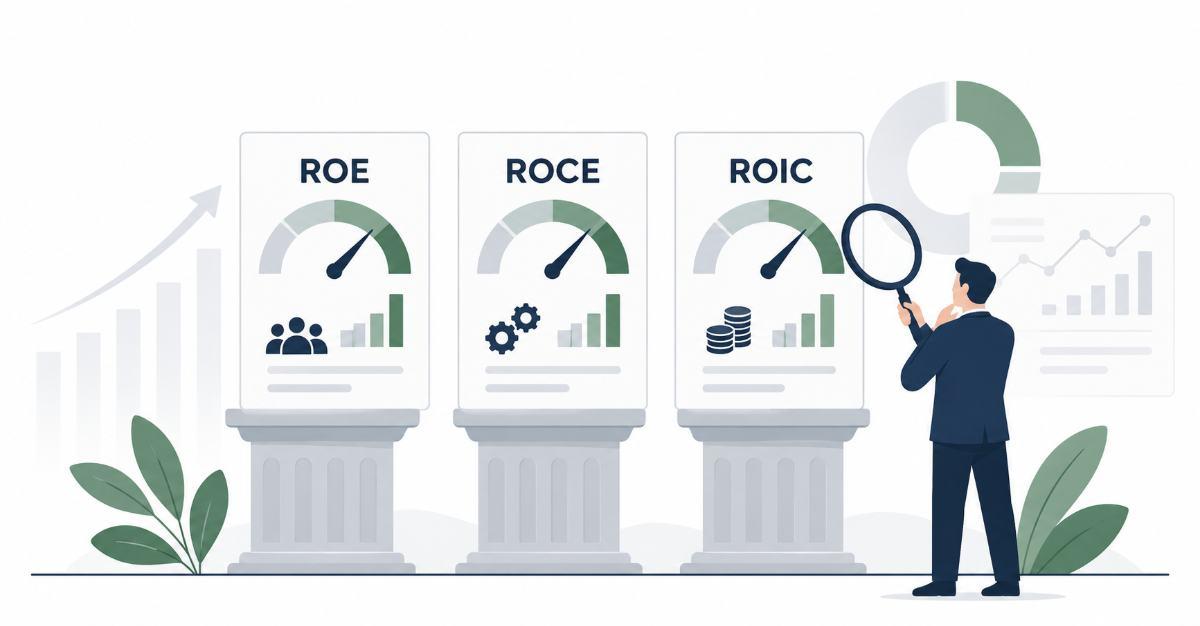
Three popular profitability ratios answer three different questions. Learn how to use each when assessing a company's financial strength.
✨ Key Takeaways
Strong profits do not necessarily mean that a company is using its capital efficiently. A business may report consistent growth in revenue and net profit, but that alone does not reveal how effectively it generates returns on the money invested in its operations. This is why investors look beyond headline earnings and examine financial ratios that measure profitability and capital efficiency.
Three important ratios used in fundamental analysis are Return on Equity (ROE), Return on Capital Employed (ROCE) and Return on Invested Capital (ROIC). Although all three evaluate profitability, they measure returns from different perspectives. Understanding ROE vs ROCE vs ROIC can help investors assess a company's financial performance, capital allocation and long-term growth potential.
1. What Is Return on Equity (ROE)?
Return on Equity (ROE) measures how efficiently a company generates profits using shareholders' funds. It indicates how much net profit a business earns for every rupee of shareholders' equity invested in the company.
ROE is calculated by dividing net profit attributable to ordinary shareholders by average shareholders' equity and multiplying the result by 100.
For example, suppose a company reports an annual net profit of Rs 120 crore and has average shareholders' equity of Rs 600 crore. Its ROE would be 20 per cent. This means the company generates Rs 20 in profit for every Rs 100 of shareholders' equity.
A higher ROE may indicate that the business is generating attractive returns for shareholders. However, investors should not evaluate ROE in isolation. A company with substantial debt may report a higher ROE because borrowing reduces its dependence on equity capital. Similarly, share buybacks or write-offs can reduce the equity base and increase ROE without improving operating efficiency.
Therefore, ROE should be assessed alongside debt levels, cash flows and earnings quality.
2. What Is Return on Capital Employed (ROCE)?
Return on Capital Employed (ROCE) measures how efficiently a company generates operating profits from the capital employed in its business. Unlike ROE, which focuses on shareholders' equity, ROCE considers a broader capital base, including funds provided by lenders.
ROCE is calculated by dividing Earnings Before Interest and Tax (EBIT) by average capital employed and multiplying the result by 100. Capital employed is commonly calculated as total assets minus current liabilities, although other definitions are also used.
For instance, if a company generates EBIT of Rs 240 crore and has average capital employed of Rs 1,200 crore, its ROCE would be 20 per cent. This indicates that the business earns Rs 20 in operating profit for every Rs 100 of capital employed.
ROCE is particularly useful when analysing capital-intensive businesses such as steel, cement, automobiles and manufacturing, where significant investments are required in plants, machinery and infrastructure.
A consistently high ROCE may indicate efficient asset utilisation and strong operating performance. However, comparisons should preferably be made between companies operating in the same industry because capital requirements vary considerably across sectors.
3. What Is Return on Invested Capital (ROIC)?
Return on Invested Capital (ROIC) measures how efficiently a company generates after-tax operating profits from the capital invested in its core business operations.
ROIC is calculated by dividing Net Operating Profit After Tax (NOPAT) by average invested capital and multiplying the result by 100. NOPAT represents operating profit after adjusting for applicable operating taxes, while invested capital generally includes equity and interest-bearing debt after excluding excess cash and certain non-operating assets.
Consider a company that generates EBIT of Rs 240 crore and has an illustrative operating tax rate of 25 per cent. Its NOPAT would be Rs 180 crore. If average invested capital is Rs 1,000 crore, its ROIC would be 18 per cent.
The importance of ROIC lies in its ability to measure how effectively management deploys capital into productive business activities. Unlike ROE, it is less directly influenced by the company's financing structure.
A consistently strong ROIC may indicate efficient capital allocation, particularly when the returns generated exceed the company's cost of capital. However, the calculation of invested capital can vary depending on accounting treatment and analyst methodology.
4. ROE vs ROCE vs ROIC: What Is the Key Difference?
The fundamental difference between ROE, ROCE and ROIC lies in the type of profit measured and the capital base used to calculate returns.
ROE focuses specifically on profitability from the perspective of equity shareholders. It uses net profit after interest and taxes and compares it with shareholders' equity. Consequently, the ratio can be significantly influenced by the amount of debt a company carries.
ROCE takes a broader approach by evaluating operating profit before interest and taxes against the capital employed in the business. This makes it useful for comparing the operating efficiency of companies with different financing structures.
ROIC goes one step further by measuring after-tax operating returns on capital invested in business operations. It helps investors determine whether the company is generating sufficient returns from the funds committed to its operations.
While all three ratios provide useful information, they answer different questions and should not be treated as interchangeable measures.
5. Why Does a High ROE Not Always Indicate a Better Business?
A company reporting a high ROE may appear financially stronger than its competitors, but the underlying reason for that return matters.
Consider two companies generating similar operating profits. One relies primarily on shareholders' equity, while the other uses substantial borrowing. The debt-funded company may report a higher ROE because its equity base is smaller.
However, higher debt also increases interest obligations and financial risk. A company may therefore display an impressive ROE without necessarily demonstrating superior operational efficiency.
Examining ROCE and ROIC alongside ROE helps investors distinguish genuine operating strength from returns magnified by leverage.
6. Why Is ROIC Important for Long-Term Value Creation?
ROIC becomes particularly meaningful when compared with a company's Weighted Average Cost of Capital (WACC), which represents the estimated overall cost of financing its operations through debt and equity.
Suppose a company generates an ROIC of 16 per cent while its WACC is 11 per cent. The five-percentage-point difference suggests that the business is earning returns above its estimated cost of capital.
Companies that consistently maintain ROIC above WACC may be better positioned to create economic value through reinvestment and expansion.
Conversely, businesses generating returns below their cost of capital may struggle to create sustainable shareholder value, even when they report accounting profits.
However, ROIC and WACC should be evaluated over several years, as temporary business conditions can influence both measures.
7. Which Ratio Should Investors Use When Selecting Stocks?
There is no single profitability ratio that works equally well for every company or sector. The choice depends on the nature of the business, its financing structure and the objective of the analysis.
ROE is particularly relevant when evaluating Banks and financial institutions, where borrowing and lending form an essential part of business operations. For manufacturing and other capital-intensive companies, ROCE provides useful insights into operating efficiency and capital utilisation.
ROIC can be particularly valuable for understanding whether non-financial companies are allocating capital productively and earning returns above their cost of capital.
Investors should examine how these ratios have changed over multiple financial years rather than relying on a single period. It is equally important to consider debt levels, operating cash flows, asset write-offs, acquisitions and industry-specific factors.
A company with consistently strong profitability ratios may demonstrate sound financial fundamentals, but its valuation must also be assessed before making an investment decision.
Conclusion
The comparison of ROE vs ROCE vs ROIC highlights three important dimensions of business profitability. ROE measures returns earned on shareholders' equity, ROCE evaluates operating efficiency relative to capital employed, and ROIC measures after-tax operating returns on invested capital.
Rather than selecting stocks based on one attractive ratio, investors can gain a more complete understanding of financial strength by analysing all three together. Consistency in profitability, prudent debt management, effective capital allocation and reasonable valuations remain important considerations when evaluating a company's long-term potential.