Rs 8,53,500 Crore Order Book: Company Records Highest-Ever Quarterly Order Inflow of Rs 1,47,700 Crore; Stock Jumps 5%
 Join Us
 Follow Us

The improvement in operating cash flow and lower working-capital intensity are equally important for a project-led group, where execution quality and collections can materially influence returns. Growth in Financial Services, where the loan book rose 28 per cent, adds another earnings stream beyond engineering and construction.
✨ Key Takeaways
Larsen & Toubro’s diversified portfolio spans infrastructure, conventional and green energy, manufacturing, technology services and retail finance. Its latest quarterly performance highlights strong demand and order-book expansion, although profitability at the operating level remained under pressure from project mix and lower margins.
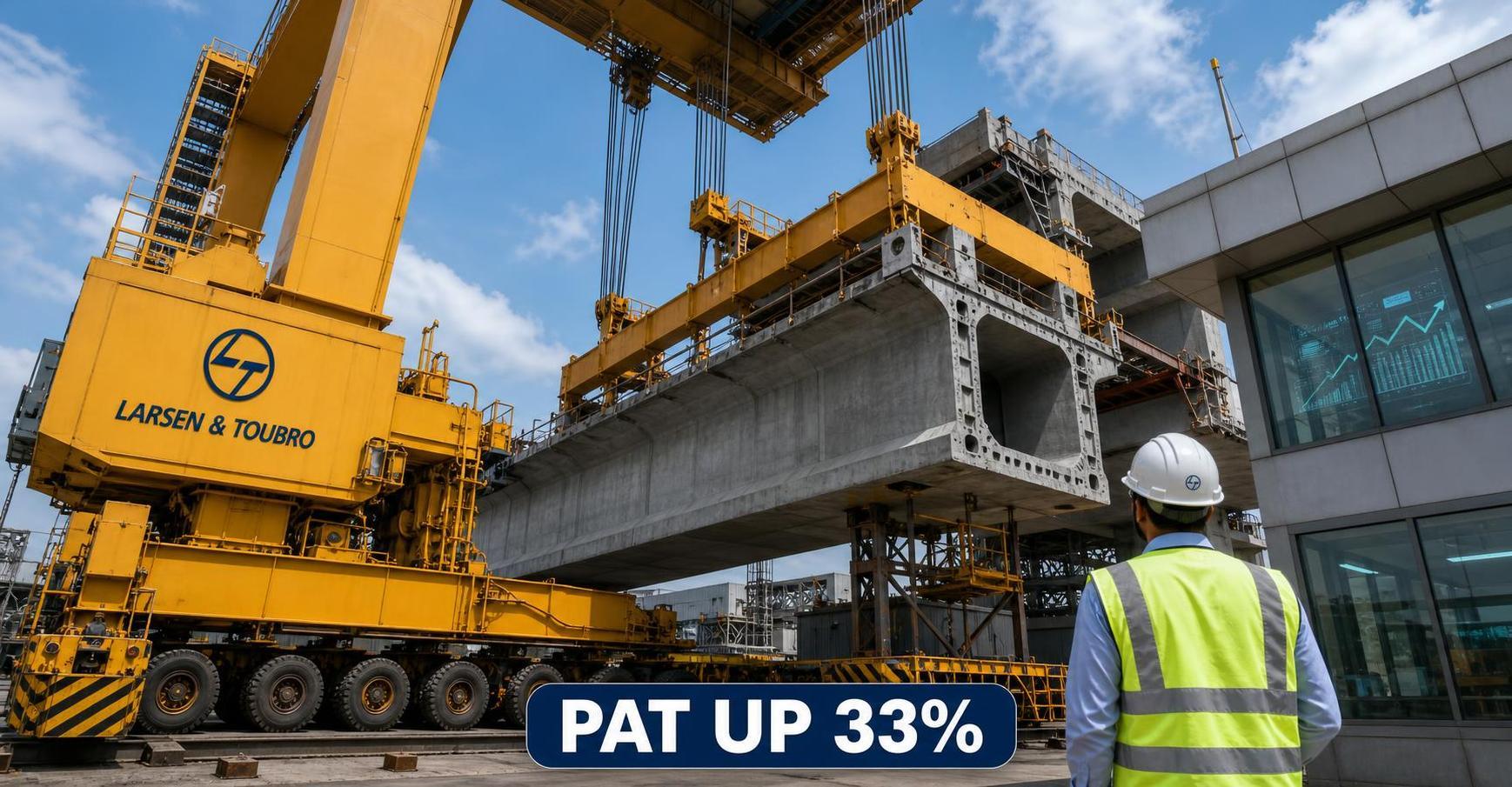
The engineering and Construction major reported a 33 per cent YoY increase in reported profit after Tax (PAT) to Rs 5,200 crore for the second quarter of FY27, while revenue rose 16 per cent to Rs 78,750 crore. Order inflow increased 28 per cent to a quarterly record of Rs 1,47,700 crore, taking the Order Book to Rs 8,53,500 crore as of September 30, 2026, up 28 per cent from a year earlier.
The stronger revenue performance was led by Energy Conventional, Energy Green, Manufacturing & Products and Financial Services. Revenue from Projects, Products & Manufacturing rose 20 per cent to Rs 58,391 crore, while Energy Green posted a 43 per cent increase in revenue as large Solar and offshore wind projects commenced execution. Energy Conventional revenue grew 29 per cent, supported by progress in hydrocarbon projects and a growing order book.
However, earnings before interest, tax, depreciation and amortisation (EBITDA) increased by only 1 per cent to Rs 6,840 crore. EBITDA margin narrowed by 130 basis points to 8.7 per cent as the revenue mix shifted towards the lower-margin Projects, Products & Manufacturing businesses. Infrastructure & Utilities margin fell to 5.7 per cent from 6.2 per cent amid cost pressures in water and treatment projects and a higher share of jobs below the margin-recognition threshold.
Cash conversion was a notable positive. Cash flow from operations, excluding Financial Services, rose 170 per cent to Rs 12,800 crore during the quarter. Net working capital fell to 1.7 per cent of revenue from 10.2 per cent a year earlier, indicating a substantial improvement in collections and working-capital discipline. For the first half of FY27, revenue grew 11 per cent to Rs 1,46,690 crore and reported PAT rose 24 per cent to Rs 9,320 crore.
As of 9:20 am on October 28, 2026, L&T shares were trading at Rs 3,867.50, up 5.38 per cent from the previous close of Rs 3,670.00. The stock remained about 12.4 per cent below its 52-week high of Rs 4,417.15. Over one year, the share price had declined 1.91 per cent, compared with a 9.01 per cent fall in the BSE 500, indicating relative resilience against the broader index.
What This Means for Investors
The record order inflow and Rs 8,53,500 crore order book reinforce L&T’s medium-term revenue visibility across infrastructure, hydrocarbons, green energy and manufacturing. The improvement in operating cash flow and lower working-capital intensity are equally important for a project-led group, where execution quality and collections can materially influence returns. Growth in Financial Services, where the loan book rose 28 per cent, adds another earnings stream beyond engineering and construction.
The result is mixed from a profitability perspective. Revenue and PAT growth were robust, but EBITDA margin declined to 8.7 per cent as lower-margin project businesses formed a larger share of revenue and cost pressures persisted in select infrastructure jobs. The central issue will be whether the enlarged backlog converts into revenue without further margin dilution. At Rs 3,670 per share at the previous close, the stock traded at 28.26 times trailing 12-month earnings, which leaves execution discipline, cash conversion and margin recovery important to the investment case.
Disclaimer: The article is for informational purposes only and not investment advice.